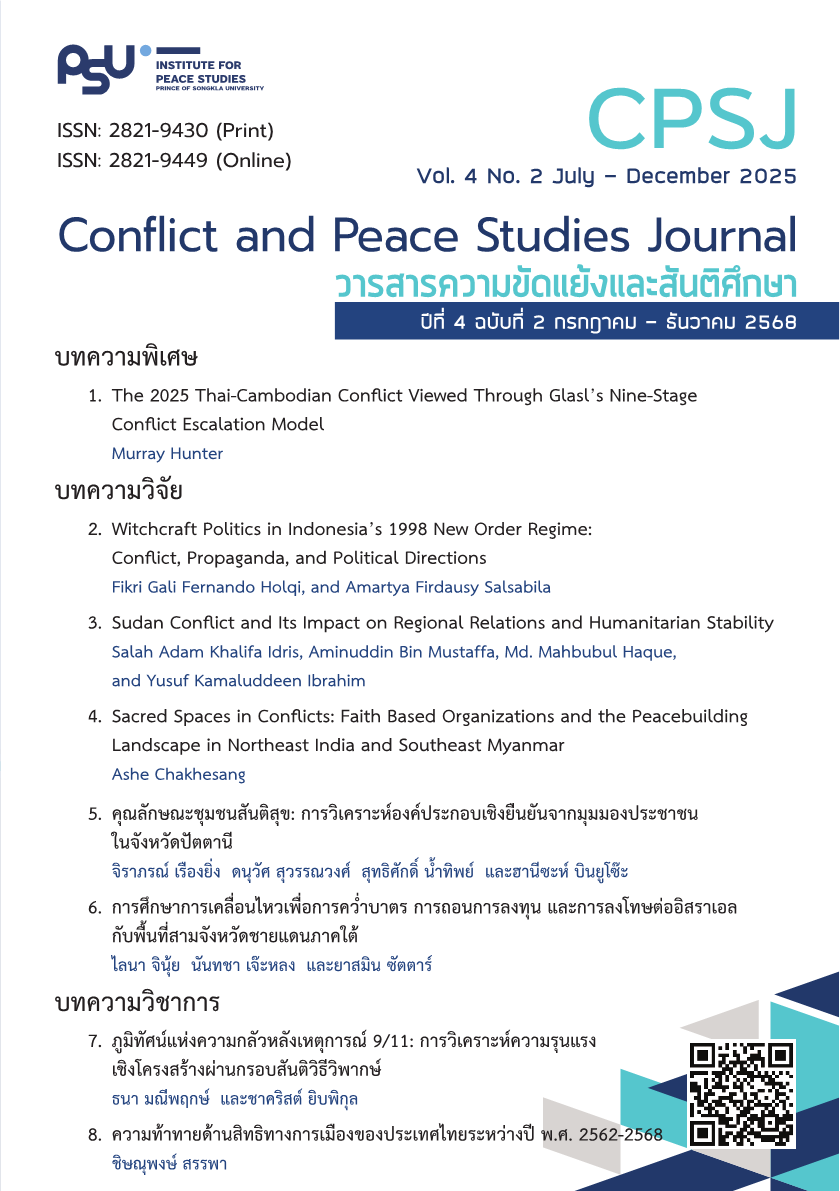
Sacred Spaces in Conflicts: Faith Based Organizations and the Peacebuilding Landscape in Northeast India and Southeast Myanmar
Article Sidebar
Main Article Content
Abstract
This study examines how Faith-Based Organizations (FBOs) create and sustain moral, spiritual, and communal spaces for reconciliation in two protracted ethno-political conflicts, namely, the Nagas in Northeast India (NEI) and the Karen people in Southeast Myanmar (SEM). Using Religious Peacebuilding Theory and drawing from historical documents and informal conversations with FBO leaders, the study analyzes how faith communities operate as critical yet often overlooked peacebuilding actors. The findings show that both movements emerged from similar colonial disruptions, which helped shape early political consciousness and collective ethnic identity. Although each community pursued self-determination, internal fragmentation driven by ideological and leadership differences complicated political negotiations. In these divided contexts, FBOs created “sacred spaces” that nurtured trust, dialogue, and communal healing in ways state institutions often could not. Among the Nagas, a largely Christian social setting allowed faith-based actors to draw on shared ideas of forgiveness, and covenant. This moral coherence gave them strong legitimacy to mediate between rival groups, ease internal violence, and support political dialogue. In the Karen context, where both Buddhist and Christian communities shape social life, peacebuilders had to form intentional interreligious partnerships. Faith actors worked together to create inclusive spiritual and cultural spaces that encouraged unity, strengthened resilience, and mobilized grassroots involvement in peace efforts. The study concludes that FBOs advance peace not only through theology but by creating sacred relational spaces where divided communities can envision new futures. Peacebuilding policy should recognize them as co-authors of reconciliation, strengthen interfaith cooperation, and deepen contextual theological training for conflict transformation.
Article Details
References
Abu-Nimer, M. (2001). Conflict Resolution, Culture, and Religion: Toward a Training Model of Interreligious Peacebuilding. Journal of Peace Research, 38(6), 685–704.
Aier, A. (1997). From Darkness to Light. Nagaland Baptist Church Council.
Appleby, R. S. (2000). The Ambivalence of the Sacred: Religion, Violence, and Reconciliation. Rowman & Littlefield.
Asadullah, M., Kashyap, R., Tiwari, R., & Sakafi, N. (2021). Community and Restorative Justice Practices in India, Nepal, and Bangladesh: A Comparative Overview. In T. Gavrielides (Ed.), Comparative Restorative Justice. Springer.
Aung-Thwin, M. A., & Aung-Thwin, M. (2012). A history of Myanmar Since Ancient Times: Traditions and Transformations. Reaktion Books.
Bouta, T., Kadayifci-Orellana, S. A., & Abu-Nimer, M. (2005). Faith-based Peace-Building: Mapping and Analysis of Christian, Muslim and Multi-faith actors. Netherlands Institute of International Relations.
Brenner, D. (2017). Inside the Karen Insurgency: Explaining Conflict and conciliation in Myanmar’s Changing Borderlands. Asian Security, 14(2), 83-99.
Brenner, D. (2019). Rebel Politics: A Political Sociology of Armed Struggle in Myanmar’s Borderlands. Cornell University Press.
Burma News International. (2012, February 23). Karen Religious Leaders Join Hands for Unity and Peace. Burma News International. Retrieved from https://www.bnionline.net/en/kic/item/12686-karen-religious-leaders-join-hands-for-unity-and-peace.html
Charney, M. W. (2009). A history of Modern Burma. Cambridge University Press.
Chasie, C. (1999). The Naga Imbroglio: A Personal Perspective. Standard Printers & Publishers.
Creswell, J. W., & Poth, C. N. (2016). Qualitative Inquiry and Research Design: Choosing Among Five Approaches. SAGE Publications.
Das, S. K. (2007). Conflict and Peace in India’s Northeast: The Role of Civil Society. East-West Center Washington.
Davie, G., Ammerman, N. T., Huq, S., Leustean, L. N., Masoud, T., Moon, S., Olupona, J. K., Sinha, V., Smilde, D. A., Woodhead, L., Yang, F., & Zurlo, G. (2018). Religions and Social Progress: Critical Assessments and Creative Partnerships. In International Panel on Social Progress (Ed.), Rethinking Society for the 21st Century: Volume 3 (641–676). Cambridge University Press.
Garbagni, G., & Walton, M. J. (2020). Imagining Kawthoolei: Strategies of Petitioning for Karen Statehood in Burma in the First Half of the 20th Century. Nations and Nationalism, (26), 759-774.
Gopin, M. (2002). Holy War, Holy Peace: How Religion Can Bring Peace to the Middle East. Oxford University Press.
Gupta, A. (2020). Constitution of India, Peace Process and Crisis Management: A study of Naga Peace Agreement. Pen Acclaims, (11), 1-7.
Hindustan Times. (2008, May 16). 12 underground cadre killed in Nagaland clashes. Retrived from https://www.hindustantimes.com/india/12-underground-cadre-killed-in-nagaland-clashes/story-CCOgxgtyULbkgLQyQGN0HI.html
Iralu, K. (2009). The Naga Saga: A historical account of the Sixty-Two Years Indo-Naga War and the story of Those Who Were Never Allowed to Tell It. ACLS Offset Press.
Jolliffe, K. (2016). Ceasefire, Governance and Development: The Karen National Union in Times of Change. The Asia Foundation.
Karen News. (2012, February 23). Karen Religious Leaders Join Hands for Unity and Peace. Retrieved from https://karennews.org/2012/02/karen-religious-leaders-join-hands-for-unity-and-peace/
Kham, K. K. M. (2021). The Quest for Peace in Kawthoolei: The Strategies, Outcomes, and Sustainability of Peacebuilding in Southeast Myanmar, 2012–2020. University of Oslo / Peace Research Institute Oslo.
Konwer, S., & Rizvi, T. (2023). The church and Peace Process in Nagaland (India). Peace Review, 35(2), 377–390.
Lederach, J. P. (1996). Preparing for Peace: Conflict Transformation Across Cultures. Syracuse University Press.
Longchar, K. (Ed.). (2011). Walking the Path of Despair and Hope: Understanding and Justifying the Ways of God: NBCC’s Work on Peace and Reconciliation (Vol. 1). Nagaland Baptist Church Council.
Longchari, A. (2016). Self-determination: A resource for Justpeace. Heritage Publishing House.
MorungExpress. (2017, September 24). Naga Reconciliation – A Public Statement. MorungExpress. Retrieved from https://morungexpress.com/naga-reconciliation-public-statement
MorungExpress. (2019, November 30). There is no future without forgiveness. MorungExpress. Retrieved from https://www.morungexpress.com/there-no-future-without-forgiveness
Philpott, D. (2007). Explaining the Political Ambivalence of Religion. American Political Science Review, 101(3), 505–525.
Philpott, D. (2009). Has the Study of Global Politics Found Religion? Annual Review of Political Science, (12), 183–202.
Rogers, M. M., Bamat, T., & Ideh, J. (Eds.). (2008). Pursuing Just Peace: An Overview and Case Studies for Faith-Based Peacebuilders. Catholic Relief Services.
Singha, K., & Singh, A. (Eds.). (2016). Identity, Contestation and Development in Northeast India. Routledge.
Smith, M. (1991). Burma: Insurgency and the Politics of Ethnicity. Bloomsbury Academic.
Srikanth, H., & Thomas, C. J. (2005). Naga resistance Movement and The Peace Process in Northeast India. Peace and Democracy in South Asia, 1(2), 57-87.
Steele, D., & Wilson-Grau, R. (2016). Supernatural Belief and The Evaluation of Faith-Based Peacebuilding. Carnegie Corporation of New York.
Subbotsky, E. (2016). Religion and Belief in the Supernatural. Sententia: European Journal of Humanities and Social Sciences. https://doi.org/10.7256/1339-3057.2016.4.21498
Venuh, N. (2005). British Colonization and Restructuring of Naga Polity. Mittal Publications.
Yin, R. K. (2017). Case Study Research and Applications: Design and Methods (6th edition). SAGE Publications.
