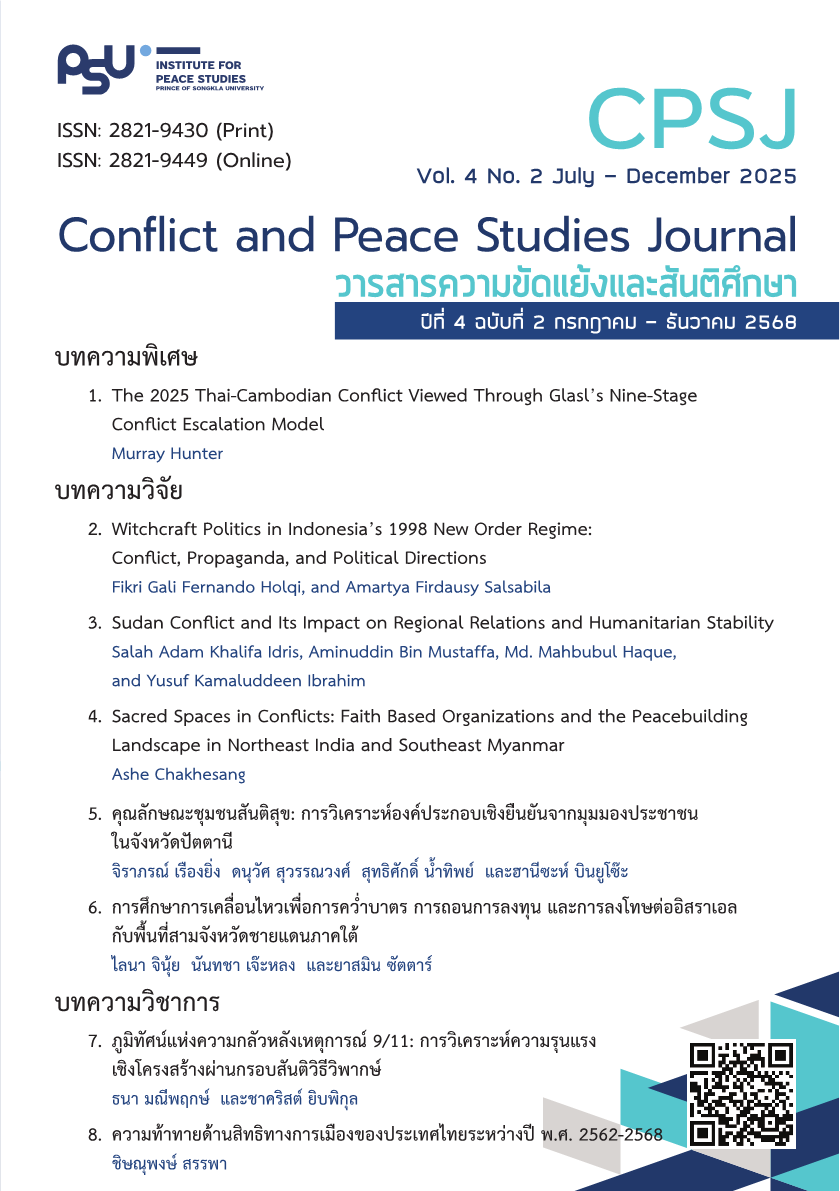
A Study of the Boycott, Divestment, and Sanctions (BDS) Movement Against Israel in Thailand’s Deep South
Article Sidebar
Main Article Content
Abstract
This study examines the Boycott, Divestment, and Sanctions (BDS) movement against Israel in Thailand’s Deep South. Initiated in 2005, the BDS campaign seeks to pressure Israel to end the occupation of Palestinian territories and halt human rights violations against Palestinians. Guided by a constructivist theoretical framework, the research analyzes how identities, norms, and local perceptions shape both the emergence and the limitations of BDS activism in the region. A qualitative methodology was employed, incorporating in-depth interviews with scholars, civil society actors, and content creators, along with document analysis and a review of public media.
The findings reveal that BDS activism in the Deep South remains limited and lacks continuity, often emerging only in response to major international events. Key constraints include low public awareness of the Israel–Palestine conflict, confusion surrounding products and services linked to Israel, the absence of strong local movement networks, and restrictive state policies. These findings indicate that the BDS movement in the Deep South has yet to develop into a sustained social force. Strengthening public knowledge, local networks, and supportive policy structures is essential to enhancing the continuity and long-term effectiveness of human-rights-based activism in the region.
Article Details
References
Abdullah, M. A. A. (2024). Military activism in Malaysia and its Boycott towards McDonald’s Malaysia: A Case Study of Palestine-Israel Conflict. Journal of Media and Information Warfare, 17(1), 105-117.
Barghouti, O. (2011). BDS: Boycott, Divestment, Sanctions: The Global Struggle for Palestinian Rights. Haymarket Books.
Efrati, A. (2017). Who’s Afraid of BDS? Economic and Academic Boycotts and the Threat to Israel. Strategic Assessment, 19(4),43-56.
Finnemore, M. (1996). National Interests in International Society. Cornell University Press.
Finnemore, M., & Sikkink, K. (1998). International Norm Dynamics and Political Change. International Organization, 52(4), 887-917.
Kurniawan, R. S., & Putri, S. H. A. (2024). The Effectiveness of the Boycott call on Israeli Products and its Impact on Local Markets. In Annual Conference on Scientific Writing. Retrieved from https://proceeding.meiravisipersada.org/index.php/acsciting/article/view/34.
McAdam, D. (1996). Conceptual Origins, Current Problems, Future Directions. In D. McAdam, J. D. McCarthy, & M. N. Zald (Eds.), Comparative Perspectives on Social Movements: Political Opportunities, Mobilizing Structures, and Cultural Framings (pp. 23-40). Cambridge University Press.
McCarthy, J. D., & Zald, M. N. (1977). Resource Mobilization and Social Movements: A Partial Theory. American Journal of Sociology, 82(6), 1212-1241. https://doi.org/10.1086/226464
Snow, D. A., & Benford, R. D. (1988). Ideology, Frame Resonance, and Participant Mobilization. International Social Movement Research, 1(1), 197-217.
Wendt, A. (1992). Anarchy is What States Make of It: The Social Construction of Power Politics. International Organization, 46(2), 391-425. https://doi.org/10.1017/S0020818300027764
Wendt, A. (1999). Social Theory of International Politics. Cambridge University Press.
