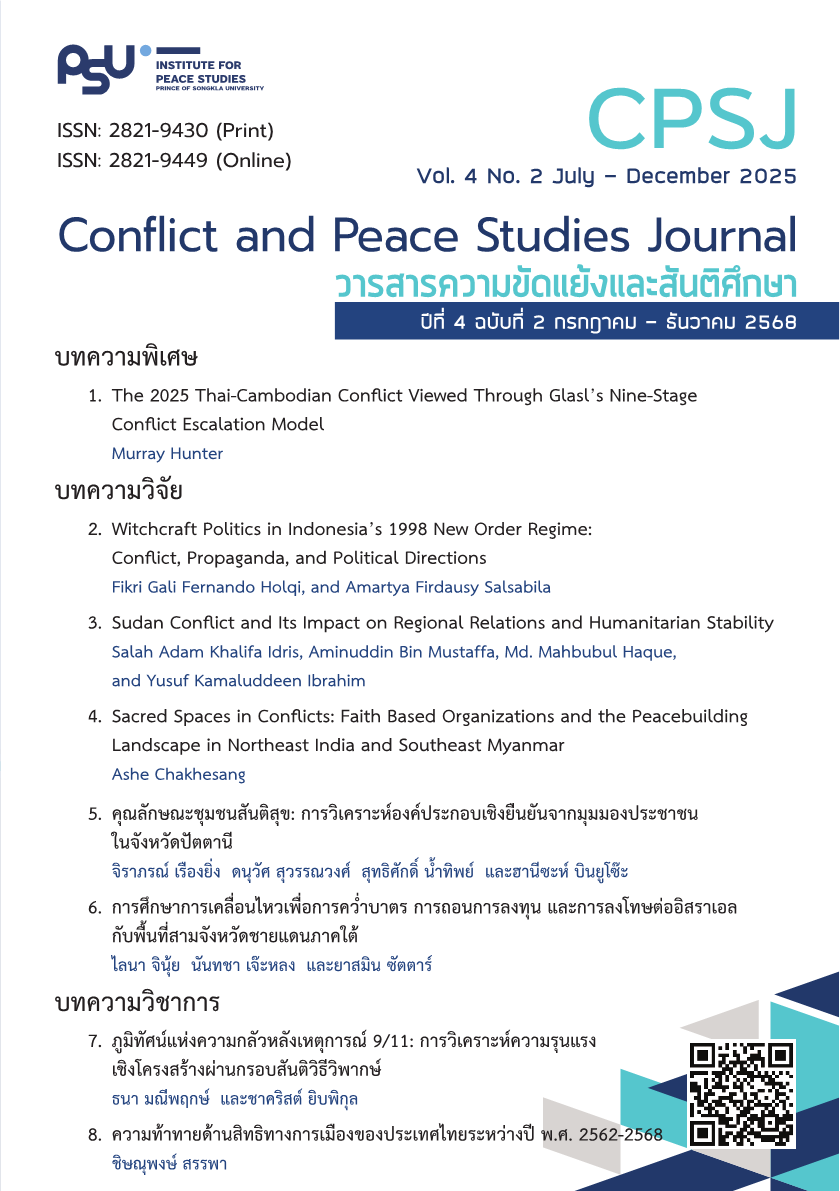
คุณลักษณะชุมชนสันติสุข: การวิเคราะห์องค์ประกอบเชิงยืนยันจากมุมมองประชาชนในจังหวัดปัตตานี
Article Sidebar
Main Article Content
บทคัดย่อ
งานวิจัยนี้มีวัตถุประสงค์เพื่อศึกษานิยามและคุณลักษณะชุมชนสันติสุขในบริบทจังหวัดปัตตานี และเพื่อยืนยันองค์ประกอบคุณลักษณะชุมชนสันติสุขจากมุมมองประชาชนในจังหวัดปัตตานี ใช้วิธีวิจัยแบบผสานวิธี เริ่มจากการวิจัยเชิงคุณภาพ โดยการสัมภาษณ์เชิงลึกผู้ให้ข้อมูลหลัก 12 คน จาก 4 กลุ่ม ประกอบด้วย ผู้บริหารหน่วยงานภาครัฐในพื้นที่ ผู้นำชุมชนและผู้นำองค์กรปกครองส่วนท้องถิ่น เจ้าหน้าที่สังกัดศูนย์อำนวยการบริหารจังหวัดชายแดนภาคใต้ และนักวิชาการด้านการพัฒนาชุมชน และสนทนากลุ่มผู้ทรงคุณวุฒิ 8 คน ส่วนการยืนยันองค์ประกอบคุณลักษณะชุมชนสันติสุขจากมุมมองประชาชน ในจังหวัดปัตตานีใช้วิธีวิจัยเชิงปริมาณ กลุ่มตัวอย่างคือประชาชนที่มีอายุระหว่าง 20 – 60 ปี ในจังหวัดปัตตานี จำนวน 150 คน ใช้วิธีการสุ่มกลุ่มตัวอย่างแบบหลายขั้นตอน เก็บรวบรวมข้อมูลโดยใช้แบบสอบถาม มีค่าความเชื่อมั่นเท่ากับ 0.812 วิเคราะห์ข้อมูลโดยการวิเคราะห์องค์ประกอบเชิงยืนยันด้วยโปรแกรม JASP ผลการวิจัยพบว่า คุณลักษณะชุมชนสันติสุขในบริบทจังหวัดปัตตานี ประกอบด้วย 5 มิติที่สอดคล้องกับข้อมูลเชิงประจักษ์อย่างดี (χ² = 158.312, df = 96, p<.001, χ²/df = 1.649, CFI = 1.015, TLI = 1.137, RMSEA = 0.038, SRMR = 0.053) มีค่าน้ำหนักองค์ประกอบอยู่ระหว่าง 0.84 – 0.93 โดยเรียงลำดับค่าน้ำหนักองค์ประกอบจากมากไปน้อย ดังนี้ 1) มิติผู้นำ มีค่าน้ำหนักองค์ประกอบเท่ากับ 0.93 มีตัวบ่งชี้สำคัญ ได้แก่ การมีวิสัยทัศน์และความชอบธรรม การมีคุณธรรมจริยธรรมและบารมี 2) มิติทางจิตใจ มีค่าน้ำหนักองค์ประกอบเท่ากับ 0.92 มีตัวบ่งชี้สำคัญ ได้แก่ การเข้าใจตนเองและผู้อื่น การยอมรับและเข้าใจความหลากหลายทางสังคมและวัฒนธรรม และการยึดโยงกับวิถีศรัทธาท้องถิ่น 3) มิติทางปัญญา มีค่าน้ำหนักองค์ประกอบเท่ากับ 0.91 มีตัวบ่งชี้สำคัญ ได้แก่ การยึดมั่นในหลักการไม่ใช้ความรุนแรง และการมีกระบวนการและกลไกจัดการความขัดแย้งอย่างสันติ 4) มิติทางกายภาพและเศรษฐกิจ มีค่าน้ำหนักองค์ประกอบเท่ากับ 0.89 มีตัวบ่งชี้สำคัญ ได้แก่ ความมั่นคงทางรายได้ การมีส่วนร่วมทางเศรษฐกิจ การพึ่งพาตนเอง การเข้าถึงปัจจัยพื้นฐานทางกายภาพ และความเสมอภาคในการเข้าถึงบริการสาธารณสุข และ 5) มิติทางสังคม มีค่าน้ำหนักองค์ประกอบเท่ากับ 0.84 มีตัวบ่งชี้สำคัญ ได้แก่ การมีส่วนร่วมอย่างครอบคลุมในกระบวนการพัฒนา การตระหนักรู้และรวมพลังทางสังคม การยอมรับความหลากหลายและการอยู่ร่วมกันอย่างสันติ และการพึ่งพิงทางสังคม
Article Details
เอกสารอ้างอิง
Budde, V., & Eickhoff, K. (2022). Fostering constructive relations: Approaches to trust-building in peacebuilding interventions (Research report). Institute for Peace Research and Security Policy. https://doi.org/10.25592/ifsh-research-report-008
Christie, D. J., Tint, B. S., Wagner, R. V., & Winter, D. D. (2008). Peace psychology for a peaceful world. American Psychologist, 63(6), 540–552. https://doi.org/10.1037/0003-066X.63.6.540
Creswell, J. W., & Plano Clark, V. L. (2011). Designing and conducting mixed methods research. (2nd ed.). Thousand Oaks, CA: Sage.
Galtung, J. (1969). Violence, peace, and peace research. Journal of Peace Research, 6(3), 167–191. https://doi.org/10.1177/002234336900600301
Galtung, J. (1996). Peace by peaceful means: Peace and conflict, development and civilization. London: SAGE.
Hair, J. F., Black, W. C., Babin, B. J., & Anderson, R. E. (2010). Multivariate Data Analysis (7th ed.). Pearson.
Haider, H. (2009). Community-based approaches to peacebuilding in conflict-affected and fragile contexts. (GSDRC Issue Paper). University of Birmingham.
Lederach, J. P. (1997). Building peace: sustainable reconciliation in divided societies. United States Institute of Peace Press.
Lederach, J. P. (2015). The little book of conflict transformation. New York: Good Books.
Narayan, D., & Cassidy, M. F. (2001). A dimensional approach to measuring social capital: Development and validation of a social capital inventory. Current Sociology, 49(2), 59–102. https://doi.org//10.1177/0011392101049002006
Paul, G.D. (2021). The influence of belief in offender redeemability and decision-making competence on receptivity to restorative justice. Negotiation and Conflict Management Research, 14(1), 1-20. https://doi.org/10.1111/ncmr.12176
Pretty, J., & Ward, H. (2001). Social capital and the environment. World Development, 29(2), 209–227. https://doi.org/10.1016/S0305-750X(00)00098-X
Putnam, R. D. (2000). Bowling alone: The collapse and revival of American community. Touchstone Books/Simon & Schuster. https://doi.org/10.1145/358916.361990
Ryff, C. D. (2013). Psychological Well-being Revisited: Advances in the Science and Practice of Eudaimonia. Psychotherapy and Psychosomatics, 83(1), 10–28. https://doi.org/10.1159/000353263
Sen, A. (1999). Development as Freedom. Oxford University Press.
Suchman, M. C. (1995). Managing legitimacy: Strategic and institutional approaches. Academy of Management Review, 20(3), 571-610. https://doi.org/10.5465/amr.1995.9508080331
Schumacker, R. E., & Lomax, R. G. (2010). A Beginner’s Guide to Structural Equation Modeling. (3rd ed.). New Jersey: Lawrence Erlbaum Associates.
Tyler, T. R. (2006). Why People Obey the Law (2nd ed.). Princeton University Press.
UNESCO. (1998). Culture of peace: A declaration and programme of action. United Nations Educational, Scientific and Cultural Organization.
United Nations. (2015). Transforming our world: The 2030 Agenda for Sustainable Development. United Nations. https://sdgs.un.org/2030agenda
Wattanapradith, K. (2018). Peace community in the 26th Buddhist Century: Knowledge Learned from Peace Community in Conflict Areas. Journal of MCU Peace Studies, 6(Sp1), 13-24.
