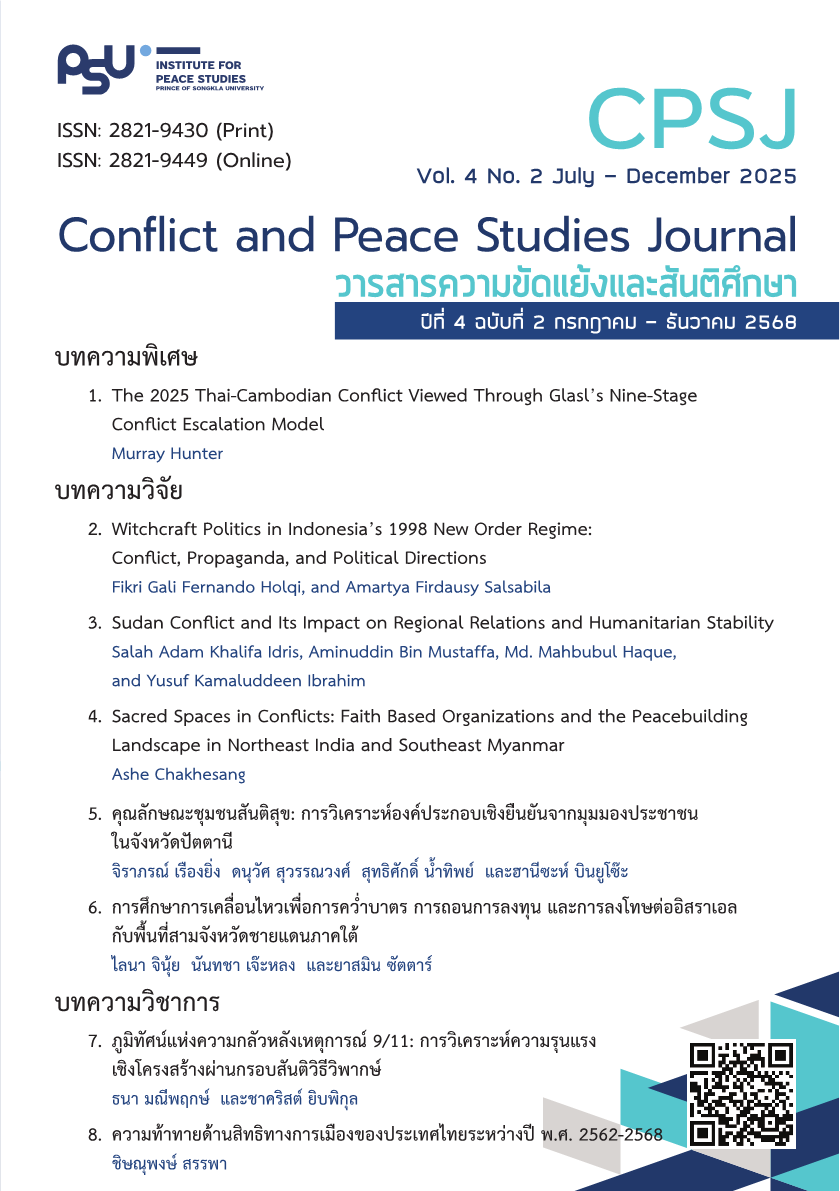
ภูมิทัศน์แห่งความกลัวหลังเหตุการณ์ 9/11: การวิเคราะห์ความรุนแรงเชิงโครงสร้างผ่านกรอบสันติวิธีวิพากษ์
Article Sidebar
Main Article Content
บทคัดย่อ
บทความนี้มีจุดมุ่งหมายเพื่อวิเคราะห์การตอบสนองของสหรัฐอเมริกาต่อเหตุการณ์ 9/11 ผ่านกรอบแนวคิดสันติวิธีวิพากษ์ โดยเน้นการพิจารณาความรุนแรงในระดับโครงสร้าง วาทกรรม และอัตลักษณ์ทางการเมือง การศึกษานี้ใช้ระเบียบวิธีวิจัยเชิงคุณภาพ โดยอาศัยการวิเคราะห์วาทกรรม และการวิเคราะห์เอกสารนโยบาย วาทกรรมทางการเมือง และถ้อยแถลงของผู้นำรัฐสหรัฐฯ ภายหลังเหตุการณ์ 9/11 พบว่า 1) การตอบโต้ของรัฐในนาม “สงครามต่อต้านการก่อการร้าย” กลายเป็นการผลิตซ้ำความรุนแรงเชิงโครงสร้าง ทั้งผ่านการออกกฎหมายที่ลดทอนสิทธิเสรีภาพ 2) การสร้างวาทกรรมที่ทำให้ความกลัวกลายเป็นเครื่องมือในการขยายอำนาจรัฐอย่างถาวร รัฐได้จัดวางอัตลักษณ์ของชาวมุสลิมให้กลายเป็น “ผู้ต้องสงสัยถาวร” ผ่านการสร้างความเชื่อมโยงระหว่างศาสนา วัฒนธรรม และความเสี่ยง ส่งผลให้การเป็นมุสลิมถูกมองว่าเป็นภัยคุกคามโดยอัตโนมัติ ไม่ว่าจะมีพฤติกรรมผิดกฎหมายหรือไม่ก็ตาม 3) แนวทางสันติวิธีกลับไม่ปรากฏในเชิงนโยบายและถูกลดทอนออกจากพื้นที่สาธารณะอย่างสิ้นเชิง ทั้งที่เป็นช่วงเวลาซึ่งควรเปิดพื้นที่ให้กับจินตนาการทางเลือกอื่นนอกเหนือจากการใช้กำลัง ข้อค้นพบสำคัญของบทความนี้คือ การตอบสนองหลังเหตุการณ์ 9/11 มิได้เป็นเพียงปฏิบัติการด้านความมั่นคงเท่านั้น หากแต่เป็นการทำให้ “ความเป็นไปได้ของสันติภาพ” หายไปจากระบบความคิดของรัฐและสังคม สันติวิธีจึงไม่ใช่เพียงทางเลือกทางจริยธรรม แต่คือการท้าทายโครงสร้างอำนาจที่ทำให้การใช้ความรุนแรงกลายเป็นเรื่องที่ “คิดได้เพียงอย่างเดียว” ในโลกที่เต็มไปด้วยความกลัว
Article Details
เอกสารอ้างอิง
Butler, J. (2004). Precarious life: The Powers of Mourning and Violence. Verso.
Chomsky, N. (2002). 9/11. Seven Stories Press.
Farmer, P. (2005). Pathologies of power: Health, human rights, and the new war on the poor. University of California Press.
Foucault, M. (2003). Society must be defended: Lectures at the Collège de France, 1975–76 (D. Macey, Trans.). Picador.
Galtung, J. (1969). Violence, peace, and peace research. Journal of Peace Research, 6(3), 167–191.
Gershkoff, A., & Kushner, S. (2005). The 9/11–Iraq connection in the Bush administration’s rhetoric. Communication and Critical/Cultural Studies, 2(4), 407–432.
Greenwald, G. (2014). No place to hide: Edward Snowden, the NSA, and the U.S. surveillance state. Metropolitan Books.
Jackson, R. (2005). Writing the war on terrorism: Language, politics and counterterrorism. Manchester University Press.
Lederach, J. P. (2005). The moral imagination: The art and soul of building peace. Oxford University Press.
Mamdani, M. (2004). Good Muslim, Bad Muslim: America, the Cold War, and the Roots of Terror. Pantheon Books.
Richmond, O. P. (2010). Resistance and the Post-liberal Peace. Millennium: Journal of International Studies, 38(3), 665–692.
Robin, C. (2004). Fear: The History of a Political Idea. Oxford University Press.
Saengkaew, P. (2012). Security discourse and fear: Political communication in Thailand [Master’s thesis, Thammasat University].
Satha-Anand, C. (2006). Living Weapons. Kobfai Publishing.
Satha-Anand, C. (2011). The State and the Discourse of Security: The Politics of Threat Construction. Internal document, Thammasat University.
Spivak, G. C. (1988). Can the Subaltern Speak? In C. Nelson & L. Grossberg (Eds.), Marxism and the Interpretation of Culture (pp. 271–313). University of Illinois Press.
Tejapira, K. (2007). Globalization, fear, and democracy. Matichon Publishing.
