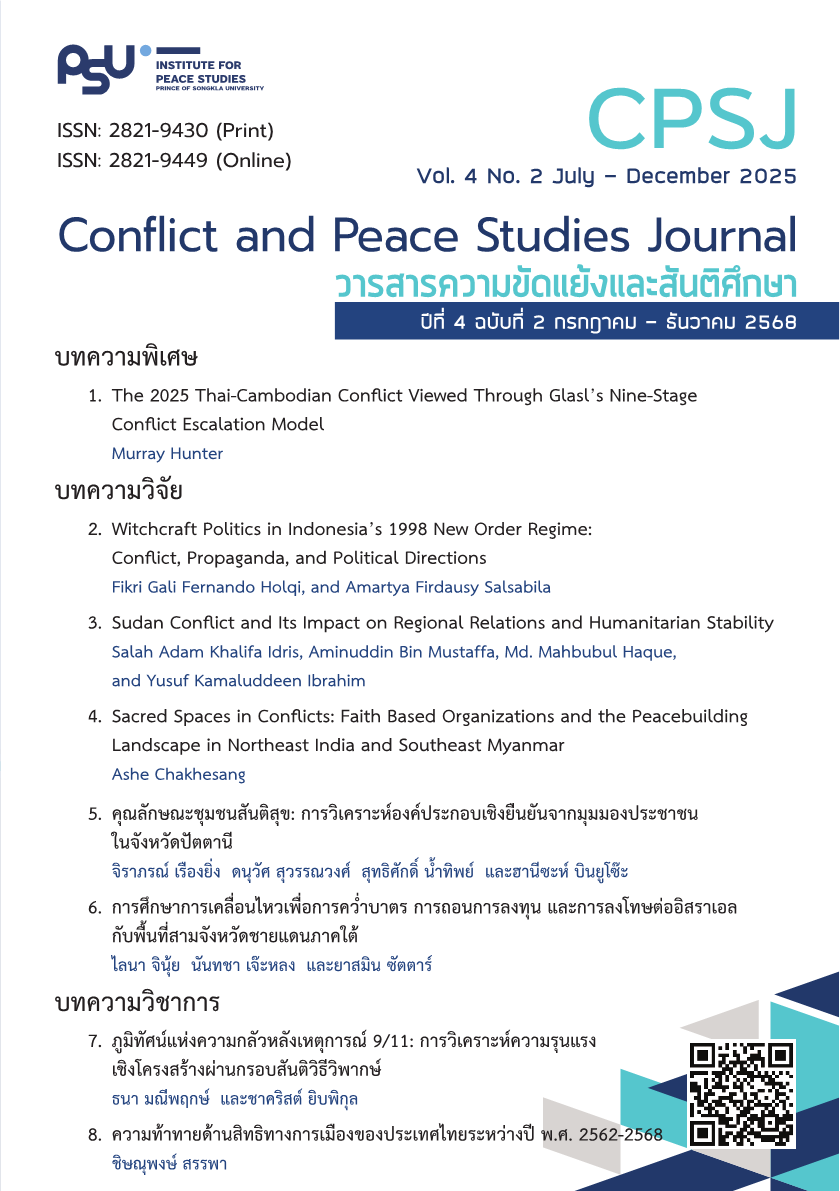
Peaceful Community Attributes: A Confirmatory Factor Analysis of Public Perspectives in Pattani, Thailand
Article Sidebar
Main Article Content
Abstract
This study examined the definition and characteristics of a Peaceful Community in Pattani Province and confirmed its structural components from residents’ perspectives. A mixed-methods design was employed. The qualitative phase involved in-depth interviews with 12 key informants, including local government administrators, community leaders, SBPAC officials, and community development scholars, complemented by an eight-person expert focus group. The quantitative phase surveyed 150 residents aged 20–60 using a multi-stage sampling method. Data were collected via a questionnaire with a reliability coefficient of .812 and analyzed through Confirmatory Factor Analysis (CFA) using JASP. The findings indicate that the characteristics of a Peaceful Community in the context of Pattani Province comprise five dimensions, which are strongly supported by empirical data (χ² = 158.312, df = 96, p < .001, χ²/df = 1.649, CFI = 1.015, TLI = 1.137, RMSEA = 0.038, SRMR = 0.053) with factor loadings ranging from 0.84 to 0.93. The dimensions, in order of descending factor loadings, are as follows: 1) Leadership (0.93), with key indicators including vision and legitimacy, ethics, and moral authority; 2) Emotional (0.92), with key indicators including self-awareness and understanding of others, acceptance and understanding of social and cultural diversity, and connection to local belief systems; 3) Intellectual (0.91), with key indicators including commitment to non-violence and the use of peaceful conflict management processes and mechanisms; 4) Physical and Economic (0.89), with key indicators including income security, economic participation, self-reliance, access to physical infrastructure, and equitable access to public health services; and 5) Social (0.84), with key indicators including comprehensive participation in development processes, social awareness and collective action, acceptance of diversity and peaceful coexistence, and social interdependence. These findings provide an empirical framework for developing and evaluating Peaceful Communities specifically in Pattani Province.
This study defines peaceful communities as social units characterized by harmonious coexistence, respect for diversity, unity, reconciliation, and equality. These communities adopt non-violent conflict resolution and rely on internal mechanisms that promote collective security and stability. Five dimensions serve as core indicators: (1) Physical—economic security; (2) Social—inclusivity, equality, participation, support, and shared values; (3) Spiritual—self-awareness, empathy, and cultural faith; (4) Intellectual—non-violent problem-solving and adaptability; and (5) Leadership—peace-driven leadership that fosters unity. This multidimensional framework is particularly applicable to Pattani Province and other Southern Border Provinces of Thailand, where promoting peaceful communities is essential for long-term conflict resolution, social integration, and sustainable development.
Article Details
References
Budde, V., & Eickhoff, K. (2022). Fostering constructive relations: Approaches to trust-building in peacebuilding interventions (Research report). Institute for Peace Research and Security Policy. https://doi.org/10.25592/ifsh-research-report-008
Christie, D. J., Tint, B. S., Wagner, R. V., & Winter, D. D. (2008). Peace psychology for a peaceful world. American Psychologist, 63(6), 540–552. https://doi.org/10.1037/0003-066X.63.6.540
Creswell, J. W., & Plano Clark, V. L. (2011). Designing and conducting mixed methods research. (2nd ed.). Thousand Oaks, CA: Sage.
Galtung, J. (1969). Violence, peace, and peace research. Journal of Peace Research, 6(3), 167–191. https://doi.org/10.1177/002234336900600301
Galtung, J. (1996). Peace by peaceful means: Peace and conflict, development and civilization. London: SAGE.
Hair, J. F., Black, W. C., Babin, B. J., & Anderson, R. E. (2010). Multivariate Data Analysis (7th ed.). Pearson.
Haider, H. (2009). Community-based approaches to peacebuilding in conflict-affected and fragile contexts. (GSDRC Issue Paper). University of Birmingham.
Lederach, J. P. (1997). Building peace: sustainable reconciliation in divided societies. United States Institute of Peace Press.
Lederach, J. P. (2015). The little book of conflict transformation. New York: Good Books.
Narayan, D., & Cassidy, M. F. (2001). A dimensional approach to measuring social capital: Development and validation of a social capital inventory. Current Sociology, 49(2), 59–102. https://doi.org//10.1177/0011392101049002006
Paul, G.D. (2021). The influence of belief in offender redeemability and decision-making competence on receptivity to restorative
justice. Negotiation and Conflict Management Research, 14(1), 1-20. https://doi.org/10.1111/ncmr.12176
Pretty, J., & Ward, H. (2001). Social capital and the environment. World Development, 29(2), 209–227. https://doi.org/10.1016/S0305-750X(00)00098-X
Putnam, R. D. (2000). Bowling alone: The collapse and revival of American community. Touchstone Books/Simon & Schuster. https://doi.org/10.1145/358916.361990
Ryff, C. D. (2013). Psychological Well-being Revisited: Advances in the Science and Practice of Eudaimonia. Psychotherapy and Psychosomatics, 83(1), 10–28. https://doi.org/10.1159/000353263
Sen, A. (1999). Development as Freedom. Oxford University Press.
Suchman, M. C. (1995). Managing legitimacy: Strategic and institutional approaches. Academy of Management Review, 20(3), 571-610. https://doi.org/10.5465/amr.1995.9508080331
Schumacker, R. E., & Lomax, R. G. (2010). A Beginner’s Guide to Structural Equation Modeling. (3rd ed.). New Jersey: Lawrence Erlbaum Associates.
Tyler, T. R. (2006). Why People Obey the Law (2nd ed.). Princeton University Press.
UNESCO. (1998). Culture of peace: A declaration and programme of action. United Nations Educational, Scientific and Cultural Organization.
United Nations. (2015). Transforming our world: The 2030 Agenda for Sustainable Development. United Nations. https://sdgs.un.org/2030agenda
Wattanapradith, K. (2018). Peace community in the 26th Buddhist Century: Knowledge Learned from Peace Community in Conflict Areas. Journal of MCU Peace Studies, 6(Sp1), 13-24.
