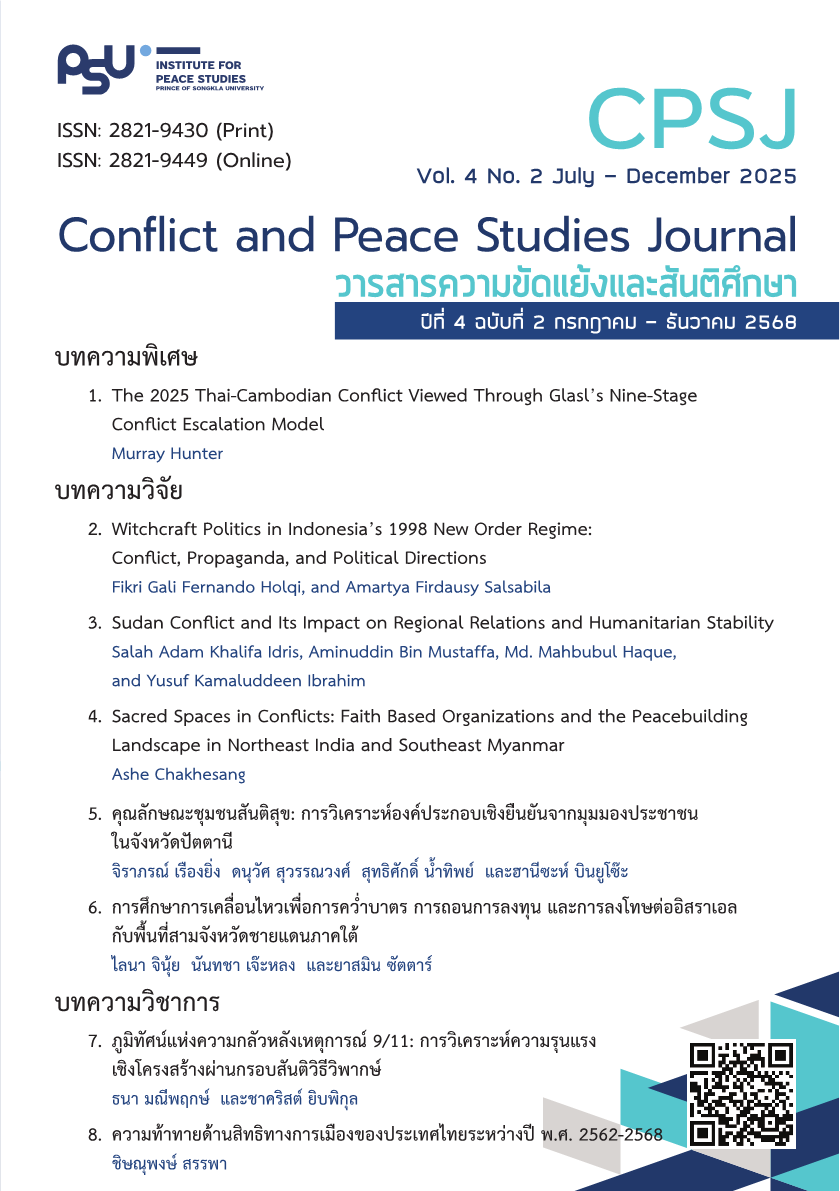
The Landscape of Fear after 9/11 Attack: Understanding Structural Violence through a Critical Peace Analysis
Article Sidebar
Main Article Content
Abstract
This article aims to analyze the United States’ response to the 9/11 attacks through the framework of critical nonviolence, with a focus on structural violence, political discourse, and identity politics. This study employs qualitative methodology and draws on discourse analysis, policy document analysis, political rhetoric, and official statements by the U.S. government leaders in the aftermath of 9/11. The findings include: 1) The state’s response under the banner of the “War on Terror” reproduced structural violence, particularly through legislation that eroded civil liberties; 2) Fear was strategically constructed as a political instrument to expand and entrench state power, so Muslim identity was framed as inherently threatening, with religion, culture, and perceived risk combined to produce Muslims as “permanent suspects,” regardless of actual behavior; and 3) Nonviolent alternatives were conspicuously absent from official policy and systematically excluded from public discourse, despite the fact that the post-9/11 period was a moment that called for a plurality of approaches beyond the use of force. The article concludes that the state’s post-9/11 response constituted more than a security strategy; it represented the erasure of peace as a conceivable option within state logic and public imagination. Nonviolence, therefore, is not merely a moral alternative but a direct challenge to the structural power that renders violence the only thinkable response in a world governed by fear.
Article Details
References
Butler, J. (2004). Precarious life: The Powers of Mourning and Violence. Verso.
Chomsky, N. (2002). 9/11. Seven Stories Press.
Farmer, P. (2005). Pathologies of power: Health, human rights, and the new war on the poor. University of California Press.
Foucault, M. (2003). Society must be defended: Lectures at the Collège de France, 1975–76 (D. Macey, Trans.). Picador.
Galtung, J. (1969). Violence, peace, and peace research. Journal of Peace Research, 6(3), 167–191.
Gershkoff, A., & Kushner, S. (2005). The 9/11–Iraq connection in the Bush administration’s rhetoric. Communication and Critical/Cultural Studies, 2(4), 407–432.
Greenwald, G. (2014). No place to hide: Edward Snowden, the NSA, and the U.S. surveillance state. Metropolitan Books.
Jackson, R. (2005). Writing the war on terrorism: Language, politics and counterterrorism. Manchester University Press.
Lederach, J. P. (2005). The moral imagination: The art and soul of building peace. Oxford University Press.
Mamdani, M. (2004). Good Muslim, Bad Muslim: America, the Cold War, and the Roots of Terror. Pantheon Books.
Richmond, O. P. (2010). Resistance and the Post-liberal Peace. Millennium: Journal of International Studies, 38(3), 665–692.
Robin, C. (2004). Fear: The History of a Political Idea. Oxford University Press.
Saengkaew, P. (2012). Security discourse and fear: Political communication in Thailand [Master’s thesis, Thammasat University].
Satha-Anand, C. (2006). Living Weapons. Kobfai Publishing.
Satha-Anand, C. (2011). The State and the Discourse of Security: The Politics of Threat Construction. Internal document, Thammasat University.
Spivak, G. C. (1988). Can the Subaltern Speak? In C. Nelson & L. Grossberg (Eds.), Marxism and the Interpretation of Culture (pp. 271–313). University of Illinois Press.
Tejapira, K. (2007). Globalization, fear, and democracy. Matichon Publishing.
