Enhancing Inclusive Participation of Vulnerable and Marginalized People in the Peacebuilding in Thailand’s Southern Border Provinces
Article Sidebar
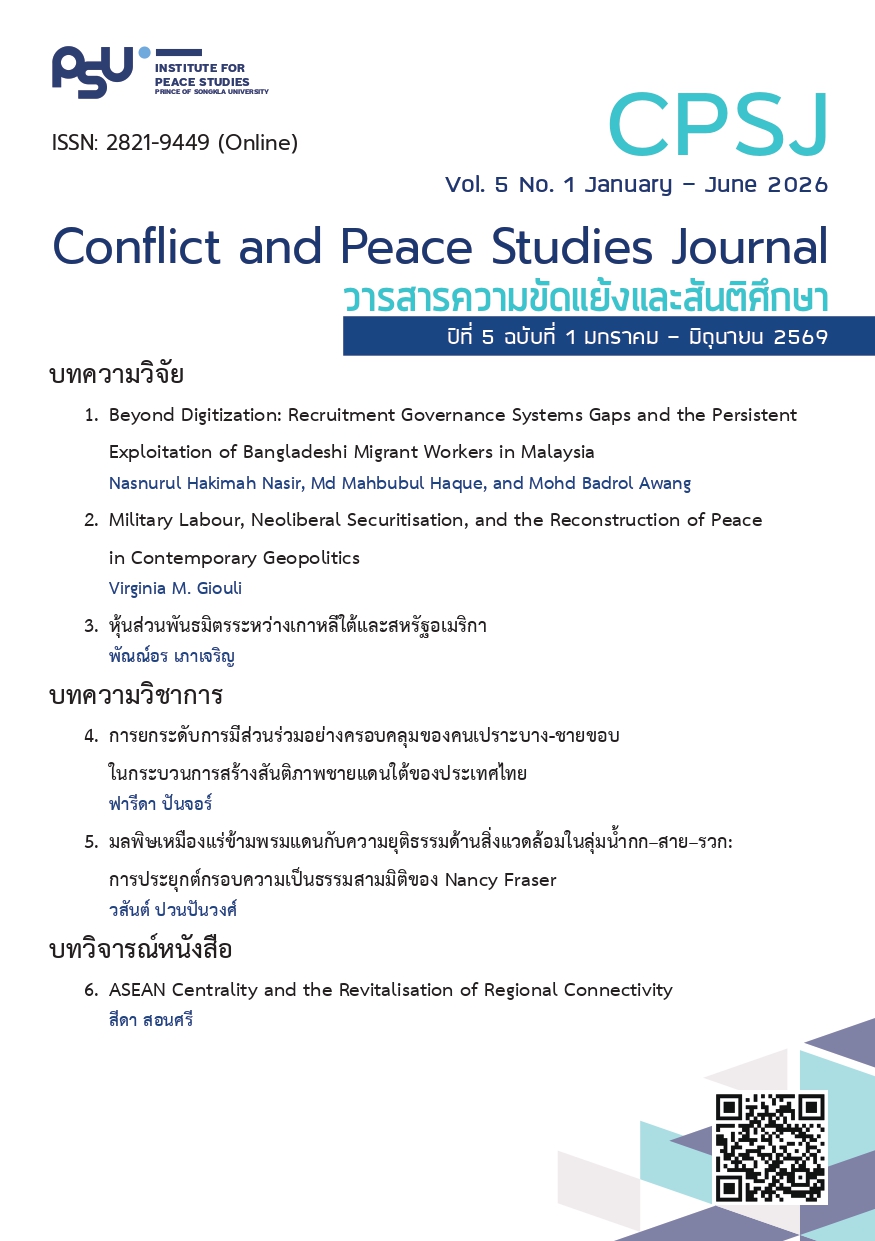
Main Article Content
Abstract
Peace negotiations and peacebuilding processes must be pursued in tandem, particularly in protracted conflict contexts such as Thailand’s southern border provinces. This article examines the participation of vulnerable and marginalized groups in the peace process under the project Inclusive Peacebuilding in Southern Thailand Provinces (2022–2025). Employing a mixed-methods approach combined with participatory research, data were collected from 169 participants across ten target groups, including widows, caregivers for orphans, persons with disabilities, the elderly, the housing-insecure, coastal fishers, at-risk youth, LGBTQ+ individuals, religious minorities, and those affected by special laws. The analysis draws on the frameworks of peacebuilding, inclusive participation, intersectionality, and conflict transformation. The findings indicate that although physical violence has declined, distrust, inequality, and social exclusion persist. Meaningful inclusion of marginalized groups is therefore a crucial factor in advancing positive peace and fostering disempowered development.
Article Details
References
Alaverdov, E., Babaoglu, C., Mirjat, R. B., Omona, A. D., & Semenov, A. (2023). Minority Rights in Post-Conflict Peacebuilding: An Analysis of Legislative Perspectives and Contemporary Challenges. European Law and Politics Journal, 10(2), 25–39. Retrieved from https://elpjournal.eu/wp-content/uploads/2023/11/ELP-Vol.10-No.2-a3-1.pdf
Berghof Foundation. (2019). Berghof Glossary on Conflict Transformation: 20 Notions for Theory and Practice. Retrieved from https://berghof-foundation.org/files/publications/berghof_glossary_2019_inclusivity.pdf
Center for Conflict Studies and Cultural Diversity. (2025). Voices from People to the Peace Negotiation Table: Lessons and Experiences of Sustainable Peacebuilding in the Southern Border Provinces 2022-2025. Institute for Peace Studies, Prince of Songkla University.
Crenshaw, K. (1989). Demarginalizing the Intersection of Race and Sex: A Black Feminist Critique of Antidiscrimination Doctrine, Feminist Theory and Antiracist Politics. University of Chicago Legal Forum, 1989(1), 139–167. Retrieved from https://chicagounbound.uchicago.edu/uclf/vol1989/iss1/8
Crenshaw, K. W. (1991). Mapping the Margins: Intersectionality, Identity Politics, and Violence Against Women of Color. Stanford Law Review, 43(6), 1241-1299.
Darby, J. (Ed.). (2001). The Effects of Violence on Peace Processes. United States Institute of Peace.
Deep South Watch. (2023). Database on the Unrest Situation in Thailand’s Southern Border Provinces, 2004–2023 [Online database].
Doyle, M. W., & Sambanis, N. (2006). Making War and Building Peace: United Nations Peace Operations. Princeton University Press.
Fischer, A. M. (2014). The Disempowered Development of Tibet in China: A Study in the Economics of Marginalization. Lanham, MD: Lexington Books.
Galtung, J. (1996). Peace by Peaceful Means: Peace and Conflict, Development and Civilization. Sage Publications.
Guterres, A. (2021, November 9). Without Full Inclusion and Equality, Peace is a Job Half Done. United Nations. Retrieved from https://press.un.org/en/2021/sgsm21013.doc.htm
International Dialogue on Peacebuilding and Statebuilding. (2011). The New Deal for Engagement in Fragile States: Aid and Development Effectiveness in Fragile Situations. OECD. Retrieved from https://one.oecd.org/document/DCD/DAC/INCAF(2011)4/en/pdf
Kanchanapan, A. (2020). Theory and Methodology of Cultural Research: Breaking through Frameworks and the Pitfalls of Dichotomous Thinking (3rd ed.). Sayam Panya.
Mizzi, R. C., et al. (2023). Marginalized Voices and the Good Friday Agreement: Inclusion and the Northern Ireland Peace Process. Treatises and Documents. Journal of Ethnic Studies /Razprave in Gradivo, 90, 127–143. Retrieved from https://doi.org/10.2478/tdjes-2023-0009
O'Reilly, M. (2015, October). Why Women? Inclusive Security and Peaceful Societies. Inclusive Security. Retrieved from https://www.inclusivesecurity.org/wp-content/uploads/2015/10/Why-Women-Brief-10.12.15.pdf
Peace Survey Network. (2023). Public Opinion Survey on the Peace Process in Thailand’s Southern Border Provinces (7th survey). Institute for Peace Studies, Prince of Songkla University.
Schirch, L. (2013). Conflict Assessment and Peacebuilding Planning: Toward a Participatory Approach to Human Security. Kumarian Press.
World Bank. (2011). World Development Report 2011: Conflict, Security, and Development. World Bank. Retrieved from https://documents.worldbank.org/en/publication/documents-reports/documentdetail/966731468161352341/world-development-report-2011-conflict-security-and-development
