
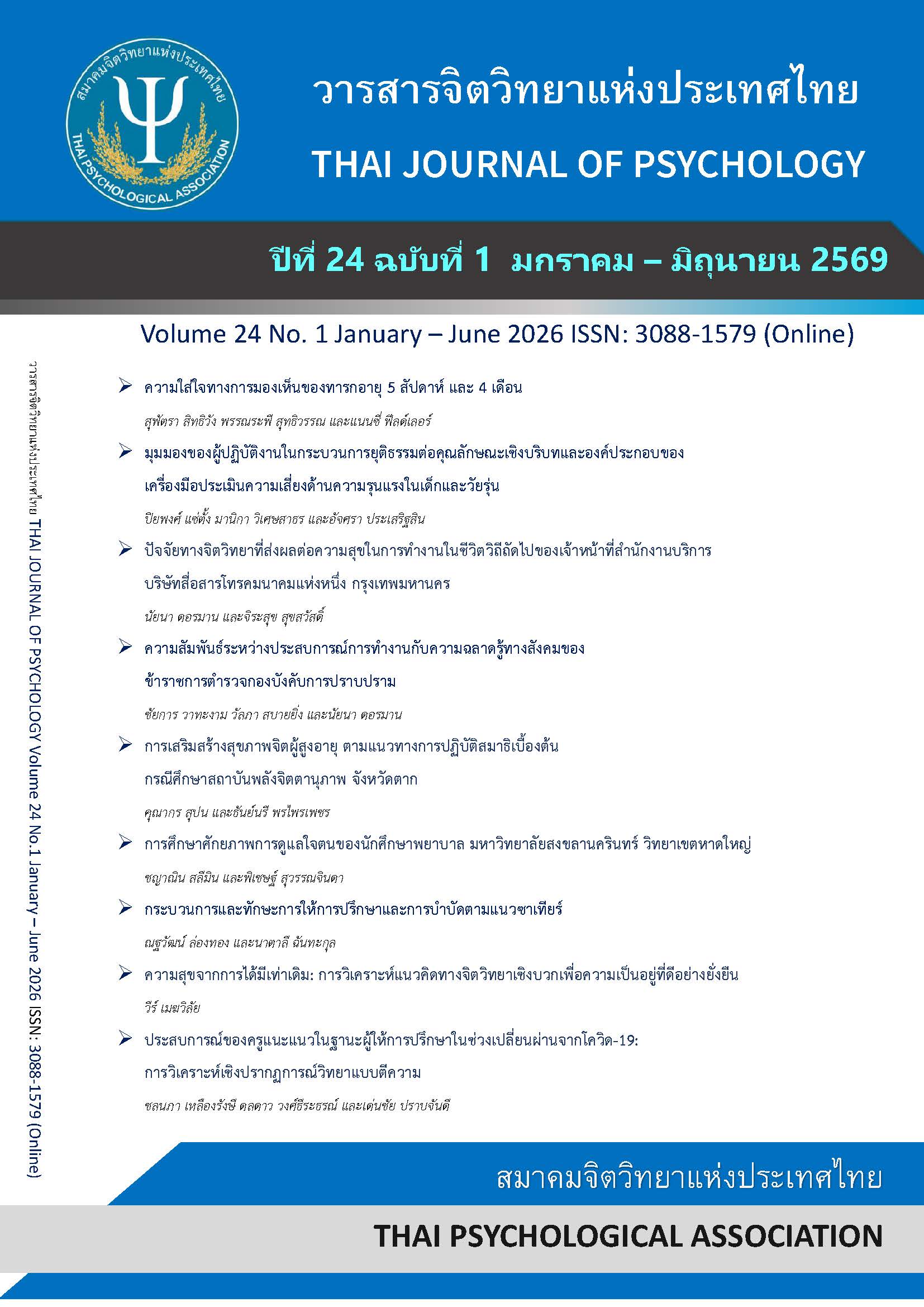
ความสุขจากการได้มีเท่าเดิม: การวิเคราะห์แนวคิดทางจิตวิทยาเชิงบวกเพื่อความเป็นอยู่ที่ดีอย่างยั่งยืน
คำสำคัญ:
ความสุข, จิตวิทยาเชิงบวก, ความรู้คุณ, ความเป็นอยู่ที่ดีบทคัดย่อ
สังคมร่วมสมัยกำลังเผชิญกับความท้าทายสำคัญในการแสวงหาความสุขที่ยั่งยืน แม้ความเจริญทางวัตถุ
จะเพิ่มขึ้นอย่างต่อเนื่อง แต่อัตราของภาวะซึมเศร้าและความวิตกกังวลกลับสูงขึ้นอย่างมีนัยสำคัญ วัฒนธรรม
การบริโภคที่เน้นการได้มาซึ่งสิ่งใหม่อย่างไม่หยุดยั้งได้สร้างวงจรของการแสวงหาที่ไม่มีที่สิ้นสุด ส่งผลให้
เกิดปรากฏการณ์การปรับตัวทางความพึงพอใจที่ทำให้ความสุขจากการได้มาซึ่งสิ่งใหม่มีอายุสั้นและค่อย ๆ
เลือนหายไป บทความนี้นำเสนอแนวคิด ‘ความสุขจากการได้มีเท่าเดิม’ ผ่านการวิเคราะห์ทางจิตวิทยาเชิงบวก โดยใช้กรอบทฤษฎีความเป็นอยู่ที่ดี (PERMA model) ของ Seligman ในการวิเคราะห์ พบว่าความสุขจากการได้มีเท่าเดิมสามารถส่งเสริมความเป็นอยู่ที่ดีได้ครบทุกองค์ประกอบของ PERMA ได้แก่ ผ่านการเพิ่มอารมณ์เชิงบวก (P) ความผูกพันกับกิจกรรมในปัจจุบัน (E) คุณภาพของสัมพันธภาพ (R) ความหมายในชีวิต (M) และความพึงพอใจต่อสิ่งที่ตนมีและทำได้แล้ว (A) กลไกหลักทางจิตวิทยา 2 ประการที่ขัดขวางความสุขจากสิ่งที่มีอยู่ ได้แก่ การปรับตัวทางความพึงพอใจและการเปรียบเทียบทางสังคม กลไกที่ส่งเสริม คือ สติและความรู้คุณ ซึ่งมีหลักฐานเชิงประจักษ์สนับสนุนอย่างมีนัยสำคัญต่อความเป็นอยู่ที่ดี การผสมผสานระหว่างความรู้คุณและสติช่วยต่อต้านการปรับตัว
ทางความพึงพอใจ ลดการเปรียบเทียบทางสังคม และสร้างความสุขที่ยั่งยืน แนวคิดนี้มีความเชื่อมโยงอย่างลึกซึ้งกับภูมิปัญญาไทยและคำสอนทางพุทธศาสนา และมีศักยภาพในการประยุกต์ใช้เพื่อส่งเสริมความเป็นอยู่ที่ดี
อย่างยั่งยืนในบริบทสังคมไทยที่กำลังเผชิญกับอิทธิพลของสังคมดิจิทัลและวัฒนธรรมการบริโภคนิยม
เอกสารอ้างอิง
กรมสุขภาพจิต. (2566). รายงานประจำปี 2566. กรมสุขภาพจิต กระทรวงสาธารณสุข. สืบค้นเมื่อ 1 พฤษภาคม 2569, จาก https://dmh-elibrary.org/items/show/1888
ฉัตรวิบูลย์ ไพจ์เซล. (2563). การกำกับอารมณ์ด้วยสติ: มุมมองเชิงการรู้คิตบนกระบวนการของอารมณ์ [Mindful emotion regulation: A cognitive perspective on emotion process]. วารสารจิตวิทยาคลินิกไทย, 51(2), 55–68. https://so03.tci-thaijo.org/index.php/tcithaijclinicpsy/article/view/250817
พระพรหมคุณาภรณ์ (ป.อ. ปยุตฺโต). (2555). พุทธธรรม ฉบับปรับขยาย (พิมพ์ครั้งที่ 31). มหาวิทยาลัยมหาจุฬาลงกรณราชวิทยาลัย.
ลวิตรา เลื่องรุ่งโรจน์, พิไล ศรีสุวรรณ, และ วัณฑ์ณา อัตสาริยะ. (2566). การทบทวนวรรณกรรมอย่างเป็นระบบเกี่ยวกับความสัมพันธ์ระหว่างสื่อสังคมออนไลน์และความเป็นอยู่ที่ดีในกลุ่มวัยรุ่น. วารสารสมาคมจิตแพทย์แห่งประเทศไทย, 68(3), 305–317. https://he01.tci-thaijo.org/index.php/JPAT/article/view/261564
Armenta, C., Jacobs Bao, K., Lyubomirsky, S., & Sheldon, K. M. (2014). Is lasting change possible? Lessons from the hedonic adaptation prevention model. In K. M. Sheldon & R. E. Lucas (Eds.), Stability of happiness: Theories and evidence on whether happiness can change (pp. 57–74). Elsevier. https://doi.org/10.1016/B978-0-12-411478-4.00004-7
Chen, L. H., & Kee, Y. H. (2008). Gratitude and adolescent athletes' well-being. Social Indicators Research, 89(2), 361–373. https://doi.org/10.1007/s11205-008-9237-4
Davis, D. E., Choe, E., Meyers, J., Wade, N., Varjas, K., Gifford, A., Quinn, A., Hook, J. N., Van Tongeren, D. R., Griffin, B. J., & Worthington, E. L., Jr. (2016). Thankful for the little things: A meta-analysis of gratitude interventions. Journal of Counseling Psychology, 63(1),
–31. https://doi.org/10.1037/cou0000107
Diener, E., & Seligman, M. E. P. (2004). Beyond money: Toward an economy of well-being. Psychological Science in the Public Interest, 5(1), 1–31. https://doi.org/10.1111/j.0963-7214.2004.00501001.x
Diniz, G., Korkes, L., Tristão, L. S., Pelegrini, R., Bellodi, P. L., & Bernardo, W. M. (2023). The effects of gratitude interventions: A systematic review and meta-analysis. Einstein (São Paulo), 21, eRW0371. https://doi.org/10.31744/einstein_journal/2023RW0371
Emmons, R. A., & McCullough, M. E. (2003). Counting blessings versus burdens: An experimental investigation of gratitude and subjective well-being in daily life. Journal of Personality and Social Psychology, 84(2), 377–389. https://doi.org/10.1037/0022-3514.84.2.377
Emmons, R. A., & Shelton, C. M. (2002). Gratitude and the science of positive psychology. In C. R. Snyder & S. J. Lopez (Eds.), Handbook of positive psychology (pp. 459–471). Oxford University Press.
Festinger, L. (1954). A theory of social comparison processes. Human Relations, 7(2), 117–140. https://doi.org/10.1177/001872675400700202
Forgeard, M. J. C., Jayawickreme, E., Kern, M. L., & Seligman, M. E. P. (2011). Doing the right thing: Measuring wellbeing for public policy. International Journal of Wellbeing, 1(1), 79–106. https://doi.org/10.5502/ijw.v1i1.15
Fliessbach, K., Weber, B., Trautner, P., Dohmen, T., Sunde, U., Elger, C. E., & Falk, A. (2007). Social comparison affects reward-related brain activity in the human ventral striatum. Science, 318(5854), 1305–1308. https://doi.org/10.1126/science.1145876
Frederick, S., & Loewenstein, G. (1999). Hedonic adaptation. In D. Kahneman, E. Diener, & N. Schwarz (Eds.), Well-being: The foundations of hedonic psychology (pp. 302–329). Russell Sage Foundation.
Hayes, S. C., & Feldman, G. (2004). Clarifying the construct of mindfulness in the context of emotion regulation and the process of change in therapy. Clinical Psychology: Science and Practice, 11(3), 255–262. https://doi.org/10.1093/clipsy.bph080
Hayes, S. C., Strosahl, K. D., & Wilson, K. G. (1999). Acceptance and commitment therapy: An experiential approach to behavior change. Guilford Press.
Jarukasemthawee, S., & Pisitsungkagarn, K. (2021). Mindfulness and eudaimonic well-being:
The mediating roles of rumination and emotion dysregulation. International Journal of Adolescent Medicine and Health, 33(6), 347–356. https://doi.org/10.1515/ijamh-2021-0009
Jeffrey J. Froh, Robert A. Emmons, Card, N. A., Bono, G., & Wilson, J. A. (2011). Gratitude and the reduced costs of materialism in adolescents. Journal of Happiness Studies, 12(2), 289–302. https://doi.org/10.1007/s10902-010-9195-9
Kabat-Zinn, J. (1990). Full catastrophe living: Using the wisdom of your body and mind to face stress, pain, and illness. Delacorte Press.
Kabat-Zinn, J. (1994). Wherever you go, there you are: Mindfulness meditation in everyday life. Hyperion.
Kahneman, D., Diener, E., & Schwarz, N. (Eds.). (1999). Well-being: The foundations of hedonic psychology. Russell Sage Foundation.
Kern, M. L., Waters, L. E., Adler, A., & White, M. A. (2014). A multidimensional approach to measuring well-being in students: Application of the PERMA framework. The Journal of Positive Psychology, 10(3), 262–271. https://doi.org/10.1080/17439760.2014.936083
Keyes, C. L. M., Shmotkin, D., & Ryff, C. D. (2002). Optimizing well-being: The empirical encounter of two traditions. Journal of Personality and Social Psychology, 82(6), 1007–1022. https://doi.org/10.1037/0022-3514.82.6.1007
Khoury, B., Sharma, M., Rush, S. E., & Fournier, C. (2015). Mindfulness-based stress reduction for healthy individuals: A meta-analysis. Journal of Psychosomatic Research, 78(6), 519–528. https://doi.org/10.1016/j.jpsychores.2015.03.009
Lyubomirsky, S. (2011). Hedonic adaptation to positive and negative experiences. In S. Folkman (Ed.), The Oxford handbook of stress, health, and coping (pp. 200–224). Oxford University Press.
Ryan, R. M., & Deci, E. L. (2001). On happiness and human potentials: A review of research on hedonic and eudaimonic well-being. Annual Review of Psychology, 52, 141–166. https://doi.org/10.1146/annurev.psych.52.1.141
Ryff, C. D. (1989). Happiness is everything, or is it? Explorations on the meaning of psychological well-being. Journal of Personality and Social Psychology, 57(6), 1069–1081. https://doi.org/10.1037/0022-3514.57.6.1069
Segal, Z. V., Williams, J. M. G., & Teasdale, J. D. (2002). Mindfulness-based cognitive therapy for depression: A new approach to preventing relapse. Guilford Press.
Seligman, M. E. P. (2011). Flourish: A visionary new understanding of happiness and well-being.
Free Press.
Seligman, M. E. P., & Csikszentmihalyi, M. (2000). Positive psychology: An introduction. American Psychologist, 55(1), 5–14. https://doi.org/10.1037/0003-066X.55.1.5
Seligman, M. E. P., Steen, T. A., Park, N., & Peterson, C. (2005). Positive psychology progress: Empirical validation of interventions. American Psychologist, 60(5), 410–421. https://doi.org/10.1037/0003-066X.60.5.410
Shapiro, S. L., Carlson, L. E., Astin, J. A., & Freedman, B. (2006). Mechanisms of mindfulness. Journal of Clinical Psychology, 62(3), 373–386. https://doi.org/10.1002/jclp.20237
Sheldon, K. M., & Lucas, R. E. (Eds.). (2014). Stability of happiness: Theories and evidence on whether happiness can change. Elsevier.
Tarka, P., & Harnish, R. J. (2022). From materialism to hedonistic shopping values and compulsive buying: A mediation model examining gender differences. Journal of Consumer Behaviour, 21(4), 804–825. https://doi.org/10.1002/cb.2037
Teasdale, J. D. (1999). Metacognition, mindfulness and the modification of mood disorders. Clinical Psychology & Psychotherapy, 6(2), 146–155. https://doi.org/10.1002/(SICI)1099-0879(199905)6:2<146::AID-CPP195>3.0.CO;2-E
Vogel, E. A., Rose, J. P., Roberts, L. R., & Eckles, K. (2014). Social comparison, social media,
and self-esteem. Psychology of Popular Media Culture, 3(4), 206–222. https://doi.org/10.1037/ppm0000047
Wang, J.-L., Wang, H.-Z., Gaskin, J., & Hawk, S. (2017). The mediating roles of upward social comparison and self-esteem and the moderating role of social comparison orientation in the association between social networking site usage and subjective well-being. Frontiers in Psychology, 8, 771. https://doi.org/10.3389/fpsyg.2017.00771
Waterman, A. S. (1993). Two conceptions of happiness: Contrasts of personal expressiveness (eudaimonia) and hedonic enjoyment. Journal of Personality and Social Psychology, 64(4), 678–691. https://doi.org/10.1037/0022-3514.64.4.678
Watkins, P. C., Woodward, K., Stone, T., & Kolts, R. L. (2003). Gratitude and happiness: Development of a measure of gratitude, and relationships with subjective well-being. Social Behavior and Personality, 31(5), 431–452. https://doi.org/10.2224/sbp.2003.31.5.431
Wills, T. A. (1981). Downward comparison principles in social psychology. Psychological Bulletin, 90(2), 245–271. https://doi.org/10.1037/0033-2909.90.2.245
Wong, Y. J., Owen, J., Gabana, N. T., Brown, J. W., McInnis, S., Toth, P., & Gilman, L. (2018). Does gratitude writing improve the mental health of psychotherapy clients? Evidence from a randomized controlled trial. Psychotherapy Research, 28(2), 192–202. https://doi.org/10.1080/10503307.2016.1169332
Wood, A. M., Froh, J. J., & Geraghty, A. W. A. (2010). Gratitude and well-being: A review and theoretical integration. Clinical Psychology Review, 30(7), 890–905. https://doi.org/10.1016/j.cpr.2010.03.005
World Health Organization. (2023). Mental disorders. https://www.who.int/news-room/fact-sheets/detail/mental-disorders
ดาวน์โหลด
เผยแพร่แล้ว
รูปแบบการอ้างอิง
ฉบับ
ประเภทบทความ
สัญญาอนุญาต
ลิขสิทธิ์ (c) 2026 สมาคมจิตวิทยาแห่งประเทศไทย

อนุญาตภายใต้เงื่อนไข Creative Commons Attribution-NonCommercial-NoDerivatives 4.0 International License.
บทความที่ได้รับการตีพิมพ์เป็นลิขสิทธิ์ของสมาคมจิตวิทยาแห่งประเทศไทย
ข้อความที่ปรากฎในบทความแต่ละเรื่องในวารสารวิชาการเล่มนี้เป็นความคิดเห็นส่วนตัวของผู้เขียนแต่ละท่านไม่เกี่ยวข้องกับสมาคมจิตวิทยาแห่งประเทศไทย แต่อย่างใด ความรับผิดชอบองค์ประกอบทั้งหมดของบทความแต่ละเรื่องเป็นของผู้เขียนแต่ละท่าน หากมีความผิดพลาดใด ๆ ผู้เขียนแต่ละท่านจะรับผิดชอบบทความของตนเองแต่ผู้เดียว


