
ENTREPRENEURIAL MANAGEMENT PRACTICES AND THE PERFORMANCE OF START-UP FIRMS IN ABEOKUTA, OGUN STATE, NIGERIA
Keywords:
Entrepreneurial management practice, Startup firm's performance, Talent management, Team morale and engagement, Creativity and innovation management, Industry sector, Years of business operationAbstract
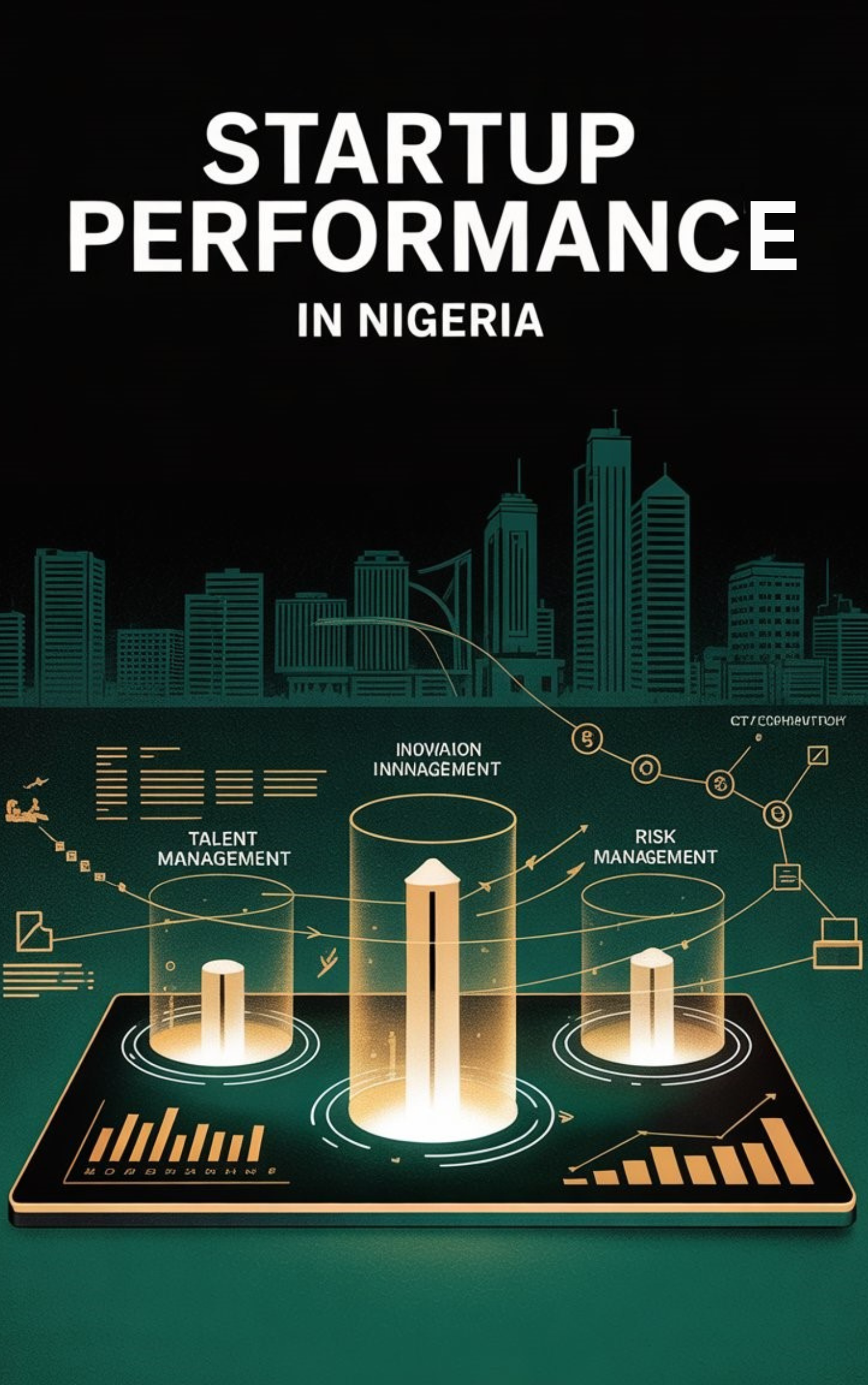
Start-up firms in developing economies face significant challenges in achieving sustainable performance due to resource constraints, market uncertainties, and management capability gaps. In Nigeria's entrepreneurial ecosystem, the failure rate of startups remains high, with inadequate management practices identified as a critical contributing factor. The study investigated the nexus between entrepreneurial management practices (talent management, creativity and innovation management, and risk management) and startup performance; and examined the influence of the entrepreneurial management practices on the performance of start-up firms in the South-west Geo-Political Zone of Nigeria, specifically on entrepreneurial enterprises in Abeokuta, Ogun State. The population of the study was 250, derived from different startup ventures in the study area. The sample size for the study was 153 respondents, determined using Yaro Yamane's (1967) sampling technique. A structured questionnaire was designed for data collection based on validated scales from previous entrepreneurial management studies. The collected data were analyzed using descriptive and inferential statistics, with industry sector and years of business operation incorporated as control variables to isolate the unique effects of management practices. The descriptive statistics employed included mean, standard deviation, and percentages. The inferential statistics used were correlation and hierarchical multiple regression, facilitated by the Statistical Package for Social Sciences (SPSS version 27). The results indicate that entrepreneurial management practices, including talent management (B = 0.536, β = 0.252, t = 4.971, p < 0.001), creativity and innovation management (B = 0.628, β = 0.321, t = 6.093, p < 0.001), and risk management (B = 1.300, β = 0.592, t = 11.242, p < 0.001), as an overarching concept, substantially influence startup performance in Nigeria's entrepreneurial ecosystem. After controlling for industry sector and years of business operation, the full hierarchical model explained 64.3% of variance in startup performance (Adjusted R² = .614), confirming the robustness of these effects. Risk management emerged as the strongest single predictor, explaining 46.6% of variance in startup performance. Years of business operation was a significant control (β = .142, p = .024), while ICT/Technology sector startups demonstrated superior performance relative to other sectors. The study offers insights for entrepreneurs, policymakers, and stakeholders regarding the significance of management practices in fostering startup success within Nigeria's entrepreneurial ecosystem.
References
Alvarez, S. A., & Busenitz, L. W. (2001). The entrepreneurship of resource-based theory. Journal of Management, 27(6), 755-775.
Adebayo, O. (2022). Challenges and opportunities for small and medium enterprises in emerging economies. Journal of Small Business and Entrepreneurship, 34(2), 165-182.
Adeyemi, O. S. (2023). The impact of digital transformation on startup performance in Nigeria. Journal of Digital Business, 4(1), 1-15.
Adeyinka, O. S. (2023). The impact of team diversity on startup performance in Nigeria. Journal of Business and Entrepreneurship, 25(3), 1-12.
Barney, J. (1991). Firm resources and sustained competitive advantage. Journal of Management, 17(1), 99-120.
Ben-Hafaiedh, C., Xheneti, M., Stenholm, P., Blackburn, R., Welter, F., & Urbano, D. (2023). The interplay of context and entrepreneurship: The new frontier for contextualisation research. Small Business Economics, 62, 1-12.
Blank, S. (2013). The four steps to the epiphany: Successful strategies for products that win. K&S Ranch.
Blank, S., & Dorf, B. (2020). The startup owner's manual: The step-by-step guide for building a great company. Scientific Research Publishing, 1(1), 41-47.
Blau, P. M. (1964). Exchange and power in social life. John Wiley & Sons.
Bromiley, P., McShane, M., Nair, A., & Rustambekov, E. (2015). Enterprise risk management: Review, critique, and research directions. Long Range Planning, 48(4), 265-276.
Brown, T. (2008). Design thinking. Harvard Business Review, 86(6), 84-92.
Brustbauer, J. (2016). Enterprise risk management in SMEs: Towards a structural model. International Small Business Journal, 34(1), 70-85.
Bruton, G. D., Ahlstrom, D., & Obloj, K. (2013). Entrepreneurship in emerging economies: Where are we today and where should the research go in the future. Entrepreneurship Theory and Practice, 32(1), 1-14.
Cappelli, P., & Keller, J. R. (2014). Talent management: Conceptual approaches and practical challenges. Annual Review of Organizational Psychology and Organizational Behavior, 1(1), 305-331.
Cardon, M. S., & Stevens, C. E. (2004). Managing human resources in small organizations: What do we know? Human Resource Management Review, 14(3), 295-323.
Chen, J., & Williams, P. (2022). The impact of team composition and management strategies on startup success. Journal of Business and Entrepreneurship, 25(2), 30-45.
Chesbrough, H. W. (2003). Open innovation: The new imperative for creating and profiting from technology. Harvard Business Press.
Christensen, C. M. (1997). The innovator's dilemma: When new technologies cause great firms to fail. Harvard Business Review Press.
Coff, R., & Kryscynski, D. (2011). Invited editorial: Drilling for micro-foundations of human capital-based competitive advantages. Journal of Management, 37(5), 1429-1443.
Collings, D. G., & Mellahi, K. (2009). Strategic talent management: A review and research agenda. Human Resource Management Review, 19(4), 304-313.
Collins, C. J., & Smith, K. G. (2006). Knowledge exchange and combination: The role of human resource practices in the performance of high-technology firms. Academy of Management Journal, 49(3), 544-560.
Combs, J., Liu, Y., Hall, A., & Ketchen, D. (2006). How much do high-performance work practices matter? A meta-analysis of their effects on organizational performance. Personnel Psychology, 59(3), 501-528.
Damanpour, F., & Evan, W. M. (1984). Organizational innovation and performance: The problem of organizational lag. Administrative Science Quarterly, 29(3), 392-409.
Dawson, P., & Andriopoulos, C. (2017). Managing change, creativity and innovation (3rd ed.). Sage Publications.
Donaldson, L. (2001). The contingency theory of organizations. Sage Publications.
Fornell, C., & Larcker, D. F. (1981). Evaluating structural equation models with unobservable variables and measurement error. Journal of Marketing Research, 18(1), 39-50.
Frese, M., Krauss, S. I., Keith, N., Escher, S., Grabarkiewicz, R., Luneng, S. T., & Friedrich, C. (2007). Business owners' action planning and its relationship to business success in three African countries. Journal of Applied Psychology, 92(6), 1481-1498.
George, G., Corbishley, C., Khayesi, J. N., Haas, M. R., & Tihanyi, L. (2016). Bringing Africa in: Promising directions for management research. Academy of Management Journal, 59(2), 377-393.
Glaub, M. E., Fischer, S., Bendell, J., & Frese, M. (2014). Replicating support for a moderated mediated model of entrepreneurship training. Journal of Business Venturing Insights, 1, 50-56.
Herzberg, F. (1959). The motivation to work. John Wiley & Sons.
Hitt, M. A., Ireland, R. D., & Hoskisson, R. E. (2020). Strategic management: Concepts and cases (13th ed.). Cengage Learning.
Hoyt, R. E., & Liebenberg, A. P. (2011). The value of enterprise risk management. Journal of Risk and Insurance, 78(4), 795-822.
Hurley, R. F., & Hult, G. T. M. (1998). Innovation, market orientation, and organizational learning: An integration and empirical examination. Journal of Marketing, 62(3), 42-54.
Jamaludin, N., & Kamal, S. (2023). The relationship between remote work and job satisfaction: The mediating role of perceived autonomy. Information Management and Business Review, 15, 10-22.
Kaplan, R. S., & Norton, D. P. (1996). The balanced scorecard: Translating strategy into action. Harvard Business Press.
Kehoe, R. R., & Wright, P. M. (2013). The impact of high-performance human resource practices on employees' attitudes and behaviors. Journal of Management, 39(2), 366-391.
Khanna, T., & Palepu, K. G. (2010). Winning in emerging markets: A road map for strategy and execution. Harvard Business Press.
Kiggundu, M. N. (2002). Entrepreneurs and entrepreneurship in Africa: What is known and what needs to be done. Journal of Developmental Entrepreneurship, 7(3), 239-258.
Lans, T., Blok, V., & Wesselink, R. (2015). Learning apart and together: Towards an integrated competence framework for sustainable entrepreneurship in higher education. Journal of Cleaner Production, 62, 37-47.
Mair, J., & Marti, I. (2009). Entrepreneurship in and around institutional voids: A case study from Bangladesh. Journal of Business Venturing, 24(5), 419-435.
March, J. G. (1991). Exploration and exploitation in organizational learning. Organization Science, 2(1), 71-87.
Maslow, A. H. (1943). A theory of human motivation. Psychological Review, 50(4), 370-396.
Meyers, M. C., & van Woerkom, M. (2014). The influence of underlying philosophies on talent management. Journal of World Business, 49(2), 192-203.
Miller, K. D., & Lessard, D. R. (2000). The strategic management of large engineering projects. MIT Press.
Miller, K. D., & Reuer, J. J. (1996). Measuring organizational downside risk. Strategic Management Journal, 17(9), 671-691.
Mitchelmore, S., & Rowley, J. (2013). Entrepreneurial competencies of women entrepreneurs pursuing business growth. Journal of Small Business and Enterprise Development, 20(1), 125-142.
Murphy, G. B., Trailer, J. W., & Hill, R. C. (1996). Measuring performance in entrepreneurship research. Journal of Business Research, 36(1), 15-23.
Mwasalwiba, E. S. (2020). Entrepreneurship education in Africa: Challenges and opportunities. International Journal of Entrepreneurial Behavior & Research, 26(3), 405-425.
Nunnally, J. C. (1978). Psychometric theory (2nd ed.). McGraw-Hill.
OECD. (2020). Entrepreneurship and innovation in small and medium enterprises. OECD Publishing.
Ogundeji, A. A. (2023). Understanding the role of strategic management in small and medium enterprises. Journal of Business Strategy, 44(4), 22-35.
Raisch, S., & Birkinshaw, J. (2008). Organizational ambidexterity: Antecedents, outcomes, and moderators. Journal of Management, 34(3), 375-409.
Rauch, A., & Hulsink, W. (2015). Putting entrepreneurship education where the intention to act lies. Academy of Management Learning & Education, 14(2), 187-204.
Ries, E. (2011). The lean startup. Crown Business.
Rodriguez, J. (2024). The role of human resource management in startup success. Journal of Small Business Management, 62(1), 1-20.
Rubera, G., & Kirca, A. H. (2012). Firm innovativeness and its performance outcomes: A meta-analytic review. Journal of Marketing, 76(3), 130-147.
Sahas, M., & Kumar, R. (2023). Team performance in startups. Journal of Entrepreneurship and Innovation Management, 10(1), 13-29.
Salter, A., Criscuolo, P., & Ter Wal, A. L. (2014). Coping with open innovation. California Management Review, 56(2), 77-94.
Schaufeli, W. B., Bakker, A. B., & Salanova, M. (2006). The measurement of work engagement with a short questionnaire. Educational and Psychological Measurement, 66(4), 701-716.
Shane, S., & Venkataraman, S. (2000). The promise of entrepreneurship as a field of research. Academy of Management Review, 25(1), 217-226.
Smith, J., & Brown, K. (2023). Resource prioritization and team efficiency in startups. Journal of Management and Organization, 29(2), 257-274.
Takeuchi, R., Lepak, D. P., Wang, H., & Takeuchi, K. (2007). An empirical examination of the mechanisms mediating between high-performance work systems and the performance of Japanese organizations. Journal of Applied Psychology, 92(4), 1069-1083.
Teece, D. J. (2007). Explicating dynamic capabilities: The nature and microfoundations of sustainable enterprise performance. Strategic Management Journal, 28(13), 1319-1350.
Teece, D. J., Pisano, G., & Shuen, A. (1997). Dynamic capabilities and strategic management. Strategic Management Journal, 18(7), 509-533.
Thompson, A. A., Peteraf, M. A., Gamble, J. E., & Strickland, A. J. (2020). Crafting and executing strategy (22nd ed.). McGraw-Hill Education.
Unger, J. M., Rauch, A., Frese, M., & Rosenbusch, N. (2011). Human capital and entrepreneurial success: A meta-analytical review. Journal of Business Venturing, 26(3), 341-358.
van Balen, T., & Tarakci, M. (2023). Recruiting talent through entrepreneurs social vision communication. Organization Science, 34(4), 1671-1690.
Venkatraman, N., & Ramanujam, V. (1986). Measurement of business performance in strategy research. Academy of Management Review, 11(4), 801-814.
Verbano, C., & Venturini, K. (2013). Managing risks in SMEs: A literature review and research agenda. Journal of Technology Management & Innovation, 8(3), 186-197.
Wernerfelt, B. (1984). A resource-based view of the firm. Strategic Management Journal, 5(2), 171-180.
Wickham, P. A. (2006). Strategic entrepreneurship (4th ed.). Pearson Education.
Williamson, I. O., Cable, D. M., & Aldrich, H. E. (2002). Smaller but not necessarily weaker: How small businesses can overcome barriers to recruitment. In J. A. Katz & T. M. Welbourne (Eds.), Managing people in entrepreneurial organizations (pp. 83-106). JAI Press.
Yaro Yamane, T. (1967). Statistics: An introductory analysis (2nd ed.). Harper and Row.
Zahra, S. A., & Covin, J. G. (1995). Contextual influences on the corporate entrepreneurship-performance relationship. Journal of Business Venturing, 10(1), 43-58.
Zeithaml, V. A., Berry, L. L., & Parasuraman, A. (1996). The behavioral consequences of service quality. Journal of Marketing, 60(2), 31-46.
Downloads
Published
How to Cite
Issue
Section
License
Copyright (c) 2026 Journal of Innovative Business Management Research

This work is licensed under a Creative Commons Attribution-NonCommercial-NoDerivatives 4.0 International License.
The opinions and content expressed in the articles are solely those of the individual authors and do not necessarily reflect the views of the journal or the authors’ affiliated institutions. Authors are fully responsible for the accuracy and correctness of their work.
Any reuse, reproduction, or redistribution of the articles, content, data, or images in other forms requires prior written permission from the Journal of Innovative Business Management Research.


