
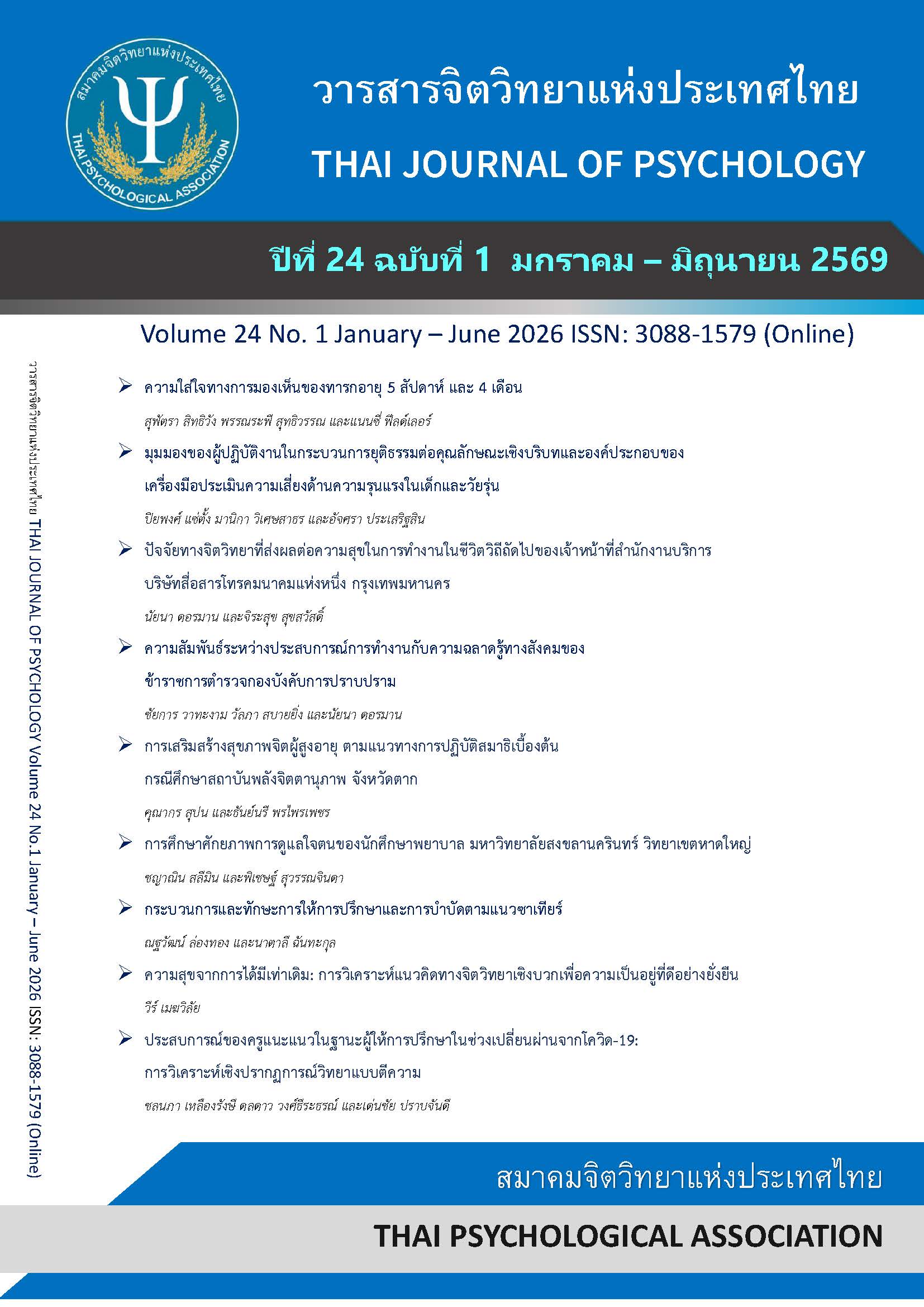
มุมมองของผู้ปฏิบัติงานในกระบวนการยุติธรรมต่อคุณลักษณะเชิงบริบทและองค์ประกอบของเครื่องมือประเมินความเสี่ยงด้านความรุนแรงในเด็กและวัยรุ่น
คำสำคัญ:
เครื่องมือประเมิน, ความเสี่ยงต่อการใช้ความรุนแรง, เด็กและวัยรุ่นบทคัดย่อ
งานวิจัยนี้มีวัตถุประสงค์เพื่อศึกษามุมมองของผู้ปฏิบัติงานในกระบวนการยุติธรรมต่อคุณลักษณะ
เชิงบริบทและองค์ประกอบของเครื่องมือประเมินความเสี่ยงด้านความรุนแรงในเด็กและวัยรุ่น อาศัยระเบียบ
วิธีวิจัยเชิงคุณภาพแบบปรากฏการณ์วิทยาเก็บข้อมูลด้วยวิธีการสัมภาษณ์เชิงลึกกับผู้เชี่ยวชาญที่มีประสบการณ์ทำงานกับเด็กและวัยรุ่นที่มีพฤติกรรมรุนแรงไม่น้อยกว่า 5 ปี จำนวน 5 คน ด้วยเทคนิค Snowball วิเคราะห์ข้อมูลโดยใช้วิธีการวิเคราะห์แก่นสาระ ผลการวิจัยสรุปเป็น 5 แก่นสาระ ได้แก่ (1) ความหมายของความรุนแรง (2) สถานการณ์การใช้เครื่องมือประเมินความเสี่ยงต่อการใช้ความรุนแรง (3) ความสำคัญและจำเป็นในการใช้เครื่องมือเพื่อคัดกรองและบำบัดฟื้นฟูพฤติกรรมรุนแรงของเด็กและวัยรุ่น (4) คุณลักษณะของเครื่องมือประเมินความเสี่ยงด้านความรุนแรงในเด็กและวัยรุ่นที่สอดคล้องกับความต้องการตามบริบทของผู้ปฏิบัติงานในกระบวนการยุติธรรม และ (5) องค์ประกอบของความรุนแรง ผลการศึกษานี้ทำให้ได้แนวทางสำหรับพัฒนามาตรวัดที่มีคุณลักษณะและองค์ประกอบตรงกับความต้องการของผู้ใช้งานและสอดคล้องกับบริบทสังคมไทย
เอื้อประโยชน์ต่อการนำไปใช้ในทางปฏิบัติโดยเฉพาะในงานด้านจิตวิทยาในกระบวนการยุติธรรม
เอกสารอ้างอิง
กัญญ์ฐิตา ศรีภา. (2562). จิตวิทยาอาชญากรรม การวิเคราะห์พฤติกรรมอาชญากรรม ความผิดปกติทางจิต และการฆาตกรรม. ภูมิการพิมพ์
กรมพินิจและคุ้มครองเด็กและเยาวชน. (ม.ป.ป.). รายงานสถิติคดีประจำปี 2567. https://www.djop.go.th/storage/files/2/สถิติประจำปี/stat-2567.pdf
คณะกรรมการวิชาชีพสาขาจิตวิทยาคลินิก. (2557). มาตรฐานการประกอบโรคศิลปะสาขาจิตวิทยาคลินิก. บริษัทอาร์ตคลอลิไฟท์จํากัด.
วัลลี ธรรมโกสิทธิ์. (2550). ความตรงของแบบประเมินความเสี่ยงต่อการเกิดความรุนแรง: HCR-20. วารสารสุขภาพจิตแห่งประเทศไทย, 15(2), 101-109.
หวาน ศรีเรือนทอง, ธรณินทร์ กองสุข, สุพัตรา สุขาวห, ทรงพล โลดทนงค์, และจินตนา ลี้จงเพิ่มพูน. (2559).
การพัฒนาแบบประเมินระดับความรุนแรงของพฤติกรรมก่อความรุนแรงในผู้ป่วยจิตเวชที่มีอาการรุนแรง. วารสารสมาคมจิตแพทย์แห่งประเทศไทย, 60(3), 253-266.
Beck, A. T., & Pretzer, J. (2005). A Cognitive Perspective on Hate and Violence. In R. J. Sternberg (Ed.), The psychology of hate (pp. 67–85). American Psychological Association.
Blair, R. J. R. (2018). Traits of empathy and anger: implications for psychopathy and other disorders associated with aggression. Philosophical Transactions of the Royal Society B: Biological Sciences, 373(1744), 20170155.
Chereji, S. V., Pintea, S., & David, D. (2012). The relationship of anger and cognitive distortions with violence in violent offenders’ population: A meta-analysis review. The European Journal of Psychology Applied to Legal Context, 4(1), 59.
de Vogel, V., & de Vries Robbé, M. (2016). Adapting risk assessment tools to new jurisdictions.
In Singh, J.P., Bjørkly, S. & Fazel (eds). International perspectives on violence risk assessment, pp.26-39. Oxford University Press.
Hamby, S. (2017). On defining violence, and why it matters [Editorial]. Psychology of Violence, 7(2), 167–180.
Hardin, K. M., Contreras, I. M., Kosiak, K., & Novaco, R. W. (2022). Anger rumination and imagined violence as related to violent behavior before and after psychiatric hospitalization. Journal of Clinical Psychology, 78(9), 1878-1895.
Heleniak, C., Bolden, C. R., McCabe, C. J., Lambert, H. K., Rosen, M. L., King, K. M., Monahan,
K. C., & McLaughlin, K. A. (2021). Distress Tolerance as a Mechanism Linking Violence Exposure to Problematic Alcohol use in Adolescence. Research on child and adolescent psychopathology, 49(9), 1211–1225.
Helfritz-Sinville, L. E., & Stanford, M. S. (2014). Hostile attribution bias in impulsive and premeditated aggression. Personality and individual differences, 56, 45-50.
Howitt, D. (2016). Introduction to qualitative research methods in psychology. Pearson UK.
Katembu, S., Zahedi, A., & Sommer, W. (2023). Childhood trauma and violent behavior in adolescents are differentially related to cognitive-emotional deficits. Frontiers in
public health, 11, 1001132.
Lee, B. X., Donnelly, P. D., Cohen, L., & Garg, S. (2016). Violence, health, and the 2030 agenda: merging evidence and implementation. Journal of public health policy, 37, 1-12.
Nakcharoen, U., Yunibhand, J., & Chaiyawat, W. (2012). The Thai Violence Risk Scale (TVRS) persons with schizophrenia: Development and initial validation. Chulalongkorn Medical Journal, 56(6), 699-718.
Neller, D. J., & Fabian, J. M. (2006). Trauma and its contribution to violent behaviour.
Criminal Justice Matters, 66(1), 6-7.
Rodriguez, C. M., Russa, M. B., & Kircher, J. C. (2015). Analog assessment of frustration tolerance: Association with self-reported child abuse risk and physiological reactivity. Child abuse & neglect, 46, 121-131.
Sanmontree, W., & Wongupparaj, P. (2023). The Short-Term Assessment of Risk and Treatability Scale: Reliability and Validity in a Thai Forensic Psychiatric Inpatient Setting. The Journal of Behavioral Science, 18(1), 84-99.
Santos, K. D. S., Ribeiro, M. C., Queiroga, D. E. U. D., Silva, I. A. P. D., & Ferreira, S. M. S. (2020). The use of multiple triangulations as a validation strategy in a qualitative study. Ciencia & saude coletiva, 25, 655-664. doi:10.1590/1413-81232020252.12302018
Sheldon, K. & Howells, K. (2017). Assessment of Violence and Homicide. In. Browne, K.D., Beech, A.R., Craig, L.A. & Chou, S. (Eds). Assessments in Forensic Practice. (pp.28-51). John Wiley & Sons.
Sturmey, P., & Lindsay, W. R. (2017). Case formulation and risk assessment. Assessments. In. Browne, K.D., Beech, A.R., Craig, L.A. & Chou, S. (Eds). Assessments in Forensic Practice. (pp.5-27). John Wiley & Sons.
Wang, Y., Cao, S., Dong, Y., & Xia, L. X. (2019). Hostile attribution bias and angry rumination:
A longitudinal study of undergraduate students. Plos one, 14(5), e0217759.
World Health Organization. (2021). Injuries and violence. https://www.who.int/news-room/fact-sheets/detail/injuries-and-violence
World Health Organization. (2020). Youth violence. https://www.who.int/news-room/fact-sheets/detail/youth-violence
ดาวน์โหลด
เผยแพร่แล้ว
รูปแบบการอ้างอิง
ฉบับ
ประเภทบทความ
สัญญาอนุญาต
ลิขสิทธิ์ (c) 2026 สมาคมจิตวิทยาแห่งประเทศไทย

อนุญาตภายใต้เงื่อนไข Creative Commons Attribution-NonCommercial-NoDerivatives 4.0 International License.
บทความที่ได้รับการตีพิมพ์เป็นลิขสิทธิ์ของสมาคมจิตวิทยาแห่งประเทศไทย
ข้อความที่ปรากฎในบทความแต่ละเรื่องในวารสารวิชาการเล่มนี้เป็นความคิดเห็นส่วนตัวของผู้เขียนแต่ละท่านไม่เกี่ยวข้องกับสมาคมจิตวิทยาแห่งประเทศไทย แต่อย่างใด ความรับผิดชอบองค์ประกอบทั้งหมดของบทความแต่ละเรื่องเป็นของผู้เขียนแต่ละท่าน หากมีความผิดพลาดใด ๆ ผู้เขียนแต่ละท่านจะรับผิดชอบบทความของตนเองแต่ผู้เดียว


