
The Relationship among Academic Innovative Behavior, Future Orientation and Self-control, and The Achievement Motivation in Learning of Undergraduate Students Kasem Bundit University
Keywords:
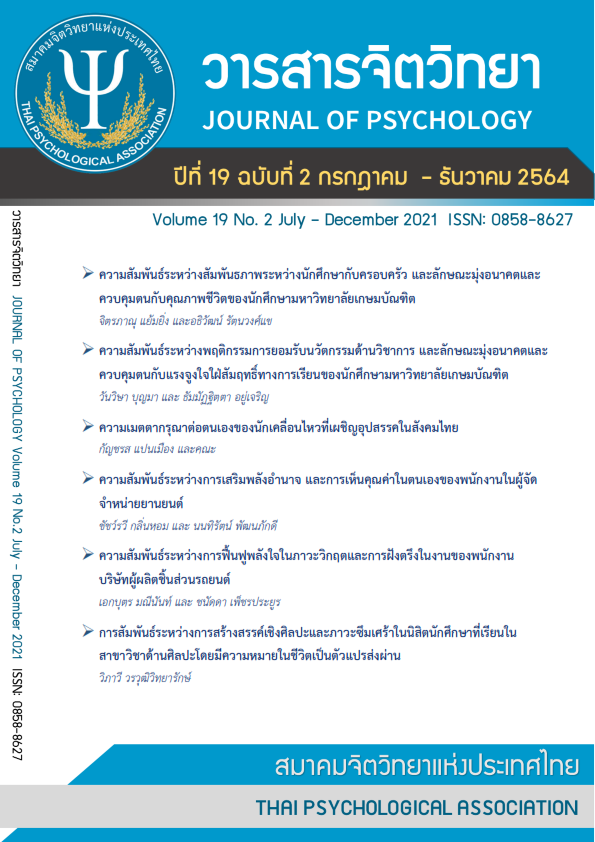
Academic innovative behavior, Future orientation, Self-control, Achievement motivation in learningAbstract
The objectives of this study were (1) to study the level of the achievement motivation in learning of undergraduate students (2) to compare the achievement motivation in learning of undergraduate students classified by personal factors consist of sex and college years and (3) to relationship between academic innovative behavior, future orientation and self-control and the achievement motivation in learning. Participants were 390 undergraduate students at Kasem Bundit University. Instrument was a questionnaire, consist of four parts: personal information, academic innovative behavior, future orientation and self-control, and the achievement motivation in learning. Data were analyzed using descriptive statistics, t-test for independent sample, One-way ANOVA , and Pearson’s Product Moment correlation coefficient. The results of this study indicated as follows: (1) Overall the achievement motivation in learning of the respondent was at a high level with an account for 3.82 percent (2) the respondent with different sex had not different the achievement motivation in learning (3) the respondent with different college years had not different the achievement motivation in learning (4) academic innovative behavior was positively related with the achievement motivation in learning with a statistical significance level of .01, with the correlation coefficient of .439 and (5) future orientation and self-control was positively related with the achievement motivation in learning with a statistical significance level of .01, with the correlation coefficient of .606
References
กระทรวงศึกษาธิการ. (2558). เกณฑ์มาตรฐานหลักสูตรระดับอุดมศึกษาพ.ศ. 2558 และเกณฑ์มาตรฐานที่เกี่ยวข้อง. วงศ์สว่างพับลิชชิ่ง แอนด์ พริ้นติ้ง.
เกริก ท่วมกลาง และจินตนา ท่วมกลาง. (2555). การพัฒนาสื่อ/นวัตกรรมทางการศึกษาเพื่อเลื่อนวิทยฐานะ (พิมพ์ครั้งที่ 1). สถาพรบุ๊คส์.
ณัฐสิมา แวงชัยภูมิ. (2557). สัมพันธภาพในครอบครัว สัมพันธภาพระหว่างนักศึกษากับอาจารย์ และสัมพันธภาพระหว่างเพื่อนที่ส่งผลต่อแรงจูงใจใฝ่สัมฤทธิ์ทางการเรียน
ของนักศึกษา. โครงงานพิเศษทางจิตวิทยา ศิลปศาสตรบัณฑิต. มหาวิทยาลัยเกษมบัณฑิต
เติมศักดิ์ คทวณิช (2559). จิตวิทยาทั่วไป (General Psychology). ซีเอ็ดยูเคชั่น.
ธัมมัฏฐิตตา อยู่เจริญ. (2557). พลวัตกลุ่มในองค์กร. เอกสารประกอบการสอนรายวิชา จว.409 พลวัตกลุ่มในองค์กร. มหาวิทยาลัยเกษมบัณฑิต.
ธิดารัตน์ คูหาพงศ์ และคณะ. (2558). แรงจูงใจใฝ่สัมฤทธิ์ทางการเรียนของนักศึกษาสถาบันการพลศึกษา. วิทยานิพนธ์ปริญญาดุษฎีบัณฑิต. สถาบันการพลศึกษา
วิทยาเขตกระบี่
นรินทร์ สังข์รักษา. (2552). การศึกษาความสัมพันธ์ระหว่างมโนภาพแห่งตนกับผลสัมฤทธิ์ทางการเรียนของนักศึกษา. วารสารศิลปากรศึกษาศาสตร์วิจัย, 1(1), 16-21.
นุชลี อุปภัย. (2555). จิตวิทยาการศึกษา (พิมพ์ครั้งที่ 2). กรุงเทพฯ: โรงพิมพ์แห่งจุฬาลงกรณ์มหาวิทยาลัย.
เนาวรัตน์ พลายน้อย และศุภวัลย์ พลายน้อย. (2532). การยอมรับนวัตกรรมที่ดำเนินการในโครงการอีสานสีเขียว : ศึกษากรณีการส่งเสริมปลูกยางพารา. (รายงานวิจัย).
มหาวิทยาลัยมหิดล.
พัศรินท์ ก่อเลิศวรพงศ์ และคณะ. (2559). การศึกษาแรงจูงใจใฝ่สัมฤทธิ์ของนักศึกษาคณะมนุษยศาสตร์และสังคมศาสตร์ มหาวิทยาลัยราชภัฏสวนดุสิต. วารสารร่มพฤกษ์
มหาวิทยาลัยเกริก,34(3), 35-54.
มลิวัลย์ อัมรัตน์. (2558). ปัจจัยที่เกี่ยวข้องกับแรงจูงใจใฝ่สัมฤทธิ์ทางการเรียนของนักศึกษาคณะจิตวิทยา มหาวิทยาลัยเกษมบัณฑิต. โครงงานพิเศษทางจิตวิทยาศิลป
ศาสตรบัณฑิต. มหาวิทยาลัยเกษมบัณฑิต
มหาวิทยาลัยเกษมบัณฑิต. (2562). เกี่ยวกับมหาวิทยาลัย. สืบค้นเมื่อ 12 มีนาคม 2564 ,จาก http://www.kbu.ac.th/home/about_kbu.php.
มารยาท โยทองยศ และปราณี สวัสดิสรรพ์. (2551). การกำหนดขนาดของกลุ่มตัวอย่างเพื่อการวิจัย. สืบค้นเมื่อ 2 เมษายน 2564, จาก
http://dspace.nstru.ac.th:8080/dspace/bitstream/123456789/1580/3/เอกสารหมายเลข2.pdf
วรทัศน์ วัฒนชีวโนปกรณ์. (2555). ปัจจัยเชิงเหตุทางจิตและสังคมที่เกี่ยวข้องกับพฤติกรรมใฝ่รู้ใฝ่ดีของนักศึกษาระดับปริญญาตรี. (ปริญญานิพนธ์ปริญญามหาบัณฑิต).
มหาวิทยาลัยศรีนครินทร์วิโรฒ
วรรธตรี ผาสุกใจ. (2556). ปัจจัยที่ส่งผลต่อแรงจูงใจใฝ่สัมฤทธิ์ทางการเรียนของนักศึกษคณะจิตวิทยา มหาวิทยาลัยเกษมบัณฑิต ภาคเรียนที่ 2 ปีการศึกษา 2556. โครง
งานพิเศษทางจิตวิทยาศิลปศาสตรบัณฑิต. มหาวิทยาลัยเกษมบัณฑิต
สำนักงานเลขาธิการสภาการศึกษา. (2560). แผนการศึกษาแห่งชาติพ.ศ. ๒๕๖๐ – ๒๕๗๙ (พิมพ์ครั้งที่ 1). พริกหวานกราฟฟิค.
สำนักงานสถิติแห่งชาติ. (2555). เทคนิคการเลือกสุ่มกลุ่มตัวอย่างและการประมาณค่า. สืบค้นเมื่อ 2 เมษายน 2564, จาก
http://service.nso.go.th/nso/nsopublish/Toneminute/files/55/A3-16.pdf.
สุนิดา ตากสินลา. (2559). ปัจจัยที่เกี่ยวข้องกับแรงจูงใจใฝ่สัมฤทธิ์ทางการเรียนของนักศึกษาคณะจิตวิทยา มหาวิทยาลัยเกษมบัณฑิต. โครงงานพิเศษทางจิตวิทยาศิลป
ศาสตรบัณฑิต. มหาวิทยาลัยเกษมบัณฑิต
สุพัตตรา แก้วพิชิต. (2548). แรงจูงใจใฝ่สัมฤทธิ์ทางการเรียนของนักศึกษามหาวิทยาลัยราชภัฏจันทรเกษม. ปริญญานิพนธ์ปริญญามหาบัณฑิต. มหาวิทยาลัยศรีนครินทร์
วิโรฒ
อัญชนา กลิ่นเทียน และจรัญ แสนราช. (2557). ปัจจัยที่มีผลต่อแรงจูงใจใฝ่สัมฤทธิ์ทางการเรียนของนักศึกษาระดับปริญญาตรีสาขาวิชาเกี่ยวกับการผลิตสื่อดิจิตอล แอนิ
เมชั่น มัลติมีเดีย และเกมส์. วารสารวิชาการนวัตกรรมสื่อสารสังคม, 2(1), 25-39.
Published
How to Cite
Issue
Section
License
Copyright (c) 2021 Thai Psychological Association

This work is licensed under a Creative Commons Attribution-NonCommercial-NoDerivatives 4.0 International License.
บทความที่ได้รับการตีพิมพ์เป็นลิขสิทธิ์ของสมาคมจิตวิทยาแห่งประเทศไทย
ข้อความที่ปรากฎในบทความแต่ละเรื่องในวารสารวิชาการเล่มนี้เป็นความคิดเห็นส่วนตัวของผู้เขียนแต่ละท่านไม่เกี่ยวข้องกับสมาคมจิตวิทยาแห่งประเทศไทย แต่อย่างใด ความรับผิดชอบองค์ประกอบทั้งหมดของบทความแต่ละเรื่องเป็นของผู้เขียนแต่ละท่าน หากมีความผิดพลาดใด ๆ ผู้เขียนแต่ละท่านจะรับผิดชอบบทความของตนเองแต่ผู้เดียว



