
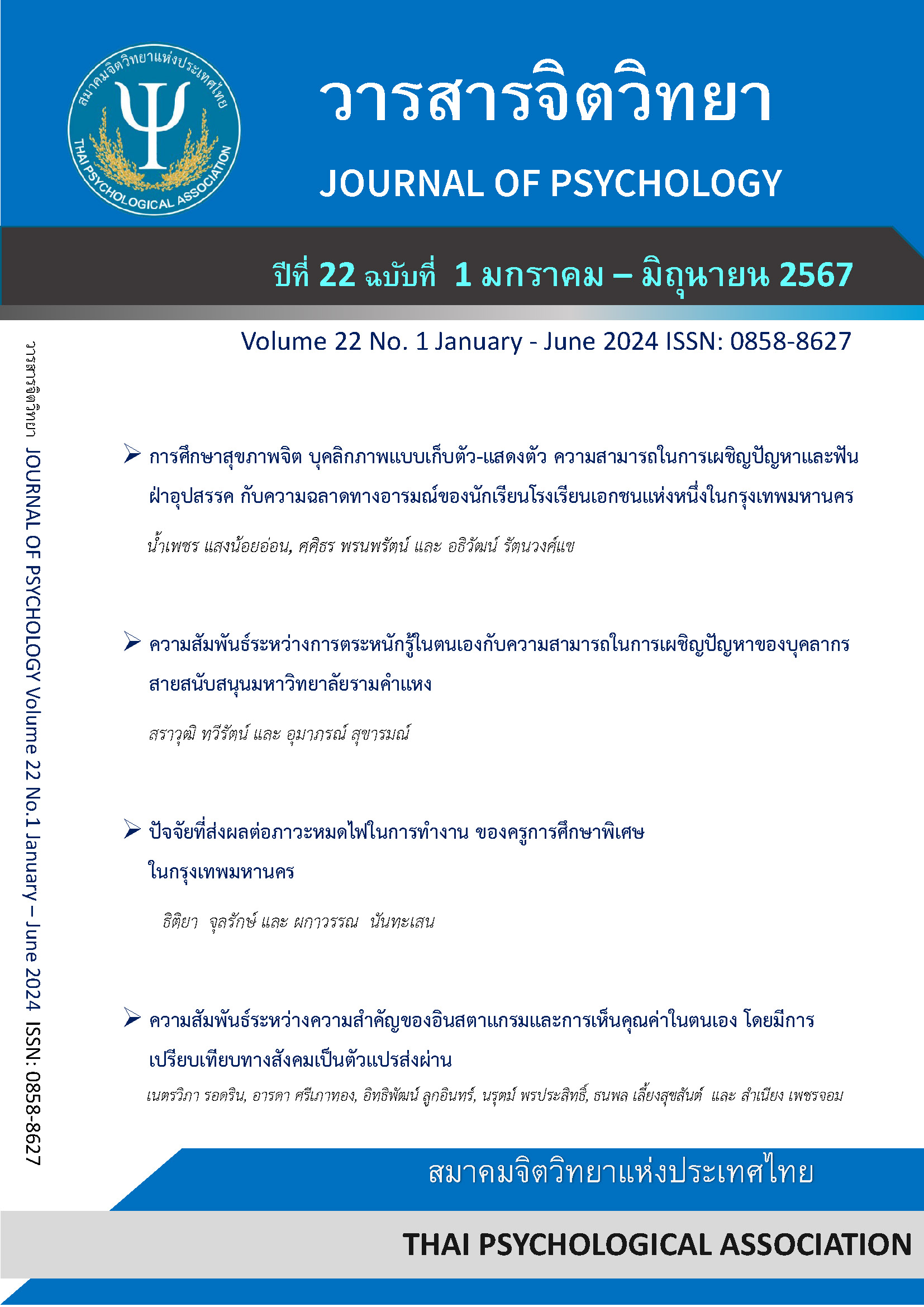
Factors affecting burnout among special education teachers in Bangkok.
Keywords:
burnout, social support, self-efficacy, special education teachersAbstract
Abstract
The objectives of this research were to: 1) study the level of burnout in special education teachers, 2) compare burnout in special education teachers with different personal factors, 3) study the relationship between self-efficacy perception and burnout in special education teachers, and 4) study the relationship between social support and burnout in special education teachers. The sample consisted of 189 special education teachers in Bangkok in the academic year 2023. Data was collected using a questionnaire. The statistics used for analysis were percentage, mean, standard deviation, t-test, One-way ANOWA, and Pearson’s correlation coefficient, with the statistical significance level set at .05. The research results found that 1) the level of burnout in special education teachers was moderate. 2) Special education teachers with different genders, highest education level, monthly income, and duration of work did not differ significantly in burnout at the .05 level, while different ages had significantly different burnout at the .05 level. 3) Self-efficacy perception has a positive relationship with burnout in special education teachers. with Statistically significant level of .05 4) Social support has a positive relationship with burnout in special education teachers, with Statistically significant level of .05
References
เอกสารอ้างอิง
จิราพรรณ เบญญศรี และชุติมา หรุ่มเรืองวงษ์.(2556). ความเครียดและปัจจัยที่เกี่ยวข้องในครูที่สอนนักเรียนพิการทางการศึกษาระดับชั้นอนุบาลและประถมศึกษาในโรงเรียน สังกัดสำนักงานคณะกรรมการส่งเสริมการศึกษาเอกชน ในเขตกรุงเทพมหานคร. [ปริญญานิพนธ์ปริญญามหาบัณฑิต]. จุฬาลงกรณ์มหาวิทยาลัย.
ธนาภรณ์ ตั้งทองสว่าง. (2563). แรงสนับสนุนทางสังคมจากมหาวิทยาลัยในสถานการณ์โควิด-19 ของนักศึกษามหาวิทยาลัยศิลปากร วังท่าพระ.ภาควิชาจิตวิทยาและการแนะแนวคณะศึกษาศาสตร์มหาวิทยาลัยศิลปากร.
ปิยะวดี สุมาลัย. (2564). ภาวะหมดไฟในการทำงานของพยาบาลวิชาชีพ สถาบันบำราศนราดู. [ปริญญานิพนธ์ปริญญามหาบัณฑิต]. มหาวิทยาลัยพยาบาลพระจอมเกล้า เพชรบุรี.
ผดุง อารญะวิญญู และดารณี ศักดิ์ศิริผล. (2544). การเรียนร่วมระหว่างเด็กปกติกับเด็กที่มีความต้องการพิเศษ. กรุงเทพมหานคร. สำนักพิมพ์แว่นแก้ว.
พัชราภรณ์ สิณัตพัฒนะศุข และ ธนาสิทธ์ วิจิตราพันธ์. (2564). ปัจจัยเสี่ยงของภาวะหมดไฟในการทำงานของบุคลากรโรงพยาบาลสันป่าตอง จังหวัดเชียงใหม่. วารสารวิชาการสาธารณสุข, 31(1), 113-124.
พัสกร แนวประณีต, พูลพงศ์ สุขสว่าง และสุชาดา กรเพชรปาณ. (2556). ความสัมพันธ์เชิงสาเหตุระหว่างการรับรู้ความสามารถของตนเองกับความเหนื่อยล้าในการปฏิบัติงานของอาจารย์โรงเรียนสาธิต. [ปริญญานิพนธ์ปริญญามหาบัณฑิต]. มหาวิทยาลัยบูรพา.
ภูเมธ แก้วเขียว. (2556). การศึกษาระดับความเครียดและประสิทธิภาพการทำงานของครูการศึกษาพิเศษในเขตกรุงเทพมหานคร. [ปริญญานิพนธ์ปริญญามหาบัณฑิต]. มหาวิทยาลัยราชภัฏสวนดุสิต.
ลัญฉน์ศักดิ์ อรรฆยากร. (2566). ภาวะหมดไฟ (Burnout syndromes). สืบค้นเมื่อ 30 มิถุนายน 2567, จาก https://www.medparkhospital.com/lifestyles/burnout-syndrome.
วชิรญาณ์ มณีวรรณ และ อภิธีร์ ทรงบัณฑิตย์. (2565). ปัจจัยที่ส่งผลต่อภาวะหมดไฟของครูในสถานศึกษา สำนักงานเขตพื้นที่การศึกษามัธยมศึกษากรุงเทพมหานคร เขต 2. [ปริญญานิพนธ์ปริญญามหาบัณฑิต]. มหาวิทยาลัยศรีนครินทรวิโรฒ.
โสภาวรรณ พรหมโยธิน. (2565). ภาวะหมดไฟในการทำงานของพนักงานในกลุ่มสถาบันเฉพาะกิจ ในเขตกรุงเทพมหานครและปริมณฑล. [ปริญญานิพนธ์ปริญญามหาบัณฑิต]. มหาวิทยาลัยมหิดล.
Bandura, A. (2004). Self-efficacy: The exercise of control. New York: W.H. Freeman and Company.
Bousquet, S. (2012). Teacher Burnout: Causes, Cures and Prevention. American International College.
Busch, T., Fallan, L., & Pettersen, A. (1998). Disciplinary differences in job satisfaction, self-efficacy, goal commitment, and organizational commitment among faculty employees in Norwegian colleges: An empirical assessment of indicators of performance. Quality of Higher Education, 4, 137–157.
Cohen, S., & Wills, A. (1985). Stress, social support and the buffering hypothesis. Psychological Bulletin, 98, 310-357.
Hinsz, V. B. (2005). Mood, gender, and situational influences on risk-taking advice for others. Social Behavior and Personality: An International Journal, 33(1), 1–10. https://doi.org/10.2224/sbp.2005.33.1.1
Maslach, C , Schaufeli, W. B. , & Leiter, M. P. (2001). Job burnout. Annual Review of Psychology, 52(1), 397-422.
Ryan, R. M., & Deci, E. L. (2000). Self-determination theory and the facilitation of intrinsic motivation, social development, and well-being. American Psychologist, 55(1), 68–78. https://doi.org/10.1037/0003-066X.55.1.68
Super, Donald E. and Crites, John O. (1968 ). Appraising Vocational Fitness. Delhi Universal Book Stall.
Szabo, E. (2019). Teacher burnout in the light of workplace, organizational, and social factors. Hungarian Educational Research Journal, 9(3), 1-21.
DOI:10.1556/063.9.2019.3.44
Downloads
Published
How to Cite
Issue
Section
License
Copyright (c) 2025 Thai Psychological Association

This work is licensed under a Creative Commons Attribution-NonCommercial-NoDerivatives 4.0 International License.
บทความที่ได้รับการตีพิมพ์เป็นลิขสิทธิ์ของสมาคมจิตวิทยาแห่งประเทศไทย
ข้อความที่ปรากฎในบทความแต่ละเรื่องในวารสารวิชาการเล่มนี้เป็นความคิดเห็นส่วนตัวของผู้เขียนแต่ละท่านไม่เกี่ยวข้องกับสมาคมจิตวิทยาแห่งประเทศไทย แต่อย่างใด ความรับผิดชอบองค์ประกอบทั้งหมดของบทความแต่ละเรื่องเป็นของผู้เขียนแต่ละท่าน หากมีความผิดพลาดใด ๆ ผู้เขียนแต่ละท่านจะรับผิดชอบบทความของตนเองแต่ผู้เดียว



