
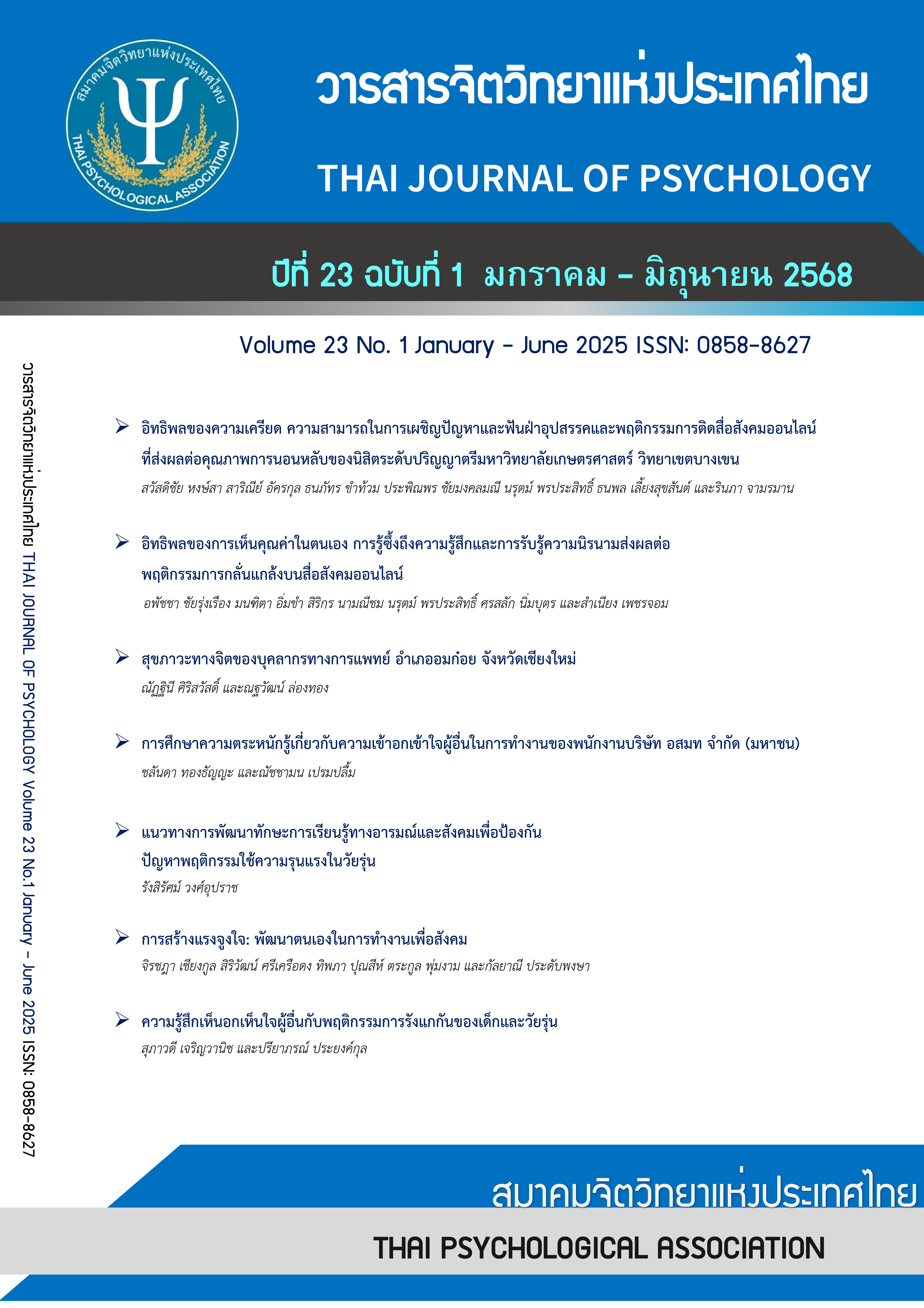
The Impact of Stress, Adversity quotient and Social media addiction behaviors on Sleep quality of undergraduate students Kasetsart University, Bang Khen
Keywords:
Stress, Adversity quotient, Social media addiction, Sleep qualityAbstract
The good quality sleep is crucial for health, especially for undergraduates facing academic stress and other activities, which can affect their sleep qualities. The factors influencing sleep quality include both internal and external factors, such as stress, sleep environment, daily activities, etc. Poor sleep quality can negatively impact memory skills, unstable emotions, lead to social relationship-building skill problems. In terms of physical health, it can result in issues such as exhaustion, heart problems and a weakened immune system. These effects can interfere with the daily activities of students and the general public. This study investigated the influence of stress, adversity quotient and social media addiction behaviors on sleep quality among 18 years and older, Kasetsart University, Bang Khen Campus students, with a sample size of 176 participants by accidental sampling. The research instruments are questionnaires including 1) Personal information 2) Stress assessment
3) Adversity Quotient; AQ 4) Social media addiction behaviors and 5) Thai version of the Pittsburgh sleep quality index; T-PSQI, with reliability coefficients ranging from .883 to .964. Data was gathered through self-administered offline questionnaires and analyzed by Multiple Linear Regression with an Enter method. The results indicated that stress had a positive effect on sleep quality (β = .366, p < .001), while Adversity quotient (β = -.514, p < .001) and social media addiction (β = -.204, p = .006) had a negative effect. The coefficient of determination (R²) was .503. The coefficient of determination (R²) was .503. The sleep quality prediction formula model was Ẑ = .37(stress) – .51(Adversity quotient) - .20(social media addiction behavior). All independent variables were able to predict sleep quality by 50.3 percent.
The results are consistent with the hypothesis regarding stress and adversity quotient (AQ) variables, while the social media addiction behavior variable did not align with the established hypothesis. Therefore, further research should explore the influence and relationships between social media addiction behavior with other variables related to sleep quality to address this issue in future studies.
References
เอกสารอ้างอิง
กนกรัตน์ สุขะตุงคะ. (2537). ความเครียด-คลายเครียด. วารสารจิตวิทยาคลินิก. 25 (1), 7-15.
กรมสุขภาพจิต. (2541, 2 มีนาคม). ความเครียดและสุขภาพจิตของคนไทย. กระทรวงสาธารณสุข.
https://dmh.go.th/news/view.asp?id=2301
ขวัญธิดา พิมพการ. (2564). การเปรียบเทียบปัจจัยที่มีผลต่อคุณภาพการนอนหลับของนักศึกษามหาวิทยาลัยสายสุขภาพและสายอาชีพ. วารสารการวัดผลการศึกษา. 38(104), 258-271.
คำจันทร์ ร่มเย็น และ สุทิศา โขงรัมย์. (2018). ศึกษาปัจจัยที่ส่งผลต่อความสามารถในการเผชิญปัญหาและการฝ่าฟันอุปสรรค (AQ) ของนักศึกษาระดับปริญญาตรี ชั้นปีที่ 1 คณะครุศาสตร์ มหาวิทยาลัยราชภัฏบุรีรัมย์. วารสารวิชาการ มหาวิทยาลัยราชภัฎบุรีรัมย์ (สาขามนุษยศาสตร์และสังคมศาสตร์), 10 (1), 47-58. https://so02.tci-thaijo.org/index.php/bruj/article/view/144770
จิตรลดา สมประเสริฐ, วารุณี ผ่องแผ้ว, ดวงทิพย์ อนันต์ศุภมงคล, และ นฤมล พรหมภิบาล. (2565). ผลของ
โปรแกรมการจัดการความเครียดและคุณภาพการนอนหลับของนิสิตพยาบาล. วารสารพยาบาล, 71(2), 19-27.
จุฑารัตน์ ศราวณะวงศ์, ขจร ฝ้ายเทศ, ดวงแก้ว เงินพูนทรัพย์ และ วัลลภา จันทรดี. (2560).
พฤติกรรมการใช้สื่อสังคมออนไลน์ของนิสิตระดับปริญญาตรี มหาวิทยาลัยเกษตรศาสตร์. วารสารบรรณศาสตร์ มศว. 10(2), 17-31.
จำลอง ดิษยวณิช, พริ่มเพรา ดิษยวณิช (2545). ความเครียด ความวิตกกังวล และสุขภาพ. คณะแพทยศาสตร์ มหาวิทยาลัยเชียงใหม่
จรัญญา ศรีวิชัย, ฉัตรพิมล ธนูศรี, ณิชกานต์ แสงจันทร์, ธิตยา ยิ้มเป็นยวง, ปรียาภรณ์ สิมกิ่ง, สุทธิรักษ์ บุบผาวงษ์, สุพรรษา อินจำนง, และลักษ์ขณา พานิชสวรรค์ (2562). ศึกษาความสัมพันธ์ความเครียดและคุณภาพการนอนหลับของนักเรียนพยาบาลทหารอากาศ ปีการศึกษา 2561. แพทยสารทหารอากาศ.65 (3), 37-44
ชาญวิทย์ พรนภดล และ คณะ. (2556). แบบทดสอบการติดสื่อสังคมออนไลน์: Social Media Addiction. http://www.cumentalhealth.com/index.php?lay=show&ac=article&Id=539909352
โชติมา วัฒนะ. (2564). พฤติกรรมการใช้สื่อสังคมออนไลน์ของนิสิตระดับปริญญาตรีมหาวิทยาลัยศรีนคริน
ทรวิโรฒ. วารสารบรรณศาสตร์ มศว. 14(2), 1-12.
ไชยรัตน์ บุตรพรหม. (2545). ปัจจัยที่มีผลต่อพฤติกรรมการติดอินเตอร์เน็ตของวัยรุ่นในเขตกรุงเทพมหานคร
[วิทยานิพนธ์ปริญญามหาบัณฑิตไม่ได้ตีพิมพ์] จุฬาลงกรณ์มหาวิทยาลัย.
ดารัสนี โพธารส. (2560). ปัจจัยที่มีความสัมพันธ์กับคุณภาพการนอนหลับของนิสิตพยาบาล. วารสารคณะพยาบาลศาสตร์ มหาวิทยาลัยบูรพา. 25(1), 25-36
นพดล ตรีประทีปศิลป์ และ ศิริลักษณ์ ผลศิริปฐม. (16 มีนาคม 2566). 5 คุณประโยชน์ของการนอนที่ดี (Surprising Reasons to Get More Sleep). มหาวิทยาลัยมหิดล คณะแพทยศาสตร์ศิริราชพยาบาล ศูนย์การแพทย์กาญจนาภิเษก. https://www.gj.mahidol.ac.th/main/knowledge-
/surprising-reasons-to-get-more-sleep/
บุญวดี เพชรรัตน์. (2532). ความเครียด ภาวะวิกฤต และการช่วยเหลือ. ภาควิชาการพยาบาลจิตเวช คณะพยาบาลศาสตร์ มหาวิทยาลัยสงขลานครินทร์
ปริวันท์ ลำพูล. (2558). ความสามารถในการเผชิญปัญหาและฟันฝ่าอุปสรรค ความเหนื่อยหน่ายในงานและผล
การปฏิบัติงานของพนักงานวิศวกร บริษัทอสังหาริมทรัพย์แห่งหนึ่ง [วิทยานิพนธ์ปริญญามหาบัณฑิตไม่ได้ตีพิมพ์]. มหาวิทยาลัยธรรมศาสตร์.
ปรีดี นุกุลสมปรารถนา. (4 มีนาคม 2567). รวมสถิติและ Insight สำคัญๆของคนไทยกับการใช้ Digital และ Social Media 2024. popticles.com. https://www.popticles.com/insight/thailand-digital-and-social-media-stats-2024/
ปาหนัน บุญหลง. (2539). สาเหตุและกลไกเจ็บป่วยทางจิต. การพยาบาลจิตเวช.กองงานวิทยาลัย สำนักงานปลัดกระทรวงสาธารณสุข.
พรรณพิมล วิปุลากร. (19 เมษายน 2561). เตือนเล่นมือถือก่อนนอนทำสุขภาพแย่.
https://www.hfocus.org/content/2018/04/15690
พิชญา สุรพลชัย. (2566). โครงการสำรวจพฤติกรรมสุขภาพของนิสิตนักศึกษาในมหาวิทยาลัย. สถาบันวิจัย
สังคม จุฬาลงกรณ์
ไพลิน จันทดิษฐ, พนิดา ศกุนตนาค และ สุรชัย มีชาญ. (2564). การพัฒนาแบบวัดความสามารถในการเผชิญ
ปัญหาและฟันฝ่าอุปสรรคสำหรับนักเรียนชั้นมัธยมศึกษาปีที่ 3. วารสารวิจัยทางการศึกษา คณะศึกษาศาสตร์ มหาวิทยาลัยศรีนครินทรวิโรฒ. 16(1). 39-54.
มนตรี สังข์ทอง, กานต์พิชชา แตงอ่อน และ ประภาส กลับนวล. (2013). ปัจจัยที่สัมพันธ์กับความสามารถในการเผชิญและฝ่าฟันอุปสรรคของนักศึกษา มหาวิทยาลัยเทคโนโลยีราชมงคลสุวรรณภูมิ. วารสารสมาคมวิจัย, 18 (1), 97-108.
มณฑิรา เหมือนจันทร์. (2563). พฤติกรรมการติดโซเชียลมีเดียและความภาคภูมิใจในตนเองของนักเรียน
มัธยมศึกษาตอนปลายในอำเภอหาดใหญ่ [วิทยานิพนธ์ปริญญามหาบัณฑิตไม่ได้ตีพิมพ์]. จุฬาลงกรณ์มหาวิทยาลัย.
ราชบัณฑิตยสถาน. (2542, 1 มีนาคม). พจนานุกรม ฉบับราชบัณฑิตยสถาน. https://dictionary.orst.go.th
โรงพยาบาลราชวิถี. (2564). 7 สาเหตุนอนไม่หลับและเคล็ดลับแก้ไข. โรงพยาบาลราชวิถี. https://www.rajavithi.go.th/rj/?p=4122#:~:text=%E0%B8%A7%E0%B8%B4%E0%B8%98%E0%B8%B5%E0%B9%81%E0%B8%81%E0%B9%89%E0%B8%9B%E0%B8%B1%E0%B8%8D%E0%B8%AB%E0%B8%B2%E0%B8%AD%E0%B8%B2%E0%B8%81%E0%B8%B2%E0%B8%A3%E0%B8%99%E0%B8%AD%E0%B8%99,%E0%B8%9C%E0%B9%88%E0%B8%AD%E0%B8%99%E0%B8%84%E0%B8%A5%E0%B8%B2%E0%B8%A2%20%E0%B8%81%E0%B8%B2%E0%B8%A3%E0%B9%81%E0%B8%8A%E0%B9%88%E0%B8%99%E0%B9%89%E0%B8%B3%E0%B8%AD%E0%B8%B8%E0%B9%88%E0%B8%99
สมบัติ ตาปัญญา. (2526). คู่มือคลายเครียด: ความรู้เรื่องความเครียด การป้องกันและแก้ไข. เหรียญบุญ
การพิมพ์.
ศิครินทร์. (ม.ป.ป.). Social Addition ผลกระทบชีวิตติดโซเชียล. https://www.sikarin.com/health/
social-addiction
Åkerstedt, T., Orsini, N., Petersen, H., Axelsson, J., Lekander, M., & Kecklund, G. (2012). Predicting sleep quality from stress and prior sleep – A study of day-to-day covariation across sixweeks. Sleep Medicine, 13(6), 674–679. https://doi.org/10.1016/j.sleep.2011.12.013
Alonzo, R., Hussain, J., Stranges, S., & Anderson, K. K. (2021). Interplay between Social Media Use, Sleep Quality, and Mental Health in Youth: a Systematic Review. Sleep Medicine Reviews, 56(101414), 101414. https://doi.org/10.1016/j.smrv.2020.101414
Andreassen, C. S., Pallesen, S., & Griffiths, M. D. (2016). The relationship between addictive use of social media, narcissism, and self-esteem: Findings from a large national survey. Addictive Behaviors, 64, 287–293.
https://doi.org/10.1016/j.addbeh.2016.03.006
Bassett, S. M., Lupis, S. B., Gianferante, D., Rohleder, N., & Wolf, J. M. (2015). Sleep quality but not sleep quantity effects on cortisol responses to acute psychosocial stress. Stress, 18(6), 638–644. https://doi.org/10.3109/10253890.2015.1087503
Beck, A. T. (1976). Cognitive therapy and the emotional disorders. International Universities Press.
Charles, L. E., Slaven, J. E., Mnatsakanova, A., Ma, C., Violanti, J. M., Fekedulegn, D., Andrew, M. E., Vila, B. J., & Burchfiel, C. M. (2011). Association of perceived stress with sleep duration and sleep quality in police officers. PubMed.
https://pubmed.ncbi.nlm.nih.gov/22900457
Cheung, L. M., & Wong, W. S. (n.d.). The effects of insomnia and internet addiction on
depression in Hong Kong Chinese adolescents: An exploratory cross-sectional analysis.
Choompunuch, B., Suksatan, W., Sonsroem, J., Kutawan, S., & In-Udom, A. (2021). Stress, adversity quotient, and health behaviors of undergraduate students in a Thai university during COVID-19 outbreak. Belitung Nursing Journal, 7(1), 1–7.
https://doi.org/10.33546/bnj.1276
Cohen, J. (1977) Statistical Power Analysis for the Behavioral Sciences. Revised Edition, Academic Press, New York.
Faul, F., Erdfelder, E., Lang, A., & Buchner, A. (2007). G*Power 3: A flexible statistical power analysis program for the social, behavioral, and biomedical sciences. Behavior Research Methods, 39(2), 175–191. https://doi.org/10.3758/bf03193146
Garett, R., Liu, S., & Young, S. D. (2016). The relationship between social media use and sleep quality among undergraduate students. Information Communication & Society, 21(2), 163–173. https://doi.org/10.1080/1369118x.2016.1266374
Kim, J., LaRose, R., & Peng, W. (2009). Loneliness as the Cause and the Effect of Problematic Internet Use: The Relationship between Internet Use and Psychological Well-Being. CyberPsychology & Behavior, 12(4), 451–455. https://doi.org/10.1089/cpb.2008.0327
Kou, G. (2024). Longitudinal study on the impact of social media on loneliness and Psychological well-being. Lecture Notes in Education Psychology and Public Media, 41(1), 37–42. https://doi.org/10.54254/2753-7048/41/20240692
Levenson, J. C., Shensa, A., Sidani, J. E., Colditz, J. B., & Primack, B. A. (2016). The association between social media use and sleep disturbance among young adults. Preventive Medicine, 85, 36–41. https://doi.org/10.1016/j.ypmed.2016.01.001
Lima, R. A., De Barros, M. V. G., Santos, M. a. M. D., Machado, L., Bezerra, J., & Soares, F. C. (2019). The synergic relationship between social anxiety, depressive symptoms, poor sleep quality and body fatness in adolescents. Journal of Affective Disorders, 260, 200–205. https://doi.org/10.1016/j.jad.2019.08.074
Lin, S., Liao, W., Chen, M., & Fan, J. (2012). The impact of shift work on nurses’ job stress, sleep quality and self-perceived health status. Journal of Nursing Management, 22(5), 604–612. https://doi.org/10.1111/jonm.12020
Maithani, T., Prabhu, S., & Pant, S. (2024). Daytime-sleepiness, factors affecting sleep and sleep-quality among professional college students of South India - A correlative study. Clinical Epidemiology and Global Health, 26. https://doi.org/10.1016/j.cegh.2024.101534
Monacis, L., de Palo, V., Griffiths, M. D., & Sinatra, M. (2017). Social networking addiction, attachment style, and validation of the Italian version of the Bergen Social Media Addiction Scale. Journal of Behavioral Addictions, 6(2), 178–186. https://doi.org/10.1556/2006.6.2017.023
Weinstein, A., & Lejoyeux, M. (2010). Internet Addiction or Excessive Internet Use. The American Journal of Drug and Alcohol Abuse, 36(5), 277–283. https://doi.org/10.3109/00952990.2010.491880
Yun, H. J. (2016). Effect of Stress and Sleep Quality on Mental Health of Adolescents. Journal of the Korean Society of School Health, 29(2), 98–106. https://doi.org/10.15434/
kssh.2016.29.2.98
Published
How to Cite
Issue
Section
License
Copyright (c) 2025 Thai Psychological Association

This work is licensed under a Creative Commons Attribution-NonCommercial-NoDerivatives 4.0 International License.
บทความที่ได้รับการตีพิมพ์เป็นลิขสิทธิ์ของสมาคมจิตวิทยาแห่งประเทศไทย
ข้อความที่ปรากฎในบทความแต่ละเรื่องในวารสารวิชาการเล่มนี้เป็นความคิดเห็นส่วนตัวของผู้เขียนแต่ละท่านไม่เกี่ยวข้องกับสมาคมจิตวิทยาแห่งประเทศไทย แต่อย่างใด ความรับผิดชอบองค์ประกอบทั้งหมดของบทความแต่ละเรื่องเป็นของผู้เขียนแต่ละท่าน หากมีความผิดพลาดใด ๆ ผู้เขียนแต่ละท่านจะรับผิดชอบบทความของตนเองแต่ผู้เดียว



