
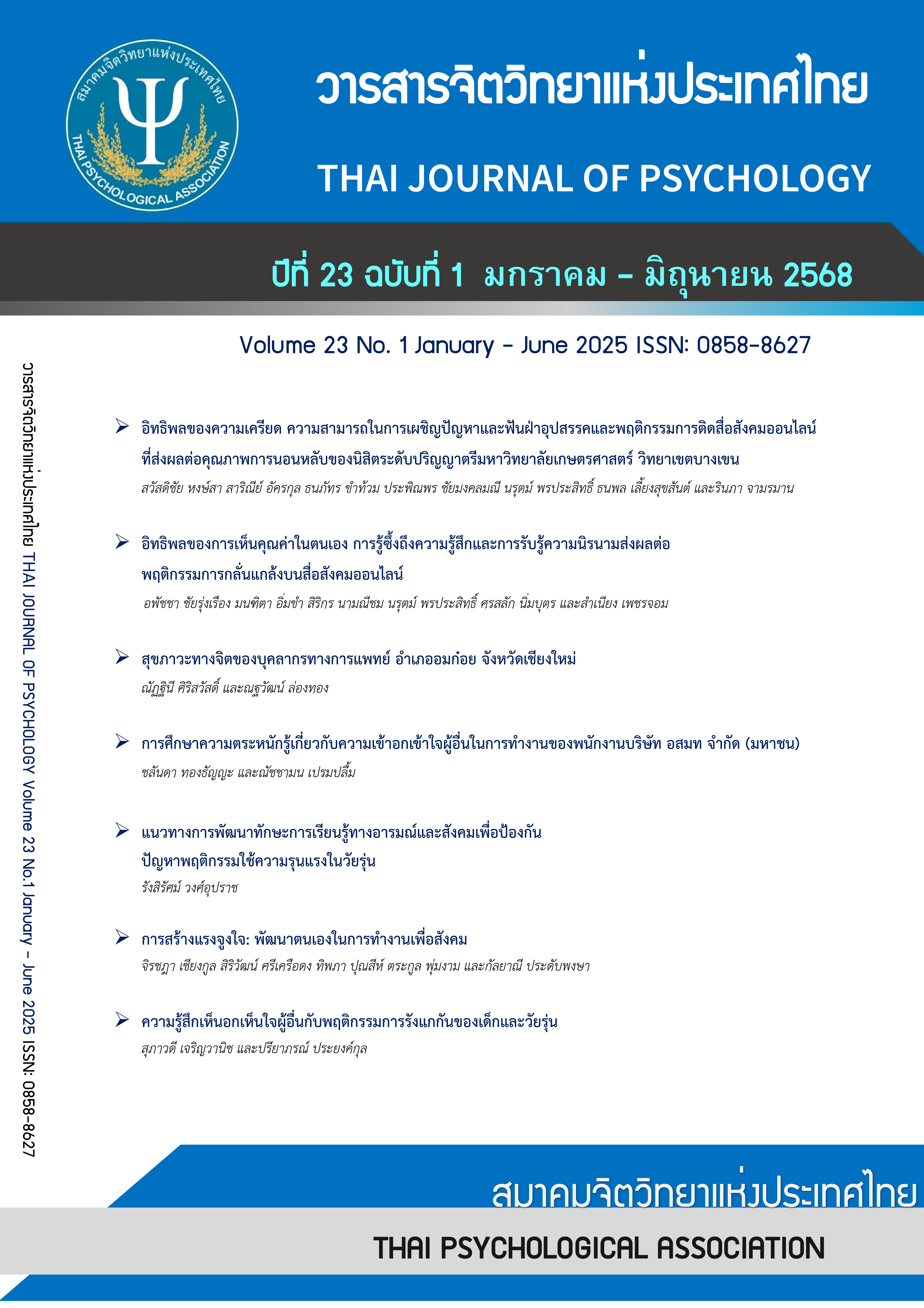
Empathy and bullying behavior of children and adolescents
Keywords:
Empathy, Child and Adolescent , Bullying BehaviorAbstract
When talking about behavioral problems of students, bullying is one of the big problems of students. Bullying has been found in students in every generation. Nowadays, technology and social media have a greater impact on students' lives. It makes the bullying behavior of students more dramatic, even physical bullying, verbal bullying, social bullying, and cyberbullying. Bullying leads students to several consequence problems, including physical health problems, psychological problems, and behavioral problems.
These problems might have a long-term impact on students’ lives.
Empathy is one of the most important factors that can help reduce bullying behavior in students. Therefore, this article was written for every related person to help them understand more about empathy and how to promote it in students. The authors believe that when students have empathy, they act respectfully toward others. That can help to prevent and reduce the number of new bullies and victims.
References
เอกสารอ้างอิง
กรมสุขภาพจิต. (2563, 10 มกราคม). บูลลี่ไม่ใช่เรื่องเด็ก ๆ ความรุนแรงที่รอวันปะทุ. สืบค้นเมื่อ 19 มกราคม 2568, จาก https://dmh.go.th
กรมสุขภาพจิต. (2564, 19 กุมภาพันธ์). บูลลี่ (Bully) คืออะไร มีกี่ประเภท วิธีที่จะรับมือจากการโดนบูลลี่. สืบค้นเมื่อ 19 มกราคม 2568, จาก https://dmh.go.th/news-dmh/view.asp?id=30612
คณะจิตวิทยา จุฬาลงกรณ์มหาวิทยาลัย. (2566, 11 มกราคม). การเสวนาทางจิตวิทยา (PSY Talk) เรื่อง ตีโจทย์ปัญหาการ Bully: เจ็บที่ไม่จบ ผลกระทบของการ Bully. สืบค้นเมื่อ 19 มกราคม 2568, จากhttps://www.psy.chula.ac.th/th/feature-articles/psy-talk-2023-bullying/
พงษ์สุดา ป้องสีดา. (2564). ความชุกของการรังแกกันและปัจจัยด้านครอบครัวที่เกี่ยวข้องในนักเรียนระดับชั้นประถมศึกษาตอนปลายและมัธยมศึกษา จังหวัดน่าน. เชียงรายเวชสาร, 13(2), 102-119. https://he01.tci-thaijo.org/index.php/crmjournal/article/view/249930
สุชาดา ทวีสิทธิ์. (2567, 25 มีนาคม). โครงการศึกษาสถานการณ์การรังแกในเยาวชนไทยและการพัฒนาโปรแกรมออนไลน์เพื่อสร้างเสริมความแข็งแกร่งทางจิตใจของเยาวชนและป้องกันปัญหาการรังแกในโรงเรียน. สืบค้นเมื่อ 22 เมษายน 2568, จาก https://ipsr.mahidol.ac.th/post_research/proj-6701080/
Adams, J., & Hannum, E. C. (2012). Under attack: A multilevel analysis of peer victimization in rural Chinese middle schools.
Agustiningsih, N., Yusuf, A., Ahsan, Q. F., & Fanani, Q. (2024). The impact of bullying and cyberbullying on mental health: A systematic review. International Journal of Public Health Science, 13(2), 513-520.
American Psychological Association (2023, June 1). Bullying. Retrieved January 19, 2025, from https://www.apa.org/topics/bullying#:~:text=Bullying%20is%20a%20form%20of,another%20person%20injury%20or%20discomfort.
Anti-Bullying Alliance. (2024, November 29). Our definition of bullying. https://anti-bullyingalliance.org.uk.
Aprilia, S. D., Prasetya, H., & Murti, B. (2023). Meta-analysis: Effect of bullying on the risk of suicide in adolescents. Journal Maternal and Child Health, 8(2), 138-147.
Azevedo Da Silva, M., & Martins, S. S. (2020). Mutual Influences on bullying perpetration and substance use among adolescents in the United States. The Journal of Adolescent Health: Official Publication of the Society for Adolescent Medicine, 67(3), 384–391. https://doi.org/10.1016/j.jadohealth.2020.04.027
Batson, C. D., Lishner, D. A., & Stocks, E. L. (2014). The empathy-altruism hypothesis. In Oxford handbooks online. Oxford University Press p.1-27.
Bi, X., & Wang, S. (2021). Parent-adolescent communication quality and life satisfaction: The mediating roles of autonomy and future orientation. Psychology Research and Behavior Management, 14, 1091–1099. https://doi.org/10.2147/PRBM.S317389
Bogart, L. M., Elliott, M. N., Klein, D. J., Tortolero, S. R., Mrug, S., Peskin, M. F., Davies, S. L., Schink, E. T., & Schuster, M. A. (2014). Peer victimization in fifth grade and health in tenth grade. Pediatrics, 133(3), 440–447. https://doi.org/10.1542/peds.2013-3510
Bosnjakovic, J., & Radionov, T. (2018). Empathy: Concepts, theories and neuroscientific basic. Alcoholism and Psychiatry Research, 54, 123-150. https://doi:10.2047/dec.2018.54.02.04.
Chan, T. K., Cheung, C. M., & Lee, Z. W. (2021). Cyberbullying on social networking sites: A literature review and future research directions. Information & Management, 58(2), 103411.
Chui, W. H., & Chan, H. C. O. (2015). Self-control, school bullying perpetration, and victimization among Macanese adolescents. Journal of Child and Family Studies, 24, 1751-1761.
Cho, S. (2018). The impact of low self-control and delinquent peer associations on bullying perpetration and victimization among South Korean adolescents: Time-concurrent, time-lagged, and latent growth curve modeling. Journal of School Violence, 17(4), 500-520.
Copeland, W., E., Wolke, D., Lereya, S., TShanahan, L., Worthman, C., & Costello, E., J. (2014). Childhood bullying involvement predicts low-grade systemic inflammation into adulthood. Proceedings of the National Academy of Sciences of the United States of America 111(21), 7570-7575
Decety, J., & Holvoet, C. (2021). The emergence of empathy: A developmental neuroscience perspective. Developmental Review, 62, 100999.
Decety, J., & Jackson, P. (2004). The functional architecture of human empathy. Behavioral and Cognitive Neuroscience Reviews, 3(2), 71-100.
Del Rey, R., Lazuras, L., Casas, J. A., Barkoukis, V., Ortega-Ruiz, R., & Tsorbatzoudis, H. (2016). Does empathy predict (cyber)bullying perpetration, and how do age, gender and nationality affect this relationship?. Learning and Individual Differences, 45, 275-281.
deLara, E. W. (2022). Family bullying in childhood: Consequences for young adults. Journal of Interpersonal violence, 37(3-4), NP2206-NP2226.
Developing Minds. (2024). Children and teen’s ability to detect emotions in other-How it happens and why it matters. https://developingminds.net.au/articles-for-professionals/2024/8/14/childrens-ability-to-detect-emotions-in-others-how-it-happens-and-why-it-matters
Doehne, M., von Grundherr, M., & Schäfer, M. (2018). Peer influence in bullying: The autonomy‐enhancing effect of moral competence. Behavior, 44(6), 591-600.
Ehrlich, K., B., Miller, G., E., & Chen, E., C. (2016). Childhood adversity and adult physical health. In D. Cicchetti (Ed.), Developmental psychopathology risk resilience, and intervention. (pp. 1–42). Hoboken, NJ: John Wiley & Sons.
Eisenberg, N. (1989). Empathy and related emotional responses. San Francisco, CA: Jossey-Bass.
Elena, L. (2020). Study related to the empathy among young generation. Ovidius University Annals, Series Physical Education and Sport/Science, Movement and Health, 20, 247-254.
Espelage, D. L., Hong, J. S., Kim, D. H., & Nan, L. (2018, February). Empathy, attitude towards bullying, theory-of-mind, and non-physical forms of bully perpetration and victimization among US middle school students. Child & Youth Care Forum, 47, 45-60.
Espejo-Siles, R., Zych, I., & Llorent, V. J. (2020). Empathy, social and emotional competencies, bullying perpetration and victimization as longitudinal predictors of somatic symptoms in adolescence. Journal of Affective Disorders, 271(15), 145-151.
Fenichel, O. (1945). The psychoanalytic theory of neurosis. New York: Norton.
Fredrickson, B., L., & Cohn, M., A. (2008). Positive emotions. In Handbook of emotions, (3rd ed., pp. 777–796).
Fourie, C. (2012). What is social equality? An analysis of status equality as a strongly egalitarian ideal. Research Publication, 18(2), 107-126.
Fourie, C., Schuppert, F., & Wallimann-Helmer, I. (Eds.). (2015). Social equality: On what it means to be equals. Oxford University Press.
Gardella, J. H., Fisher, B. W., & Teurbe-Tolon, A. R. (2017). A systematic review and meta-analysis of cyber-victimization and educational outcomes for adolescents. Review of Educational Research, 87(2), 283-308. https://doi.org/10.3102/0034654316689136.
Gini, G., & Pozzoli, T. (2009). Association between bullying and psychosomatic problems: A meta-analysis. Pediatrics, 123(3), 1059–1065. https://doi.org/10.1542/peds.2008-1215
Hanson, R. F., Sawyer, G. K., Begle, A. M., & Hubel, G. S. (2010). The impact of crime victimization on quality of life. Journal of Traumatic Stress, 23(2), 189-197. https://doi.org/10.1002/jts.20508.
Hawley, P. H. (1999). The ontogenesis of social dominance: A strategy-based evolutionary perspective. Developmental Review, 19(1), 97-132.
Heilmann, A., Mehay, A., Watt, R. G., Kelly, Y., Durrant, J. E., van Turnhout, J., & Gershoff, E. T. (2021). Physical punishment and child outcomes: A narrative review of prospective studies. The Lancet, 398(10297), 355–364. https://doi.org/10.1016/S0140-6736(21)00582-1
Hoffman, M. (2000). Empathy and moral development: Implications for caring and justice. New York: Cambridge University Press.
Husserl, E. (1962). Phänomenologische Psychologie. Martinus Nijhoff.
Jaskulska, S., Jankowiak, B., Pérez-Martínez, V., Pyżalski, J., Sanz-Barbero, B., Bowes, N., ... & Silva, E. (2022). Bullying and cyberbullying victimization and associated factors among adolescents in six European countries. Sustainability, 14 (21), 14063.
Jeffrey, D. (2016). Clarifying empathy: The first step to more humane clinical care. British Journal of General Practice, 66(643), e143-e145.
Karaman, F., Saygin Şahin, B., Yerebakan Şen, A. N., Rashidi, M., Şen Yilmaz, M., Kocadereli, A., & Ustaoğlu, A. (2024). Development of an empathy scale in nurses. BMC Nursing, 23(1), 1-6.
Kennedy, R. S., Dendy, K., & Lawrence, A. (2024). Trends in traditional bullying and cyberbullying victimization by race and ethnicity in the United States: A meta-regression. Aggression and Violent Behavior, 101958.
Kohut, H. (2010). On empathy. International Journal of Psychoanalytic Self Psychology, 2, 122-131.
Kontopanos, G. (2024). Impact of social media on adolescents and young adults' empathy: A literature review. Annals of the Al. I. Cuza University, Psychology Series, 33.
Lee, N., Ray, J. V., & Peck, J. H. (2023). Examining the mediating role of peer antisocial behavior on the relationship between parenting and bullying behaviors. Journal of Crime and Justice, 46(3), 348-368.
Lereya, S. T., Copeland, W. E., Costello, E. J., & Wolke, D. (2015). Adult mental health consequences of peer bullying and maltreatment in childhood: Two cohorts in two countries. The lancet. Psychiatry, 2(6), 524–531. https://doi.org/10.1016/S2215-0366(15)00165-0
Li, J. J. (2018). Children's reward and punishment sensitivity moderates the association of negative and positive parenting behaviors in child ADHD symptoms. Journal of Abnormal Child Psychology, 46(8), 1585–1598. https://doi.org/10.1007/s10802-018-0421-y
Li, X., Huebner, E. S., & Tian, L. (2021). Vicious cycle of emotional maltreatment and bullying perpetration/victimization among early adolescents: Depressive symptoms as a mediator. Social Science & Medicine, 291, 114483.
Liddle, M. J. E., Bradley, B. S., & Mcgrath, A. (2015). Baby empathy: Infant distress and peer prosocial responses. Infant Mental Health Journal, 36(4), 446-458.
Litvack-Miller, W., McDougall, D., & Romney, D. M. (1997). The structure of empathy during middle childhood and its relationship to prosocial behavior. Genetic, Social, and General Psychology Monographs, 123(3), 303-325.
Lyer-Eimerbrink, P. A., & Jensen-Campbell, L. A. (2019). The long-term consequences of peer victimization on physical and psychological health: A longitudinal study. Journal of Applied Biobehavioral Research, 68, 87-93.
Malti, T., Peplak, J., & Zhang, L. (2020). The development of respect in children and adolescents. Monographs of the Society for Research in Child Development, 85(3), 7–99. https://doi.org/10.1111/mono.12417
Mead, G., H. (1934). Mind, self, and society. University of Chicago Press.
Menefee, D. S., Ledoux, T., & Johnston, C. A. (2022). The importance of emotional regulation in mental health. American Journal of Lifestyle Medicine, 16(1), 28-31.
Mitsopoulou, E., & Giovazolias, T. (2015). Personality traits, empathy, and bullying behavior: A meta-analytic approach. Aggression and Violent Behavior, 21, 61-72.
Moore, S. E., Norman, R. E., Suetani, S., Thomas, H. J., Sly, P. D., & Scott, J. G. (2017). Consequences of bullying victimization in childhood and adolescence: A systematic review and meta-analysis. World Journal of Psychiatry, 7(1), 60-76. https://doi.org/10.5498/wjp.v7.i1.60
Mullins, C., & Panlilio, C. (2023). Adversity, engagement, and later achievement: The role of emotional regulation and parent-child relationship quality. Children and Youth Services Review, 148.
Ng, Z. J., Willner, C. J., Hoffmann, J. D., Bailey, C. S., Mack, V., Brackett, M. A., & Cipriano, C. (2025). Development of the student emotion regulation assessment (SERA) for children and adolescents in grades 1–12. Social and Emotional Learning: Research, Practice, and Policy, 5, 100104.
Noorden, V. T., Haselager, G. J. T., Cillessen, A. H. N., & Bukowski, W. M. (2015). Empathy and involvement in bullying in children and adolescents: A systematic review. Journal of Youth and Adolescence, 44, 637–657.
O’Grady, A. M., & Nag, S. (2024). Promoting emotion understanding in middle childhood: A systematic review of school-based SEL programs. Social and Emotional Learning: Research, Practice, and Policy, 100068.
Olweus, D. (1994). Bullying at school: Basic facts and effects of a school-based intervention program. Journal of Child Psychology and Psychiatry, 37(7), 1171–1190.
Paley, B., & Hajal, N. J. (2022). Conceptualizing emotion regulation and coregulation as family-level phenomena. Clinical Child and Family Psychology Review, 25(1), 19-34. https://doi.org/10.1007/s10567-022-00378-4
Palmer, A. R., Labella, M., Plowman, E., J., Foster, R., & Maston, A. S. (2020). Parental emotional regulation strategies and parenting quality predict child internalizing symptoms in families experiencing homelessness. Social Development, 29(3), 732-749.
Passini, S., & Melotti, A. B. G. (2012). Risk and protective factors on perpetration of bullying and cyberbullying. Studia Edukacyjne, 23, 33–55.
Powell, P. A., & Roberts, J. (2017). Situational determinants of cognitive, affective, and compassionate empathy in naturalistic digital interactions. Computers in Human Behavior, 68, 137-148.
Quinn, S. T., & Stewart, M. C. (2018). Examining the long-term consequences of bullying on adult substance use. American Journal of Criminal Justice, 43, 85-101.
Raina, R. (2022). Moving crisis to opportunities: A corporate perspective on the impact of compassionate empathic behaviour on the well-being of employees. International Journal of Global Business and Competitiveness, 17(2), 239-255.
Reedy, A. R. (2018). Raising a Secure Child: How circle of security parenting can help you nurture your child’s attachment, emotional resilience, and freedom to explore. Journal of Baccalaureate Social Work, 23(1), 311-313.
Rigby, K. (2003). Addressing bullying in schools: Theory and practice. Trends & Issues in Crime & Criminal Justice, 259.
Ringwald, W. R., & Wright, A. G. C. (2020). The affiliative role of empathy in everyday interpersonal interactions. European Journal of Personality, 35(2), 197–211. https://doi.org/10.1002/per.2286
Rowe, A. D., & Fitness, J. (2018). Understanding the role of negative emotions in adult learning and achievement: A social functional perspective. Behavioral sciences, 8(2), 27.
Sagi, A., & Hoffman, M. L. (1976). Empathic distress in the newborn. Developmental Psychology, 12(2), 175.
Sharp, S., Smith, P. K., & Smith, P. (2002). School bullying: Insights and perspectives. Routledge.
Silkenbeumer, J., Luken, L., Holodynski, M., & Kartner, J. (2024). Emotional socialization in early childhood education and care-How preschool teachers support children’s emotional regulation. Social and Emotional Learning: Research, Practice, and Policy. https://doi.org/10.1016/j.sel.2024.100057
Smith, T. E., Bauerband, L. A., Aguayo, D., McCall, C. S., Huang, F. L., Reinke, W. M., & Herman,
K. C. (2022). School bullying and gender minority youth: Victimization experiences and perceived prevalence. School Psychology Review, 1-14.
Smolyaninova, O. G., Posokhova, S. T., & Izotova, M. K. (2020). The possibilities of empathy in preventing interpersonal conflicts in the educational environment of higher education institutions. Journal of Siberian Federal University, 13(2), 219–233.
Solberg, M. E., & Olweus, D. (2003). Prevalence estimation of school bullying with the Olweus Bully/Victim Questionnaire. Aggressive Behavior, 29(3), 239-268.
Sprung, M., Munch, H. M., Harris, P. L., Ebesutani, C., & Hofmann, S. G. (2015). Children’s emotion understanding: A meta-analysis of training studies. Developmental Review, 37, 41–65.
Tichener, E. B. (1909). Lectures on the experimental psychology of the thought-process. Macmillan.
Tsaousis, I. (2016). The relationship of self-esteem to bullying perpetration and peer victimization among schoolchildren and adolescents: A meta-analytic review. Aggression and Violent Behavior, 31, 186-199.
UNESCO. (2023). Prevention of violence and bullying in school: The global education monitoring report. https://www.unesco.org/gem-report/en/articles/prevention-violence-and-bullying-school.
UNESCO UIS. (2018, October 1). New SDG 4 data on bullying. Uis.Unesco.org. Retrieved April 21, 2025, from https://uis.unesco.org/en/news/new-sdg-4-data-bullying
UNICEF. (2024, July 1). Bullying. Retrieved April 22, 2025, from https://data.unicef.org/topic/child-protection/violence/bullying/
Van der Werf, C. (2014). The effects of bullying on academic achievement. Desarrollo y Sociedad, 74, 275-308.
Vervoort, M. H., Scholte, R. H., & Overbeek, G. (2010). Bullying and victimization among adolescents: The role of ethnicity and ethnic composition of school class. Journal of Youth and Adolescence, 39(1), 1–11. https://doi.org/10.1007/s10964-008-9355-y
Walters, G. D. (2021). School-age bullying victimization and perpetration: A meta-analysis of prospective studies and research. Trauma, Violence, & Abuse, 22(5), 1129-1139.
Walters, G. D., & Espelage, D. L. (2023). Mediating the pathway from bullying victimization to bullying perpetration with hostility, peer delinquency, and pro-bullying attitudes: Transforming victims into aggressors. Psychology of Violence, 13(3), 194.
Wei, H., Jonson-Reid, M., & Tsao, H. (2007). Bullying and victimization among Taiwanese 7th graders: A multi-method assessment. School Psychology International, 28, 479–500.
Weinstein, N., Huo, A., & Itzchakov, G. (2021). Parental listening when adolescents self-disclose: A preregistered experimental study. Journal of Experimental Child Psychology, 209, 105178.
Whittaker, E., & Kowalski, R. M. (2015). Cyberbullying via social media. Journal of School Violence, 14(1), 11-29.
Wiggers, M., & Paas, F. (2022). Harsh physical discipline and externalizing behaviors in children: A systematic review. International Journal of Environmental Research and Public Health, 19(21), 14385. https://doi.org/10.3390/ijerph192114385
Wolke, D., & Lereya, S. T. (2015). Long-term effects of bullying. Archives of Disease in Childhood, 100(9), 879-885.
Xu, M., Macrynikola, N., Waseem, M., & Miranda, R. (2020). Racial and ethnic differences in bullying: Review and implications for intervention. Aggression and Violent Behavior, 50, 101340. https://doi.org/10.1016/j.avb.2019.101340
Ye, Z., Wu, D., He, X., Ma, Q., Peng, J., Mao, G., Feng, L., & Tong, Y. (2023). Meta-analysis of the relationship between bullying and depressive symptoms in children and adolescents. BMC Psychiatry, 23(1), 215. https://doi.org/ 10.1186/s12888-023-04681-4
Zuo, Y. (2023). The association between parent-child relationship and emotional regulation. Journal of Education Humanities and Social Sciences, 22. 518-522.
Published
How to Cite
Issue
Section
License
Copyright (c) 2025 Thai Psychological Association

This work is licensed under a Creative Commons Attribution-NonCommercial-NoDerivatives 4.0 International License.
บทความที่ได้รับการตีพิมพ์เป็นลิขสิทธิ์ของสมาคมจิตวิทยาแห่งประเทศไทย
ข้อความที่ปรากฎในบทความแต่ละเรื่องในวารสารวิชาการเล่มนี้เป็นความคิดเห็นส่วนตัวของผู้เขียนแต่ละท่านไม่เกี่ยวข้องกับสมาคมจิตวิทยาแห่งประเทศไทย แต่อย่างใด ความรับผิดชอบองค์ประกอบทั้งหมดของบทความแต่ละเรื่องเป็นของผู้เขียนแต่ละท่าน หากมีความผิดพลาดใด ๆ ผู้เขียนแต่ละท่านจะรับผิดชอบบทความของตนเองแต่ผู้เดียว



