
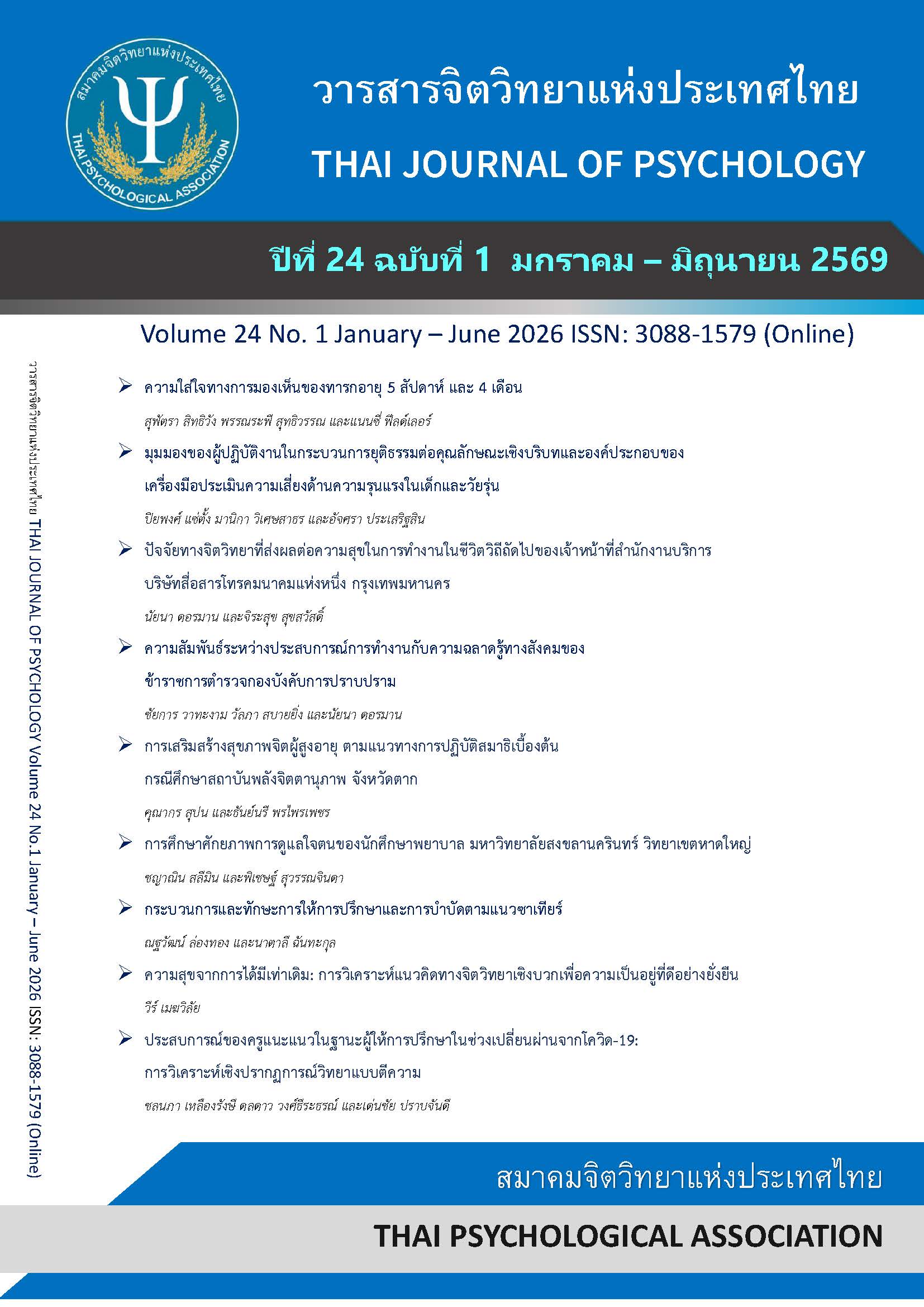
Psychological Factors Affecting Work Happiness in the Next Normal of Office Service Staffs at a Telecommunications Company in Bangkok
Keywords:
Positive psychological capital, Coping strategies, Happiness in work, Next normalAbstract
In this era where the work environment rapidly changes, especially within the context of the next normal. Maintaining happiness at work has gradually become
an important issue. The objectives of this study were to: (1) study the levels of positive psychological capital, coping strategies and work happiness in the next normal of office service staffs at a telecommunications company in Bangkok; and (2) create a predicting equation to predict work happiness in the next normal of office service staffs at
a telecommunications company in Bangkok. The sample was 169 office service staffs at
a telecommunications company in Bangkok. The sample size was determined by using
multi-stage sampling. The employed research instruments were positive psychological capital scale, problem-focused coping strategy scale, emotion-focused coping strategy scale, avoidance coping strategy scale and work happiness in the next normal scale with reliability coefficients of .90, .73, .60, .60 and .89, respectively. Data were statistically analyzed in
term of frequency, percentage, mean, standard deviation and multiple regression analysis.
The study findings revealed that: (1) positive psychological capital, problem-focused coping and work happiness in the next normal were at the highest level, while emotion-focused coping and avoidance coping were at a high level (2) positive psychological capital,
emotion-focused coping and avoidance coping had a statistically significant effect on
work happiness in the next normal at the .01 level. These variables collectively predicted 64% of the variance in work happiness in the next normal and the predictive equation
for work happiness in the next normal using standardized scores was shown as
Z'= .78X1 +.21X3 -.12X4.
References
ธนัชชา โสวรรณดิฐพร. (2566). กลวิธีการรับมือเพื่อลดผลกระทบที่ก่อให้เกิดความเจ็บปวดทางจิตใจจากความรุนแรงทางคำพูด ของวัยผู้ใหญ่ตอนต้นในเขตกรุงเทพมหานคร [วิทยานิพนธ์ปริญญา-มหาบัณฑิต ไม่ได้ตีพิมพ์]. มหาวิทยาลัยศรีนครินทรวิโรฒ.
นิพิฐพนธ์ สนิทเหลือ, วัชรีพร สาตร์เพ็ชร์, และญาดา นภาอารักษ์. (2562). การคำนวณขนาดตัวอย่างด้วยโปรแกรมสำเร็จรูป G*POWER. วารสารวิชาการ สถาบันเทคโนโลยีแห่งสุวรรณภูมิ, 5(1), 496–507.
พิรุฬห์พร เพียงพิมพ์. (2563) ปัจจัยทุนจิตวิทยาเชิงบวกที่ส่งผลต่อการหมดไฟในการทำงานของข้าราชการรุ่นใหม่ในสำนักการสอบสวนและนิติการ กรมการปกครอง (รายงานการศึกษาวิจัยรัฐประศาสนศาสตรมหาบัณฑิต ไม่ได้ตีพิมพ์). จุฬาลงกรณ์มหาวิทยาลัย.
รจิต พุ่มพฤกษ์. (2566). การศึกษาแนวทางเพื่อฟื้นฟูภาวะถดถอยทางการเรียนรู้ของนักเรียนระดับมัธยมศึกษาภายหลัง สถานการณ์การแพร่ระบาดของเชื้อไวรัสโควิด-19 ในภาวะปกติถัดไป [วิทยานิพนธ์ปริญญามหาบัณฑิต ไม่ได้ตีพิมพ์]. มหาวิทยาลัยศรีนครินทรวิโรฒ.
สำนักงานกองทุนสนับสนุนการสร้างเสริมสุขภาพ. (2552). แผนงานสุขภาวะองค์กรเอกชน. กรุงเทพฯ: สำนักงานกองทุนสนับสนุนการสร้างเสริมสุขภาพ (สสส.).
__________ (2552). องค์กรแห่งความสุข. http://www.happy8 workplace.com
สุภารัตน์ ศรีปฏิมากร. (2562). ความสัมพันธ์ระหว่างความสามารถในการเผชิญปัญหาและฟันฝ่าอุปสรรค การรับรู้การสนับสนุนจากองค์การ และความตั้งใจคงอยู่ในงานของพนักงาน โดยมีความสุขในการทำงานเป็นตัวแปรกำกับ [วิทยานิพนธ์ปริญญามหาบัณฑิต ไม่ได้ตีพิมพ์]. มหาวิทยาลัยธรรมศาสตร์.
Bandura, A. (1977). Self-efficacy: Toward a unifying theory of behavioral change. Psychological Review, 84(2), 191–215. https://doi.org/10.1037/0033-295X.84.2.191
Carver, C. S., Scheier, M. F., & Weintraub, J. K. (1989). Assessing coping strategies: A theoretically based approach. Journal of Personality and Social Psychology, 56(2), 267-283. https://doi.org/10.1037/0022-3514.56.2.267
Csikszentmihalyi, M. (1990). Flow: The psychology of optimal experience. Harper & Row.
Diener, E., & Biswas-Diener, R. (2008). Happiness: Unlocking the mysteries of psychological wealth. Blackwell Publishing.
Diener, E., & Myers, D. G. (2003). Subjective well-being: The science of happiness and life satisfaction. New York: Guilford Press.
Folkman, S., & Moskowitz, J. T. (2004). Coping: Pitfalls and promise. Annual Review of Psychology, 55, 745-774. https://doi.org/10.1146/annurev.psych.55.090902.141456
Lazarus, R. S., & Folkman, S. (1984). Stress, appraisal, and coping. Springer.
Locke, E. A. (1976). The nature and causes of job satisfaction. Handbook of industrial and organizational psychology, 1297-1343.
Luthans, F., & Avolio, B. (2003). Authentic leadership development. In K. S. Cameron, J. E. Dutton, &
R. E. Quinn (Eds.), Positive organizational scholarship (241–261). Barrett-Koehler.
Luthans, F., Youssef, C. M., & Avolio, B. J. (2007). Psychological capital: Developing the human competitive edge. Oxford University Press.
Manion J. (2003). Joy at work: Creating a positive workplace. Journal of nursing Administration, 652-659. https://doi.org/10.1097/00005110-200312000-00008
Masten, A. S. (2001). Ordinary magic: Resilience processes in development. American Psychologist, 56(3), 227-238. https://doi.org/10.1037/0003-066X.56.3.227
Rhett, H. W., & Lester, W. J. (2006). Why consumers use and do not use technology-enabled services. Journal of Services Marketing, 20(2), 125–135. https://doi.org/10.1108/08876040610657057
Schaufeli, W. B., Salanova, M., González-Romá, V., & Bakker, A. B. (2002). The measurement of engagement and burnout: A two sample confirmatory factor analytic approach. Journal of Happiness Studies, 3(1), 71-92. https://doi.org/10.1023/A:1015630930326
Seligman, M. E. P. (2006). Learned optimism: How to change your mind and your life. Vintage.
Snyder, C. R., Rand, K. L., & Sigmon, D. R. (1991). Hope theory: A member of the positive psychology family. In C. R. Snyder & D. R. Forsyth (Eds.), Oxford handbook of positive psychology (pp. 257–276). Oxford University Press.
Sonnentag, S., & Fritz, C. (2015). Recovery from job stress: The stressor-detachment model as an integrative framework. Journal of Organizational Behavior, 36(S1), S72–S103. https://doi.org/10.1002/job.1924
Warr, P. (1990). The psychology of happiness in the workplace. Cambridge University Press.
Downloads
Published
How to Cite
Issue
Section
License
Copyright (c) 2026 Thai Psychological Association

This work is licensed under a Creative Commons Attribution-NonCommercial-NoDerivatives 4.0 International License.
บทความที่ได้รับการตีพิมพ์เป็นลิขสิทธิ์ของสมาคมจิตวิทยาแห่งประเทศไทย
ข้อความที่ปรากฎในบทความแต่ละเรื่องในวารสารวิชาการเล่มนี้เป็นความคิดเห็นส่วนตัวของผู้เขียนแต่ละท่านไม่เกี่ยวข้องกับสมาคมจิตวิทยาแห่งประเทศไทย แต่อย่างใด ความรับผิดชอบองค์ประกอบทั้งหมดของบทความแต่ละเรื่องเป็นของผู้เขียนแต่ละท่าน หากมีความผิดพลาดใด ๆ ผู้เขียนแต่ละท่านจะรับผิดชอบบทความของตนเองแต่ผู้เดียว



