
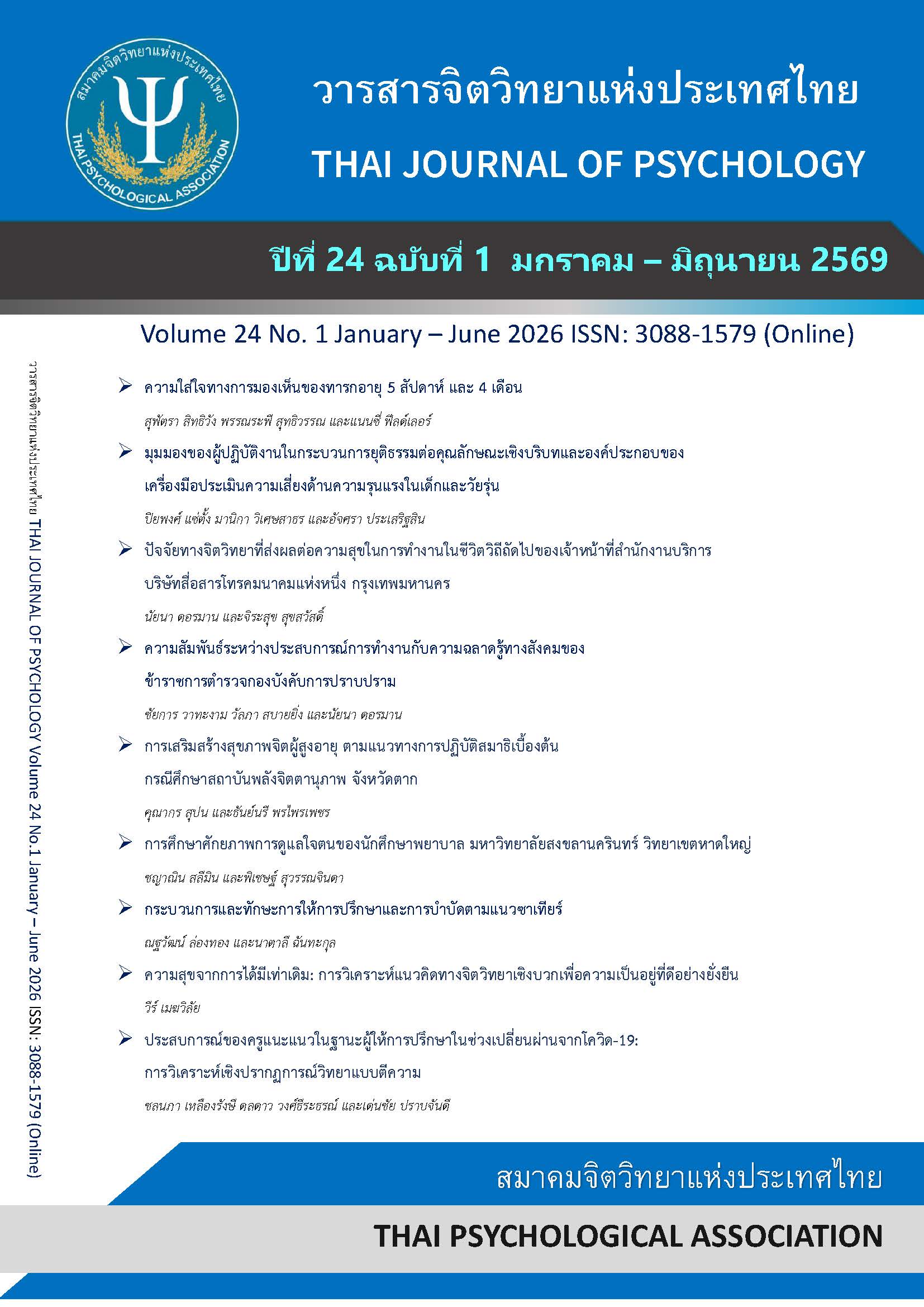
Visual Attention Ability in 5-Week-Old and 4-Month-Old Infants
Keywords:
Visual attention, infants, alerting network, orienting network, neurodevelopmentAbstract
Visual attention plays a crucial role in an infant's perception and development, especially during the first year of life. This visual attention system consists of three key networks: the alerting network, the orienting network, and the executive control network.
This study aimed to examine the relationship between visual attention in the alerting and orienting networks in 5-week-old infants and visual attention in the orienting network in
4-month-old infants. The participants were 137 infants with prenatal exposure to pesticides, as part of the "SAWASDEE Project" in Chiang Mai, Thailand. The research instruments used were the NICU Network Neurobehavioral Scale (NNNS) and the Visual Habituation Task. The findings obtained by hierarchical regression analysis revealed a significant negative correlation between visual attention in the alerting network at 5 weeks and visual attention in the orienting network at 4 months (β = -0.31, p < .01). However, no significant correlation was found between visual attention in the orienting network at 5 weeks and visual attention in the orienting network at 4 months. This discrepancy may reflect the developmental timing of the orienting network, which is still immature at 5 weeks and becomes more functionally established around
3 to 4 months of age. These findings suggest that well-developed visual attention in
the alerting network may serve as a crucial foundation for the development of visual attention in the orienting network, which helps direct infants' focus and enables them to concentrate on relevant stimuli.
References
Barbaro, K., Clackson, K., & Wass, S. V. (2017). Infant attention is dynamically modulated with changing arousal levels. Child Development, 88(2), 629–639. https://doi.org/10.1111/cdev.12689
Bornstein, M. H. (2018). The SAGE Encyclopedia of Lifespan Human Development. SAGE Publications, Inc. https://doi.org/10.4135/9781506307633
Burstein, O., Zevin, Z., & Geva, R. (2021). Preterm Birth and the Development of Visual Attention during the First 2 Years of Life: A Systematic Review and Meta-analysis. JAMA Network Open, 4(3). https://doi.org/10.1001/jamanetworkopen.2021.3687
Clohessy, A. B., Posner, M. I., & Rothbart, M. K. (2001). Development of the functional visual field. Acta Psychologica. 106(1-2), 51-68. https://doi.org/10.1016/S0001-6918(00)00026-3
Colombo, J. (2004). Visual Attention in Infancy: Process and Product in Early Cognitive Development. In M. I. Posner (Ed.), Cognitive neuroscience of attention (pp. 329–341). The Guilford Press.
Courage, M. L., Reynolds, G. D., & Richards, J. E. (2006). Infants’ attention to patterned stimuli: Developmental change from 3 to 12 months of age. Child Development, 77(3), 680–695. https://doi.org/10.1111/j.1467-8624.2006.00897.x
Cuevas, K., & Bell, M. A. (2014). Infant Attention and Early Childhood Executive Function. Child Development, 85(2), 397–404. https://doi.org/10.1111/cdev.12126
Diamond, A. (1990). The development and neural bases of higher cognitive functions. Introduction. Annals of the New York Academy of Sciences, 608. https://doi.org/10.1111/j.1749-6632.1990.tb48888.x
Fan, J., McCandliss, B. D., Sommer, T., Raz, A., & Posner, M. I. (2002). Testing the efficiency and independence of attentional networks. Journal of Cognitive Neuroscience, 14(3), 340-347. https://doi.org/10.1162/089892902317361886
Figueiredo, B., Dias, C. C., Pinto, T. M., & Field, T. (2016). Infant sleep-wake behaviors at two weeks, three and six months. Infant Behavior and Development, 44, 169–178. https://doi.org/10.1016/j.infbeh.2016.06.011
Lester, B. M., & Tronick, E. Z. (2004). The Neonatal Intensive Care Unit Network Neurobehavioral Scale Procedures. Pediatrics, 113(3), 641–667. https://doi.org/10.1542/peds.113.s2.641
Petersen, S. E., & Posner, M. I. (2012). The attention system of the human brain: 20 years after. Annual Review of Neuroscience, 35, 73-89. https://doi.org/10.1146/annurev-neuro-062111-150525
Posner, M. I., & Petersen, S. E. (1990). The attention system of the human brain. Annual Review of Neuroscience, 13, 25-42. https://doi.org/10.1146/annurev.ne.13.030190.000325
Rueda, R., & Conejero, A. (2020). Developing attention and self-regulation in infancy and childhood. In J. Rubenstein, P. Rakic, B. Chen, & K. Y. Kwan (Eds), Neural Circuit and Cognitive Development (2nd ed). Academic Press. https://doi.org/10.1016/b978-0-12-814411-4.00023-8
Tronick, E., & Lester, B. M. (2013). Grandchild of the NBAS: The NICU Network Neurobehavioral Scale (NNNS): A review of the research using the NNNS. Journal of Child and Adolescent Psychiatric Nursing, 26(3), 193–203. https://doi.org/10.1111/jcap.12042
Wang, H., & Fan, J. (2007). Human attentional networks: A connectionist model. Journal of Cognitive Neuroscience, 19(10), 1678–1689. https://doi.org/10.1162/jocn.2007.19.10.1678
Zhang, Y., Han, S., Liang, D., Shi, X., Wang, F., Liu, W., Zhang, L., Chen, L., Gu, Y., & Tian, Y. (2014). Prenatal Exposure to Organophosphate Pesticides and Neurobehavioral Development of Neonates: A Birth Cohort Study in Shenyang, China. PLoS ONE, 9(2), e88491. https://doi.org/10.1371/journal.pone.0088491
Downloads
Published
How to Cite
Issue
Section
License
Copyright (c) 2026 Thai Psychological Association

This work is licensed under a Creative Commons Attribution-NonCommercial-NoDerivatives 4.0 International License.
บทความที่ได้รับการตีพิมพ์เป็นลิขสิทธิ์ของสมาคมจิตวิทยาแห่งประเทศไทย
ข้อความที่ปรากฎในบทความแต่ละเรื่องในวารสารวิชาการเล่มนี้เป็นความคิดเห็นส่วนตัวของผู้เขียนแต่ละท่านไม่เกี่ยวข้องกับสมาคมจิตวิทยาแห่งประเทศไทย แต่อย่างใด ความรับผิดชอบองค์ประกอบทั้งหมดของบทความแต่ละเรื่องเป็นของผู้เขียนแต่ละท่าน หากมีความผิดพลาดใด ๆ ผู้เขียนแต่ละท่านจะรับผิดชอบบทความของตนเองแต่ผู้เดียว



