
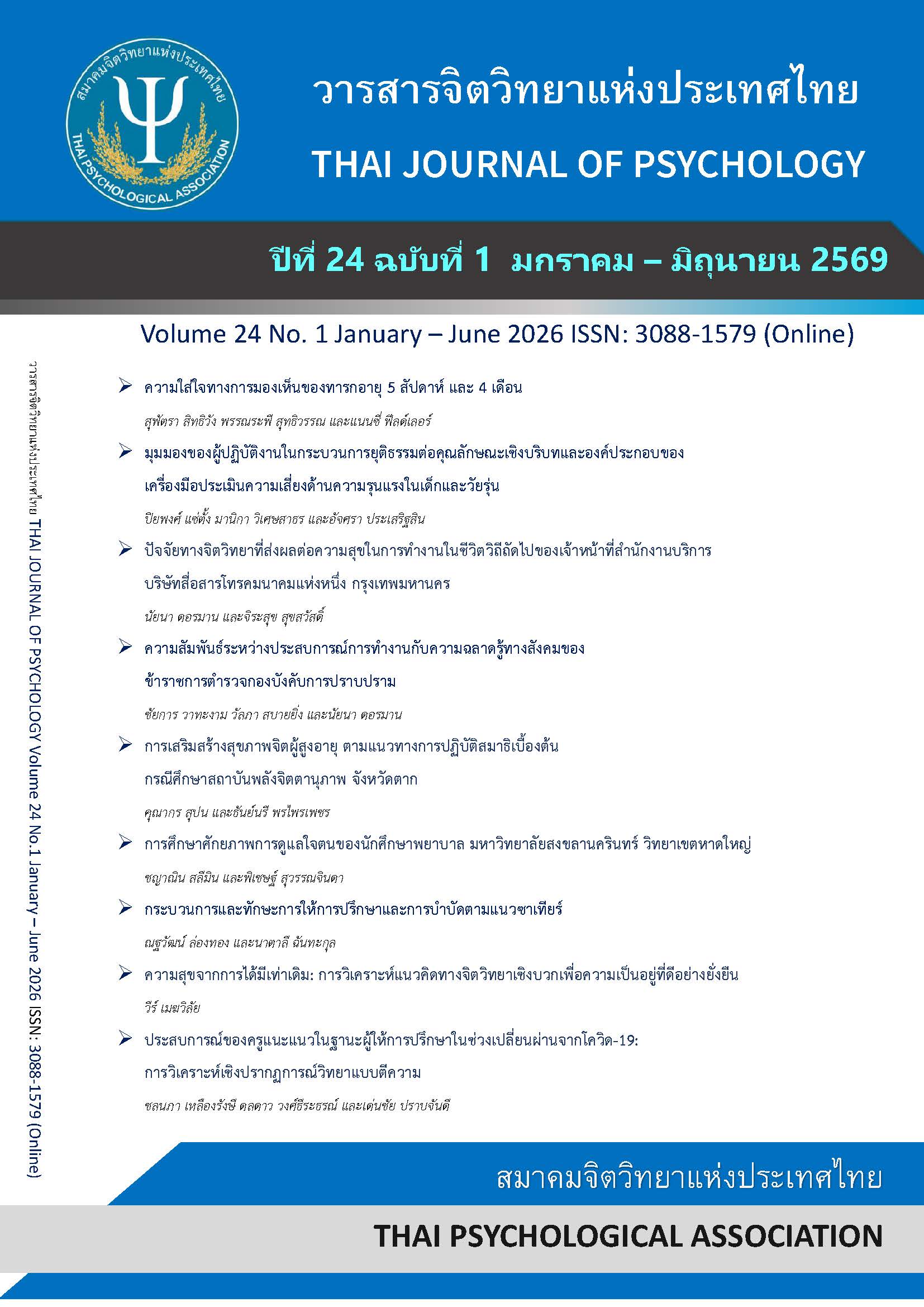
A Study on the Psychological Self-care Potential of Nursing Students at Prince of Songkla University, Hat Yai Campus
Keywords:
individual factors, Psychological Self-care Potential, Nursing StudentsAbstract
This study aimed to examine the level of psychological self-care potential and
the personal factors influencing psychological self-care potential among nursing students. The sample consisted of 180 nursing students from the first to fourth year, selected through stratified random sampling. The research instrument was a psychological self-care potential scale with a reliability coefficient of .98. Data were analyzed using descriptive statistics to present the level of psychological self-care potential, including mean and standard deviation. Pearson’s product–moment correlation coefficient was employed to examine the relationships between personal factors and psychological self-care potential among nursing students, with the level of statistical significance set at p < .05. The findings revealed that the majority of nursing students (80.60%) demonstrated a high level of psychological
self-care potential. In addition, no personal factors were found to be significantly associated with psychological self-care potential.
The findings of this study underscore the pivotal role of the curriculum in designing mental health promotion activities within nursing education institutions. It is therefore recommended that such activities be implemented for all students, with an emphasis on enhancing intrapersonal skills and fostering a supportive environment conducive to sustainable self-care. Furthermore, the findings can inform the development of mental health promotion programs and learning environments that support nursing students
in effectively coping with stress and strengthening their psychological resilience,
thereby preparing them to become competent professional nurses in the future.
References
Asturias, N., Andrew, S., Boardman, G., & Kerr, D. (2021). The influence of socio-demographic factors on stress and coping strategies among undergraduate nursing students. Nurse Education Today, 99, 104780. https://doi.org/10.1016/j.nedt.2020.104780
Auttama, N., Seangpraw, K., Ong-Artborirak, P., & Tonchoy, P. (2021). Factors associated with self-esteem, resilience, mental health, and psychological self-care among university students in Northern Thailand. Journal of Multidisciplinary Healthcare, 14, 1213–1221.
Buatchum, K., Nukaew, O., Suwannawat, J., Worrasirinara, P., Jeratchayaporn, K., & Christraksa, W. (2022). Factors predicting mental health status among nursing students, Prince of Songkla University. Journal of Research in Nursing-Midwifery and Health Sciences, 42(2), 98–109. (in Thai)
Chandel, R., Bhagat, A., Malhotra, A. S., Rohilla, R., Kaur, G., & Prakash, K. (2025). Jigsaw technique: Will it help Gen Z nursing students? Advances in Physiology Education, 49, 304–313. https://doi.org/10.1152/advan.00145.2024
Chatrung, C., Mahaprom, T., Kerdmuang, S., & Suwanchareon, S. (2022). Factors associated with depression in nursing students. Journal of Health and Nursing Research, 38(3), 82–90. (in Thai)
Chow, S. K. Y., Lam, K.-M., Lie, S.-H., Mak, K.-C., Mong, K.-C., So, C.-M., & Yuen, W.-Y. (2018). Do demographic factors and a health-promoting lifestyle influence the self-rated health of college nursing students? BMC Nursing, 17, 50.
Cohen, J. (1987). Statistical power analysis for the behavioral sciences (2nd ed.). Lawrence Erlbaum Associates.
Henshall, C., Davey, Z., & Jackson, D. (2020). The implementation and evaluation of a resilience enhancement programme for nurses working in the forensic setting. International Journal of Mental Health Nursing, 29(3), 508–520. https://doi.org/10.1111/inm.12689
Hill, L., & Smith, N. (1990). Self-care: Nursing promotion of health (2nd ed.). Appleton & Lange.
Lakens, D. (2013). Calculating and reporting effect sizes to facilitate cumulative science: a practical primer for t-tests and ANOVAs. Frontiers in Psychology, 4, 863.
Lazarus, R. S., & Folkman, S. (1984). Stress, appraisal, and coping. Springer Publishing.
Linton, M., & Koonmen, J. (2020). Self-care as an ethical obligation for nurses. Nursing Ethics, 27(8), 1694–1702. https://doi.org/10.1177/0969733020940371
Polevaya, N. M., & Sitnikova, V. V. (2025). Formation of students’ communication skills in the educational process of the university within the framework of the “friendly environment” model. Pedagogy and Psychology of Education, 15(1), 34–42. https://doi.org/10.25807/22224378_2025_5_96
Puapairoj, V., & Choksawadphinyo, K. (2020). Health-promoting lifestyle on self-care, self-regulation, and self-efficacy of nursing students. Journal of Public Health Nursing, 34(13), 31–47. (in Thai)
Reeve, K. L., Shumaker, C. J., Yearwood, E. L., Crowell, N. A., & Riley, J. B. (2013). Perceived stress and social support in undergraduate nursing students’ educational experiences. Nurse Education Today, 33(4), 419–424. https://doi.org/10.1016/j.nedt.2012.11.009
Roy, C. (1976). Introduction to nursing: An adaptation model. Prentice Hall.
Saleemin, C. (2024). Effects of Positive Psychological Coaching on Psychological Self-care Potential and Positive Psychological Capital of Nursing Students, Prince of Songkla University, Hat Yai Campus [Unpublished master’s thesis]. Prince of Songkla University.
Saleemin, C., Choorat, P., Kuha, A., & Rukpanusit, T. (2024). Effects of positive psychological coaching, psychological self-care potential, and positive psychological capital of nursing, Prince of Songkla University, Hat Yai Campus. The Periodic of Behavioral Science, 30(1), 88–108. (in Thai)
Satitnarakorn, B. (2010). Research methodology in nursing (5th ed.). U & I Inter Media.
(in Thai)
Suktae, W., Wonglamthong, S., & Paipayob, A. (2019). Spending behaviors of nursing students: A case study of Boromarajonani College of Nursing, Sawanpracharak Nakhonsawan. Graduate Studies Review, Nakhonsawan Buddhist College, 7(2), 33–44. (in Thai)
Tiangkamol, C., Throrungraung, A., Poungjuntaradej, N., Saiwongtuak, K., Traprasit, Y., Kongmun, K., Hakim, C., & Punpayuk, S. (2021). Predictive factors for problem coping behavior of nursing students at Police Nursing College. Journal of Research for Health Improvement and Quality of Life, 1(3), 1–12. (in Thai)
Watson, R., Gardiner, E., Hogston, R., Gibson, H., Stimpson, A., Wrate, R., & Deary, I. (2009). A longitudinal study of stress and psychological distress in nurses and nursing students. Journal of Clinical Nursing, 18(2), 270–278. https://doi.org/10.1111/j.1365-2702.2008.02555.x
Zhao, L., Su, Y., Jiang, N., Zhou, F., Liao, L., & Liu, Y. (2022). Changes in professional commitment of undergraduate nursing students before and after internship: A longitudinal study. BMC Medical Education, 22, 282. https://doi.org/10.1186/s12909-022-03364-0
Downloads
Published
How to Cite
Issue
Section
License
Copyright (c) 2026 Thai Psychological Association

This work is licensed under a Creative Commons Attribution-NonCommercial-NoDerivatives 4.0 International License.
บทความที่ได้รับการตีพิมพ์เป็นลิขสิทธิ์ของสมาคมจิตวิทยาแห่งประเทศไทย
ข้อความที่ปรากฎในบทความแต่ละเรื่องในวารสารวิชาการเล่มนี้เป็นความคิดเห็นส่วนตัวของผู้เขียนแต่ละท่านไม่เกี่ยวข้องกับสมาคมจิตวิทยาแห่งประเทศไทย แต่อย่างใด ความรับผิดชอบองค์ประกอบทั้งหมดของบทความแต่ละเรื่องเป็นของผู้เขียนแต่ละท่าน หากมีความผิดพลาดใด ๆ ผู้เขียนแต่ละท่านจะรับผิดชอบบทความของตนเองแต่ผู้เดียว



