
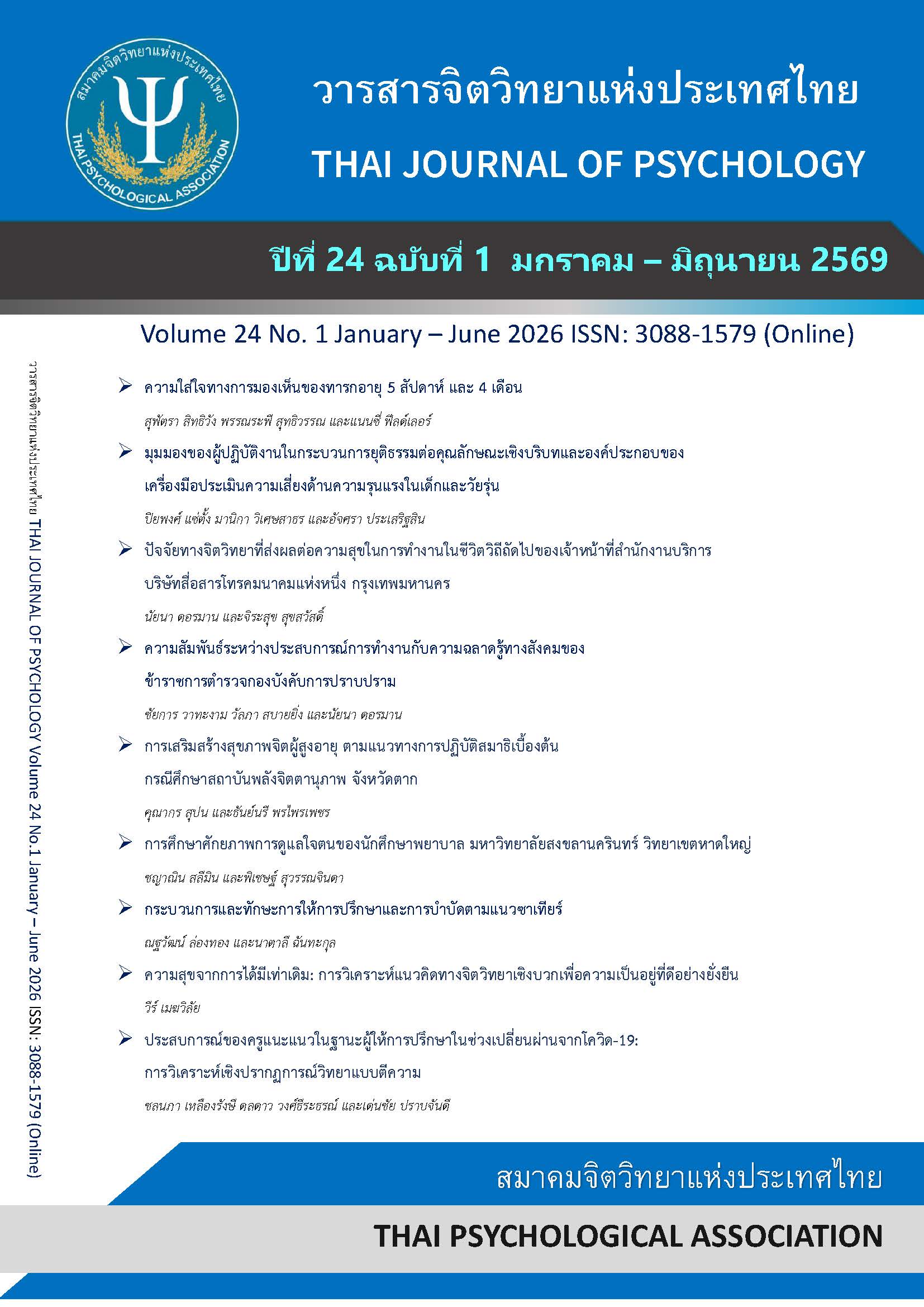
Guidance Teachers’ Experiences as Counselors During the Transition Surrounding COVID-19 Pandemic: Interpretive Phenomenological Analysis
Keywords:
Guidance Teachers’ Experiences, Counseling, Pre- and Post-COVID-19 TransitionAbstract
This qualitative study aimed to explore the experiences of guidance teachers in their role as providers of counseling services during the transitional period before and after the COVID-19 pandemic. The research employed Interpretative Phenomenological Analysis (IPA) as the methodological approach. Participants were three secondary guidance teachers. At present, all three work at large public schools but they have also had experience working in schools of different sizes and in private schools. Each teacher has at least five years of experience in counseling and has worked both before and after the COVID-19 pandemic, meeting the qualifications consistent with the purposive sampling criteria. The findings revealed four key themes: 1) counseling students as the core of guidance services, 2) collaboration with all stakeholders as a necessity, 3) challenges in working during the COVID-19 period, and 4) essential perspectives for working during the transitional phase. These findings highlight the adaptive role of guidance teachers in responding to change, connect with related literature, and offer practical recommendations for enhancing post-crisis guidance services.
References
Banlung Rohitsathien. (2021). The Ministry of Education (MOE) announced the temporary closure of educational institutions under its supervision and jurisdiction in 28 provinces from January 4 to 31, 2021, due to special circumstances. Schools are instructed to conduct teaching and learning in accordance with the guidelines set by the MOE. https://www.moe.go.th/ศธ-ประกาศให้สถานศึกษาใน/
Chatchai Tuangrattanaphan. (2021). COVID-19 education disruption: How does it affect education quality? Bangkok Biz News. https://www.bangkokbiznews.com/columnist/966219
Chomphunut Srichannil. (2019). Interpretative phenomenological analysis: Quality criteria. Journal of Human Sciences, 20(1), 189-213.
Chutima Suraseth. (2021). Psychological counseling for teachers (11th ed.). Chulalongkorn University Press.
Cohen, K. A. (2024). Brief school-based interventions targeting student mental health or well-being: A systematic review and meta-analysis. Journal of Adolescent Health. https://pubmed.ncbi.nlm.nih.gov/38884838/
Faith Zabek, M. D. L., Noor Alwani, Julia V. Taylor, Erica Brown-Meredith, Melinda A. Cruz, & Vickie H. Southall. (2022). Roles and functions of school mental health professionals within comprehensive school mental health systems. Advances in School Mental Health Promotion, 15, 1–18. https://link.springer.com/article/10.1007/s12310-022-09535-0
Jetsada Maboonhom. (2015). Principles of guidance and student development (4th ed.). Smile Printing and Graphic Design.
Greg Guest, Arwen Bunce and Laura Johnson (2006). How Many Interviews Are Enough? An Experiment with Data Saturation and Variability. Field Methods, 18(1), 59-82. https://journals.sagepub.com/doi/10.1177/1525822x05279903?utm
Kiatipoom Wongrachit. (2020). Open statistics: Thai adolescents seek mental health hotline 1323 consultation most often, with stress as the number one problem. Thai Post. https://www.thaipost.net/main/detail/56782
Nattasuda Taepan. (2022). When losing a loved one: Understanding the mental state of grief. Faculty of Psychology, Chulalongkorn University. https://www.psy.chula.ac.th/th/feature-articles/stage-of-depression/
Nilubon Sukwanich. (2023). “Unconditional positive regard”: A useful technique in counseling love problems. iStrong. https://www.istrong.co/single-post/unconditional-positive-regard
Phitchaya Techalan. (2021). “School counselors”: A role that schools must provide for reassurance, even if (perhaps) it does not help Thai students understand themselves. Nisit Journal. https://nisitjournal.press/2021/11/13/guidance-service-problems/
Preeyapat Srikrai. (2022). Administration of student support systems in the new normal era of school administrators in Educational Quality Development Network Center 3, Mueang Sripoom, under Roi Et Primary Educational Service Area Office 2. Roi Et Journal of Educational Administration, 2(3). http://202.29.86.169/index.php/RJGE/article/view/2043
Seidman, I. (2006). Interviewing as qualitative research. Teachers College Press. https://www.researchgate.net/file.PostFileLoader.html?id=563ce2da6225ff3cae8b4590&assetKey=AS%3A292843798188032%401446830810198
Smith, J. A., Flowers, P., & Larkin, M. (2009). Interpretative phenomenological analysis: Theory, method and research. Sage.
Thee Phawangkanant. (2021). Educational administration during the COVID-19 pandemic in the new normal era. Journal of Borsahakan Education and Humanities and Social Sciences, 2(2). https://so03.tci-thaijo.org/index.php/JOB_EHS/article/view/258866
Downloads
Published
How to Cite
Issue
Section
License
Copyright (c) 2026 Thai Psychological Association

This work is licensed under a Creative Commons Attribution-NonCommercial-NoDerivatives 4.0 International License.
บทความที่ได้รับการตีพิมพ์เป็นลิขสิทธิ์ของสมาคมจิตวิทยาแห่งประเทศไทย
ข้อความที่ปรากฎในบทความแต่ละเรื่องในวารสารวิชาการเล่มนี้เป็นความคิดเห็นส่วนตัวของผู้เขียนแต่ละท่านไม่เกี่ยวข้องกับสมาคมจิตวิทยาแห่งประเทศไทย แต่อย่างใด ความรับผิดชอบองค์ประกอบทั้งหมดของบทความแต่ละเรื่องเป็นของผู้เขียนแต่ละท่าน หากมีความผิดพลาดใด ๆ ผู้เขียนแต่ละท่านจะรับผิดชอบบทความของตนเองแต่ผู้เดียว



