
Culture in a State of Non-Correspondence: Toward the Development of a Theory of Cultural Obscuration
DOI:
https://doi.org/10.69598/decjournalartanddesign.5.206-229Keywords:
cultural obscuration, meaning management, culture in a state of non-correspondence, levels of cultural obscuration, installation art, cultural dynamicsAbstract
This article aims to 1) define and develop the conceptual framework of “Cultural Obscuration” as an approach for explaining the dynamics of contemporary culture; 2) analyze and synthesize the processes of cultural obscuration in three levels—Surface Obscuration, Meaning Obscuration, and Structural Obscuration—in order to explain the condition of “culture in a state of non-correspondence”; and 3) extend the concept toward artistic creation to reflect the conceptual framework of Cultural Obscuration. This study employs a qualitative approach through Conceptual and Interpretive Research, utilizing secondary data from academic literature, theories in cultural studies, related research, and case studies from the Man River Basin communities in Dan Sai District, Loei Province, together with artistic interpretation through installation art.
The findings reveal that the concept of Cultural Obscuration can explain conditions in which culture continues to exist in visible forms while its meanings, values, and inner essence are concealed, distorted, or manipulated. The obscuration occurs across three major levels: 1) Surface Obscuration, where attention is focused primarily on external forms and symbols; 2) Meaning Obscuration, where people continue to perceive culture as unchanged although its inner meanings have shifted; and 3) Structural Obscuration, where cultural meanings are controlled and instrumentalized through structures of power, resulting in conditions of concealment, distortion, and manipulation. The analysis further demonstrates that Cultural Obscuration differs from existing concepts such as Cultural Hegemony, Cultural Appropriation, and Cultural Transformation in that it more clearly explains the condition in which culture persists under newly constructed meanings, or what is described in this study as “culture in a state of non-correspondence.”
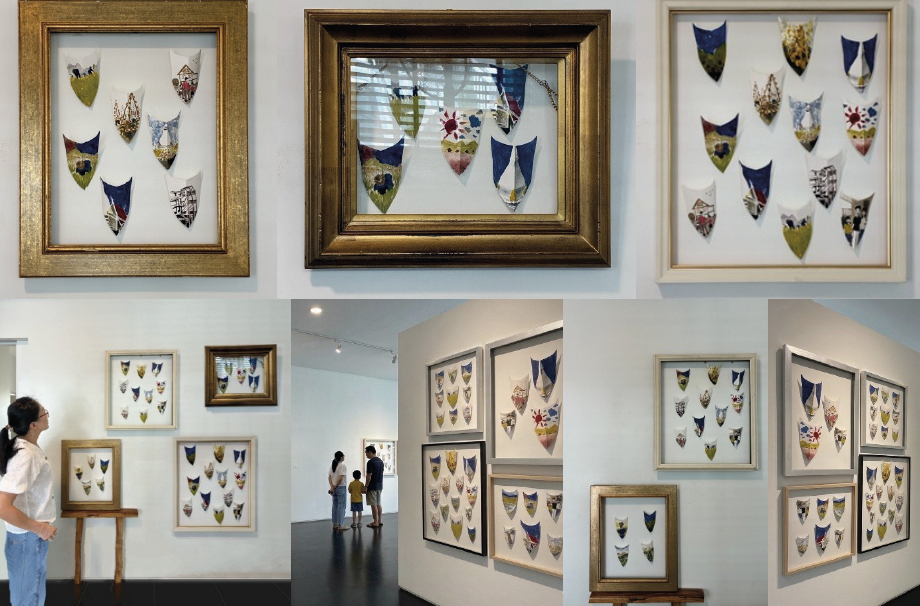
In addition, the installation art created in this study reflects the potential of art as a medium for revealing obscured meanings and fostering awareness of the dynamics of contemporary culture through interpretation, communication, and critical reflection on cultural meanings in the age of globalization.
References
สุชาติ เศรษฐมาลินี. (2552). เศรษฐศาสตร์การเมืองว่าด้วยทุนนิยมและวัฒนธรรม. ฟ้าเดียวกัน.
สุชาติ สวัสดิ์ศรี. (2552). ลับ ลวง พราง: ว่าด้วยกลยุทธ์การต่อสู้ทางวัฒนธรรม. อ่าน.
Bourdieu, P. (1990). The logic of practice. Stanford University Press.
Bourdieu, P. (1993). The field of cultural production: Essays on art and literature. Polity Press.
Dewey, J. (1934). Art as experience. Minton, Balch & Company.
Eisner, E. W. (2002). The arts and the creation of mind. Yale University Press.
Foucault, M. (1980). Power/knowledge: Selected interviews and other writings 1972–1977. Pantheon books.
Gramsci, A. (1971). Selections from the prison notebooks. International publishers.
Hall, S. (1997). The work of representation. In Hall, S. (Ed.), Representation: Cultural representations and signifying practices (pp. 13–74). Sage.
Scott, J. C. (1990). Domination and the arts of resistance: Hidden transcripts. Yale University Press.
Sullivan, G. (2010). Art practice as research: Inquiry in visual arts (2nd ed.). Sage.
UNESCO. (2001). UNESCO universal declaration on cultural diversity. United Nations Educational, Scientific and Cultural Organization. https://unesdoc.unesco.org/ark:/48223/pf0000127160
Ziff, B., & Rao, P. V. (Eds.). (1997). Borrowed power: Essays on cultural appropriation. Rutgers University Press.
Downloads
Published
How to Cite
License
Copyright (c) 2026 DEC Journal : Art and Design

This work is licensed under a Creative Commons Attribution-NonCommercial-NoDerivatives 4.0 International License.
Published by Academic Affairs Division, Faculty of Decorative Arts, Silpakorn University. The copyright of the article belongs to the article owner. Published articles represent the views of the authors. The editorial board does not necessarily agree with and is not responsible for the content of such articles.

