
The Role of Biomimicry in Innovation Furniture Design
DOI:
https://doi.org/10.69598/decjournalartanddesign.4.58-87Keywords:
Biomimicry Concept, Biomimicry Design Theory, Biomimicry in Furniture Innovation, The Concept of Imitating the Relationship Between Humans and Nature.Abstract
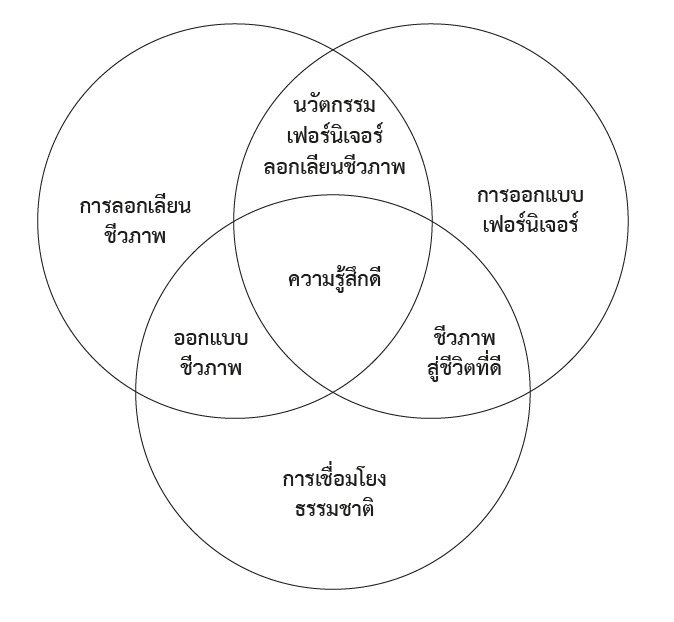
Humans have observed and studied the physical characteristics of various biological components, learning about the behaviors of living organisms occurring in ecosystems and natural phenomena. This has led to the science of developing strategic problem-solving methods known as "Biomimicry", which means mimicking nature or using examples from nature in the development of technology, innovations, or new ideas that create better design efficiency. This article aims to disseminate information related to the role of biomimicry concepts in the design of furniture innovations, gathering and analyzing relevant theoretical data that the researchers consider important for principles and processes that are appropriate and can be practically integrated into furniture innovation design. By choosing to conduct the research through a literature review and selecting furniture design works that primarily use the concept of biomimicry from international designers as criteria for this case study, data is analyzed by comparing it with two design theories: the theory from biology to design and the theory from design to biology. A survey questionnaire is used to collect data, followed by a summary and discussion of the research results. Finally, the concept of innovatively designed furniture inspired by nature emerged, which involves mimicking the shapes and forms of nature, imitating natural processes, replicating the environmental properties of nature, and reflecting the relationship between humans and nature. Therefore, the researcher suggests that applying the concept of biomimicry in furniture design will result in solutions that meet user needs, enhance user experience, promote sustainability, and foster a deeper relationship with nature. Innovations that are more efficient are created, enhancing the feeling of relaxation and connecting with nature, reducing the impact on the environment (Eco-Impact), and promoting sustainability in design. This is the starting point for continuous learning and development, not just providing 'goods' but offering 'choices for living in harmony with nature with consciousness.' It is a design that meets the needs of both humans and the Earth, creating a new experience that is deeply meaningful and sustainable.
References
ณัฎฐ์สุพล ชุติธนภานนท์. (2562). อุณหภูมิมีผลต่อการบินมากกว่าที่คิด. (http://www.thaiphysoc.org/article/156/)
น่าอยู่. (2565). ส่องผังเมืองระยอง เมืองนี้ที่ดินน่าอยู่จริงไหม?. http://nayoo.co/rayong/blocgs/eec-landuse/
ส.เจริญ. (2566). วัสดุชนิดใหม่ที่ใช้รักษาบาดแผลด้วยวิธีเลียนแบบธรรมชาติ. http://www.scharoen.com/tharticle/ค้นพบวัสดุชนิดใหม่/
Andrea, I. W., Robin, F., Hendry, A., & Paul, N. (2012). Antoine Lavoisier (1743–1794) :
Philosophy of chemistry (6th ed.). North Holland.
Benyus, J. (2002). Biomimicry : Innovation inspired by nature (21st ed.) Harper Perennial.
Benyus, J. (2024). Biomimicry is learning from and then emulating nature’s forms, processes, and ecosystems to create more sustainable designs. https://biomimicry.net/what-is-biomimicry/.
Biomimicry Institute. (2023). The biomimicry design process. https://toolbox.biomimicry.org/
Biomimicry Institute. (2024). Design for transformation. https://d4t.biomimicry.org/
ELİBOL, G. C., TÜRKKAN, V. D., & BEZCİ, İ. (2021). Biologically inspired design : A case study on furniture design experiences of interior architecture students. Journal of Science, 9(4), 679-689.
dproducts. (2023). The vast potential of self-healing materials. https://4dproducts.co.uk/healing-by-design-harnessing-biomimicry-and-embracing-natures-wisdom-in-future-product-design/.
Justenergy. (2020). Everything you need to know about wind energy.
https://justenergy.com/blog/everything-you-need-to-know-about-wind-energy/.
Learn biomimicry. (2025). 50 of the world's best biomimicry examples (so far). https://www.learnbiomimicry.com/blog/best-biomimicry-examples
Lizoňová, D., & Tončíková, Z. (2019). Exploring the application of nature-inspired geometric principles when designing furniture and interior equipment. Acta Facultatis Xylologiae Zvolen, 61(1), 131−145.
Naylor, R. (2023). The role of biomimicry in furniture design.
https://furniturenews.net/resources/the-role-of-biomimicry-in-furniture-design.
Pathak, S. (2019). Biomimicry : Innovation inspired by nature. International Journal of New Technology and Research (IJNTR), 5(6), 34-38.
Tavsana, F., & Sonmezb, E. (2015). Biomimicry in furniture design. In social and behavioral sciences, 7th world conference on educational sciences, (WCES-2015) 05-07
February 2015, (pp. 2285 – 2292). Procedia - Social and Behavioral Sciences.
Thearchitectsdiary. (2023). Biomimicry in architecture – Towards a sustainable approach. https://thearchitectsdiary.com/biomimicry-in-architecture-towards-a-sustainable-approach/#google_vignette.
Downloads
Published
How to Cite
Issue
Section
Categories
License
Copyright (c) 2025 DEC Journal : Art and Design

This work is licensed under a Creative Commons Attribution-NonCommercial-NoDerivatives 4.0 International License.
Published by Academic Affairs Division, Faculty of Decorative Arts, Silpakorn University. The copyright of the article belongs to the article owner. Published articles represent the views of the authors. The editorial board does not necessarily agree with and is not responsible for the content of such articles.

