The Guidelines for Developing a Model of Art Learning Activities Package for Children in Generation Beta
DOI:
https://doi.org/10.69598/decjournalartanddesign.4.88-111Keywords:
Generation Beta, Art Learning Activities, Art Learning PackageAbstract
The objectives of this research were: 1) to explore approaches for developing an art activity model, and 2) to propose a development model of art activities for Generation Beta children at the lower primary education level. The survey sample consisted of 69 participants, including parents of current and future Generation Alpha and Beta children, art teachers, and art education students, selected through accidental sampling. The interview sample included seven participants: primary school art teachers, parents of Generation Alpha and Beta children, and a physician specializing in psychiatry, selected through purposive sampling. The group of experts for evaluating the activity set comprised three specialists in teaching and designing learning materials for primary school children, also selected through purposive sampling. The research instruments were: 1) a questionnaire on guidelines for developing art activities for Generation Beta children, 2) an interview form on guidelines for developing art activities for Generation Beta children, 3) a prototype set of art activities for Generation Beta, and 4) an expert evaluation form for the activity set. Qualitative data were analyzed using descriptive statistics, and quantitative data were analyzed using descriptive statistics with mean values.
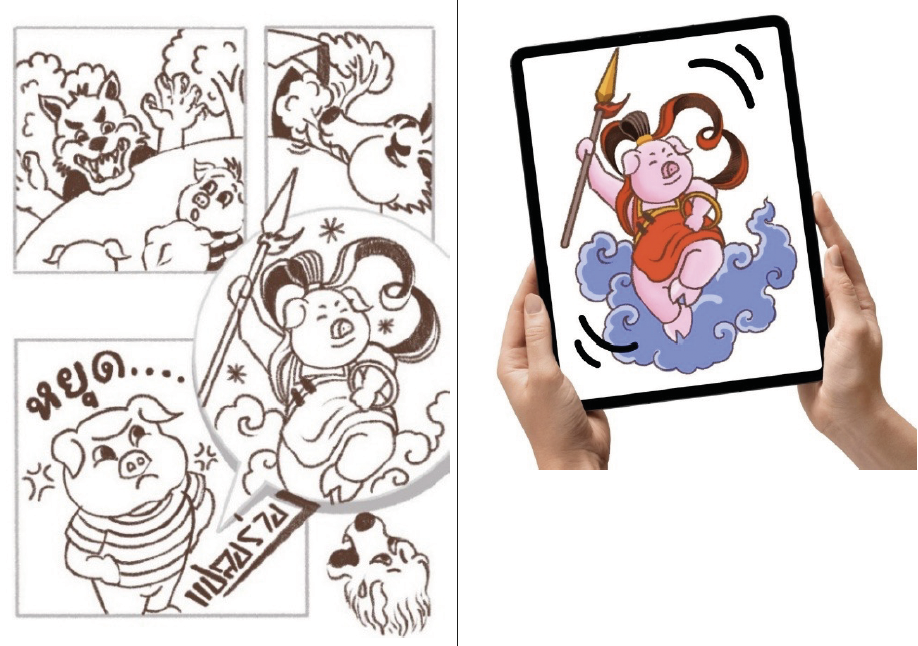
The results revealed that: 1) the art activity set for Generation Beta, based on blended learning, self-directed learning, and collaborative learning approaches, comprised activities categorized into six art technique areas and seven content-based categories, such as the “Transforming Cartoon” activity; 2) expert evaluation indicated a high level of suitability in all aspects. Experts commented that the activity set offered engaging teaching approaches, incorporated connections to nature, and adapted technology appropriately. It was considered suitable for the target group’s learning; however, it was recommended that more detailed content, activity steps, and adaptations be added for learners with special needs.
References
กระทรวงศึกษาธิการ. (2551, 11 กรกฎาคม). หลักสูตรแกนกลางการศึกษาขั้นพื้นฐาน พุทธศักราช 2551.
https://academic.obec.go.th/images/document/1559878925_d_1.pdf
ภัสรำไพ จ้อยเจริญ. (2568). AI mazing เล่น สำรวจ ร่วมมือ สร้างเด็กปฐมวัย Gen Beta. [Symposium]. ห้องประชุมดวงเดือน พิศาลบุตร คณะครุศาสตร์ จุฬาลงกรณ์มหาวิทยาลัย.
Anderson, L. W., & Krathwohl, D. R. (2001). A taxonomy for learning, teaching, and assessing: A revision of Bloom’s taxonomy of educational objectives. Longman.
Dewey, J. (1934). Art as Experience.Minton, Balch & Company.
Eisner, E. W. (2002). The Arts and the Creation of Mind. Yale University Press.
Fernando, P. A., & Premadasa, H. K. S. (2024). Use of gamification and game-based learning in educating
Generation Alpha: A systematic literature review. Educational Technology & Society, 27(2), 114-132.
McCrindle, M. (2014). The ABC of XYZ: Understanding the Global Generations. McCrindle Research.
McCrindle, M., & Fell, A. (2021). Generation Alpha: Understanding Our Children and Helping Them Thrive. Hachette Australia.
World Economic Forum. (2025, January 15). Global Risk Report. https://www.weforum.org/publications/ global-risks-report-2025/digest/
Yusuf, A. (2023). Futuristic Curriculum Concept for Generation Alpha in Indonesia: A Case Study. Kuram ve Uygulamada Eğitim Yönetimi Educational Administration:
Theory and Practice, 29(2). 130-150. https://kuey.net/index.php/kuey/article/view/642
Downloads
Published
How to Cite
License
Copyright (c) 2025 DEC Journal : Art and Design

This work is licensed under a Creative Commons Attribution-NonCommercial-NoDerivatives 4.0 International License.
Published by Academic Affairs Division, Faculty of Decorative Arts, Silpakorn University. The copyright of the article belongs to the article owner. Published articles represent the views of the authors. The editorial board does not necessarily agree with and is not responsible for the content of such articles.

