Art Activities to Promote the Appreciation of Thai Traditions for Elementary School Students
DOI:
https://doi.org/10.69598/decjournalartanddesign.5.154-177Keywords:
tradition, art activities, primary school studentsAbstract
Currently, there is a significant influx of technology and foreign cultures, while increasing numbers of students are enrolling in international schools. As a result, younger generations are becoming less connected to Thai cultural roots, leading to decreased interest in traditional practices. UNESCO has emphasized the importance of safeguarding cultural heritage through the Sustainable Development Goals, while Thailand’s Soft Power policy also seeks to strengthen cultural identity. Therefore, fostering awareness and appreciation among youth is essential for preserving Thai traditions.
Preliminary studies indicate a strong connection between art and tradition. Art education encourages imagination, hands-on learning, and a sense of pride, which can help cultivate appreciation of cultural values. Primary school students are at an appropriate developmental stage to understand such concepts.
This study aims to explore guidelines for organizing art activities that promote appreciation of Thai traditions among primary school students. The research methodology involves analyzing student development, approaches to value cultivation, the significance of art, and activity formats and media from both domestic and international contexts.
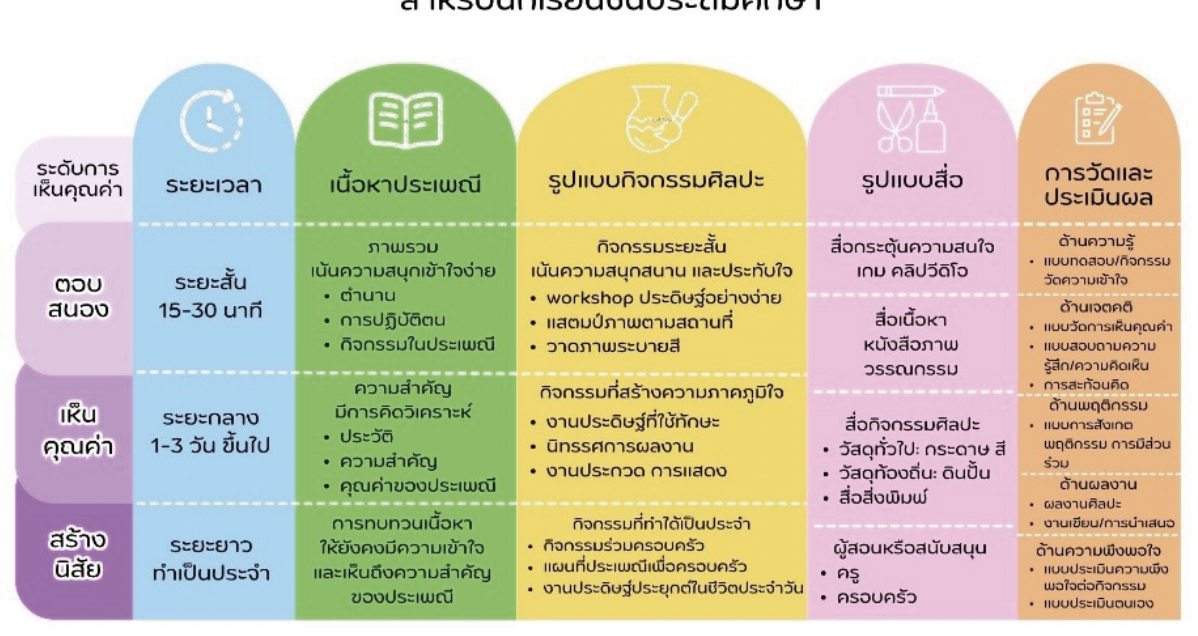
The findings suggest five key components: (1) clearly defined appreciation levels with continuous development, (2) simple and age-appropriate traditional content, (3) collaborative art activities involving peers and families, (4) engaging, modern, and accessible materials, and (5) comprehensive evaluation of knowledge, attitudes, behaviors, student work, and satisfaction.
References
กระทรวงการต่างประเทศ (2567, 4 ธันวาคม). “ต้มยำกุ้ง” ได้รับการขึ้นทะเบียนเป็นมรดกวัฒนธรรมที่จับต้องไม่ได้ขององค์การ UNESCO. https://www.mfa.go.th/th/content/tomyum-kung-unesco-th?cate=5d5bcb4e1 5e39c306000683d
ณัฏฐภรณ์ หลาวทอง. (2550). การประเมินจิตพิสัยในการประเมินผลการเรียนรู้แนวใหม่. จุฬาลงกรณ์มหาวิทยาลัย.
ณัฐกาญจน์ จันทน์เนื้อไม้. (2561). การพัฒนาชุดกิจกรรมการเรียนรู้เพื่อส่งเสริมการเห็นคุณค่าศิลปะล้านนา. [วิทยานิพนธ์ครุศาสตรมหาบัณฑิต, จุฬาลงกรณ์มหาวิทยาลัย]. Chula DigiVerse. http://doi.org/10.58837/CHULA.THE. 2018.1377
ทิศนา แขมมณี. (2566). รูปแบบการเรียนการสอน: ทางเลือกที่หลากหลาย(ครั้งที่ 10). จุฬาลงกรณ์มหาวิทยาลัย.
ธัญชนก กังนิกร. (2564). การจัดการเรียนรู้ตามอัธยาศัยสําหรับเด็กและเยาวชน ด้วยกระบวนการมีส่วนร่วมเพื่อส่งเสริมความตระหนักรู้คุณค่าในการแสดงหนังใหญ่ วัดสว่างอารมณ์ จังหวัดสิงห์บุรี. วารสารชุมชนวิจัย, 15(4), 260-270. https://so04.tci-thaijo.org/index.php/NRRU/article /view/248050/173208
ธนพร สายวงศ์ปัญญา. (2565). การพัฒนานวัตกรรมการเรียนรู้เพื่อส่งเสริมการเห็นคุณค่าศิลปวัฒนธรรม : กรณีศึกษาจังหวัดกำแพงเพชร. [วิทยานิพนธ์ครุศาสตรมหาบัณฑิต ไม่ได้ตีพิมพ์]. จุฬาลงกรณ์มหาวิทยาลัย.
ธีติ พฤกษ์อุดม. (2567). การพัฒนาชุดกิจกรรมทางศิลปะเพื่อส่งเสริมการเห็นคุณค่าสำหรับเยาวชนจากการวิเคราะห์รูปแบบอัตลักษณ์ของงานศิลปหัตถกรรมภาคใต้. วารสารสำนักหอสมุด มหาวิทยาลัยทักษิณ, 13(1), 52-69. https://so14.tci-thaijo.org/index.php/TSULJ/article/view/994/639
ประชิด สกุณะพัฒน์. (2546). วัฒนธรรมพื้นฐานประเพณีไทย. ภูมิปัญญา
ปุณณรัตน์ พิชญไพบูลย์. (2561). จิตวิทยาศิลปะ : สุนทรียศาสตร์เชิงประจักษ์. จุฬาลงกรณ์มหาวิทยาลัย.
ภิมลพรรณ อุ่นแก้ว. (2563). หลักพื้นฐานบรรณาธิการหนังสือเด็ก. บ้านพระอาทิตย์.
วัฒนะ จูฑะวิภาต. (2552). ศิลปะพื้นบ้าน. จุฬาลงกรณ์มหาวิทยาลัย.
วรวิทย์ จันทร์สุวรรณ. (2568, 1 กุมภาพันธ์). ระดับขั้นความสามารถของบลูม (Bloom’s Taxonomy). SCIRMUTP. https://sci.rmutp.ac.th/woravith/?page_id=11322#c
สำนักราชบัณฑิตยสภา. (2554). พจนานุกรม ฉบับราชบัณฑิตยสถาน. https://dictionary.orst.go.th/
โสภณ ศุภวิริยสกร. (2560). ศิลปหัตถกรรมไทยพื้นฐาน. คณะวิเทศศึกษา มหาวิทยาลัยสงขลานครินทร์ วิทยาเขตภูเก็ต.
Harrington, J. M. (2016). “We’re all kids!” Picture books and cultural awareness. The Social Studies, 107(6), 244-256. https://doi.org/10.1080/00377996.2016.1214906
Sarraj, H., Bene, K., Li, J., & Burley, H. (2015). Raising cultural awareness of fifth-grade students through multicultural education: An action research study. Multicultural Education, 22(2), 39-45. https://eric.ed.gov/?id=EJ1065316
Sato, C., & Kitagawa, Y. (2022, 01 August). The past and future of "Let's go with your kids! Gion festival" that connects Kyoto traditions to children. Kyoto-iju https://kyoto-iju.com/column /hito_26
Downloads
Published
How to Cite
License
Copyright (c) 2026 DEC Journal : Art and Design

This work is licensed under a Creative Commons Attribution-NonCommercial-NoDerivatives 4.0 International License.
Published by Academic Affairs Division, Faculty of Decorative Arts, Silpakorn University. The copyright of the article belongs to the article owner. Published articles represent the views of the authors. The editorial board does not necessarily agree with and is not responsible for the content of such articles.

