
Catch That Element: Development of a Web-based Educational Game on the Periodic Table of Elements for Grade 8 Learners
Article Sidebar
Main Article Content
Abstract
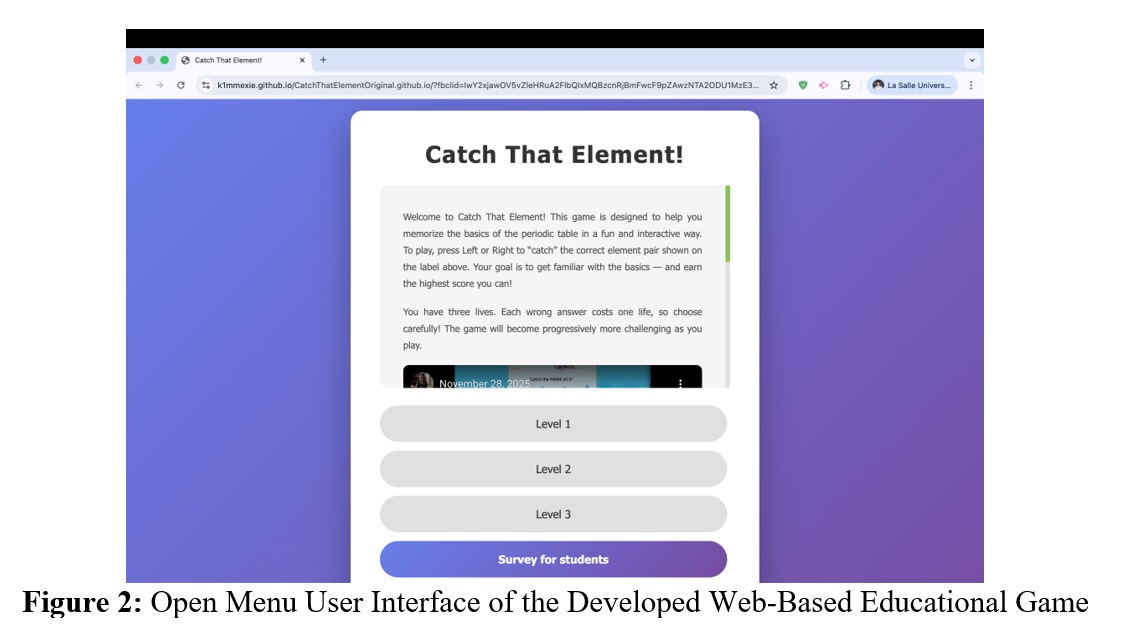
The Periodic Table of Elements in Grade 8 Science is often perceived by learners as abstract, content-heavy, and difficult to master using traditional instructional approaches. To address these challenges, this study aimed to develop a web-based educational game titled Catch That Element. Moreover, this study also determines the teacher evaluation, students’ achievement, and students’ perceptions towards the developed material. The study employed a developmental and quasi-experimental research design. The game was developed using the ADDIE model and incorporated interactive challenges, immediate feedback, scoring mechanisms, and increasing levels of difficulty to reinforce students’ knowledge of element names, symbols, atomic numbers, and mass. The participants included 50 Grade 8 students for the implementation of the game, and eight Junior High School Science teachers for the evaluation of the developed game. Statistical analysis also revealed a significant difference between the pretest and posttest scores (normalized gain = 0.89) providing that the instructional material enhances students’ understanding. Moreover, the game gained a rating of “very satisfactory” (mean = 3.72) in the teacher evaluation of content, instructional, and technical quality, indicating that the game meets curriculum standards and supports effective learning. Lastly, the students' perception of the developed game was “very high” (mean = 3.56) in interest/enjoyment, value/usefulness, and perceived choice. These results show that the game is engaging, relevant, promotes autonomous learning, and fosters positive affective and motivational outcomes. Overall, the results highlight the potential of the material in enhancing both cognitive and affective learning outcomes for teaching abstract and content-heavy concepts.
Article Details

This work is licensed under a Creative Commons Attribution-NonCommercial-NoDerivatives 4.0 International License.
License to Publish (LTP)
Upon acceptance of a manuscript, authors will be asked to complete a License to Publish (LTP) Agreement. Authors retain the copyright of their work and grant the International Journal of Science Education and Teaching (IJSET) a non-exclusive license to publish, distribute, and archive the article. All published articles are distributed under the Creative Commons Attribution 4.0 International (CC BY 4.0) License.
[!IMPORTANT]
The information provided here is for reference purposes only. Please do not complete or submit this form during the initial submission stage. If your paper is accepted, the editorial office will provide you with specific instructions on how to finalize and submit the formal agreement.
Download the License to Publish (LTP).
References
Ajogbeje, O. J. (2023). Enhancing classroom learning outcomes: The power of immediate feedback strategy. International Journal of Disabilities, Sports and Health Sciences, 6(3), 453–465. https://doi.org/10.33438/ijdshs.1323080
Angub, K. A., Genon, E. O., & Quinco-Cadosales, M. N. (2025). A meta-synthesis on gamification in high school chemistry education. International Journal of Progressive Science and Technologies, 52(1), 202–204.
Bakhsh, K., Hafeez, M., Shahzad, S., Naureen, B., & Farid, M. F. (2022). Effectiveness of digital game-based learning strategy in higher educational perspectives. Journal of Education and e-Learning Research, 9(4), 258–268. https://doi.org/10.20448/jeelr.v9i4.4247
Ballesteros, M., & Cajucom, E. (2025). Follow the order: A strategic intervention material to enhance Grade 8 students’ understanding of the periodic table. Psychology and Education: A Multidisciplinary Journal, 41(1), 161–170. https://doi.org/10.70838/pemj.410110
Camacho-Morles, J., Slemp, G. R., Pekrun, R., Loderer, K., Hou, H., & Oades, L. G. (2021). Activity achievement emotions and academic performance: A meta-analysis. Educational Psychology Review, 33(4), 1051–1095. https://doi.org/10.1007/s10648-020-09585-3
Carril, P., Sellés, N., Abeledo, E., & Sanmamed, M. (2021). Factors influencing students’ perceived impact of learning and satisfaction in computer-supported collaborative learning. Computers & Education, 174, 104310. https://doi.org/10.1016/j.compedu.2021.104310
Chowdhury, P. (2022). Learners’ misconceptions in periodic table: An analysis of cognitive skills development. Universal Journal of Educational Research, 10(1), 57–66. https://doi.org/10.13189/ujer.2022.100106
Coello, J. P. C., Parrales, V. S. M., Pihuave, Z. D. C., & Vicente, K. J. C. (2025). The use of interactive games and the impact on autonomous learning. Revista Científica de Innovación Educativa y Sociedad Actual “ALCON,” 5(3), 358–366. https://doi.org/10.62305/alcon.v5i3.604
Covaci, A., Ghinea, G., Lin, C. H., Huang, S. H., & Shih, J. L. (2018). Multisensory games-based learning: Lessons learnt from olfactory enhancement of a digital board game. Multimedia Tools and Applications, 77, 21245–21263. https://doi.org/10.1007/s11042-017-5459-2
Da Silva Júnior, J., Winum, J. Y., Basso, A., Gelati, L., Moni, L., Júnior, A. C., Mafezoli, J., Zampieri, D., Alexandre, F. R., Vega, K. J., & Monteiro, A. F. (2022). STR120: A web-based board game for aiding students in review of the structural theory of organic compounds. Journal of Chemical Education, 99(9), 3315–3322. https://doi.org/10.1021/acs.jchemed.2c00389
De Boni, L., Hassan, S., & Rasheed, A. (2024). An interactive chemistry game for educational engagement. In Proceedings of the Second Southern Science Conference (Book B). https://doi.org/10.48141/sscon_02_2024
Department of Education. (2016). Evaluation rating sheet for non-print resources. Learning Resources Management and Development System. https://depedpines.com/wp-content/uploads/2015/11/6.6-Evaluation-Rating-Sheet-for-Non-Print.pdf
Department of Education. (2023). Matatag curriculum science grade 3–10. https://www.academ-e.ph/wp-content/uploads/2023/09/Science-CG-2023.pdf
Gui, Y., Cai, Z., Yang, Y., Kong, L., Fan, X., & Tai, R. H. (2023). Effectiveness of digital educational game and game design in STEM learning: A meta-analytic review. International Journal of STEM Education, 10, 1–25. https://doi.org/10.1186/s40594-023-00424-9
Hassan, N., & Shafiq, M. (2023). Effect of problem-solving method on learning of the periodic table by using game instruction. Journal of Contemporary Teacher Education, 6(1), 118–130. https://doi.org/10.58444/jcte.v6i1.732
Irmita, L., Zevanna, A., Limas, J., & Pribadi, M. (2025). Development of “CrossChemistry games”: A web-based educational game on organic chemistry topics. Priviet Social Sciences Journal, 5(10), 365–374. https://doi.org/10.55942/pssj.v5i10.641
Khaldi, A., Bouzidi, R., & Nader, F. (2023). Gamification of e-learning in higher education: A systematic literature review. Smart Learning Environments, 10(1), Article 10. https://doi.org/10.1186/s40561-023-00227-z
Li, Y., Chen, D., & Deng, X. (2024). The impact of digital educational games on students’ motivation for learning: The mediating effect of learning engagement and the moderating effect of the digital environment. PLOS ONE, 19, e0294350. https://doi.org/10.1371/journal.pone.0294350
McKagan, S. B., Sayre, E. C., & Madsen, A. (2022). Normalized gain: What is it and when and how should I use it? Retrieved from https://www.physport.org/recommendations/Entry.cfm?ID=93334
Palisbo, V., Pusta, A., Razo, J., & Malayao, S. (2022). Dual development of board game and guided-inquiry activity in teaching electricity for Grade 5. International Journal of Science Education and Teaching, 1(3), 160–179. https://doi.org/10.14456/ijset.2022.13
Sailer, M., & Homner, L. (2019). The gamification of learning: A meta-analysis. Educational Psychology Review, 32, 77–112. https://doi.org/10.1007/s10648-019-09498-w
Saleem, A., Noori, N., & Ozdamli, F. (2021). Gamification applications in e-learning: A literature review. Technology, Knowledge and Learning, 27, 139–159. https://doi.org/10.1007/s10758-020-09487-x
Smiderle, R., Rigo, S. J., Marques, L. B., de Miranda Coelho, J. A. P., & Jaques, P. A. (2020). The impact of gamification on students’ learning, engagement and behavior based on their personality traits. Smart Learning Environments, 7(1), Article 12. https://doi.org/10.1186/s40561-019-0098-x
Sousa, C., Hwang, J., Cabrera-Perez, R., Fernandez, A., Misawa, A., Newhook, K., & Lu, A. (2021). Active video games in fully immersive virtual reality elicit moderate-to-vigorous physical activity and improve cognitive performance in sedentary college students. Journal of Sport and Health Science, 11, 164–171. https://doi.org/10.1016/j.jshs.2021.05.002
Uslu, N. A., & Durak, H. Y. (2022). Predicting learner autonomy in collaborative learning: The role of group metacognition and motivational regulation strategies. Learning and Motivation, 78, 101804. https://doi.org/10.1016/j.lmot.2022.101804
Vermehren, J., Trikoili, A., & Pittich, D. (2025). Abstract thought in STEM education: An integrative literature review. International Journal of STEM Education, 12(1), Article 73. https://doi.org/10.1186/s40594-025-00573-z
Wijaya, A., Nugroho, E., & Harnadi, B. (2025). Developing educational game application for chemistry periodic table. SISFORMA, 11(2), 154–159. https://doi.org/10.24167/sisforma.v11i2.11422
Yang, S. H., & Choi, J. (2023). Mendeleev’s cards: Educational game to learn Mendeleev’s idea on the periodic table of elements. Journal of Chemical Education, 100(12), 4925–4932. https://doi.org/10.1021/acs.jchemed.3c00719
