
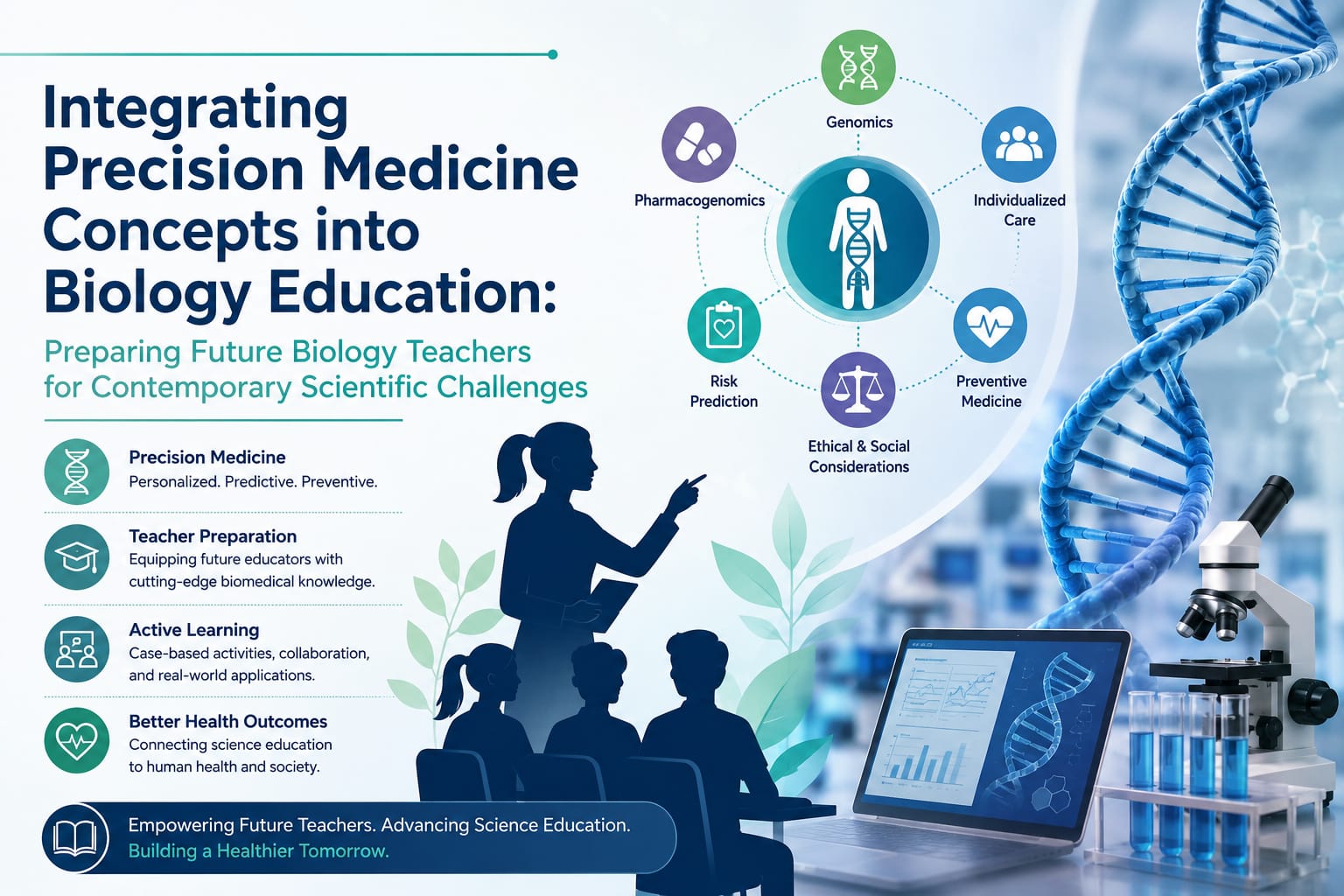
Integrating Precision Medicine Concepts into Biology Education: Preparing Future Biology Teachers for Contemporary Scientific Challenges
Article Sidebar
Main Article Content
Abstract
The present research aimed to investigate the integration of precision medicine concepts into biology teacher preparation programs in light of rapid advancements in genomics and biomedical technologies, which have positioned precision medicine as a key component of modern healthcare. A descriptive–analytical mixed-methods design was employed. The participants included 50 pre-service biology teachers enrolled in the Faculty of Education at Kafr El-Sheikh University, along with six experts in curriculum and science education. Data were collected using a structured questionnaire based on a five-point Likert scale to assess participants’ knowledge, attitudes, and readiness regarding precision medicine concepts. In addition, semi-structured interviews were conducted with experts to explore the feasibility, challenges, and strategies for integrating these concepts into teacher preparation programs. Observations of collaborative learning activities and analysis of students’ activity sheets and case-based responses were also used to document practical engagement with precision medicine applications. Quantitative data were analyzed using descriptive statistics (means and standard deviations), while qualitative data were analyzed through thematic analysis. The findings revealed that pre-service biology teachers demonstrated a moderate to high level of awareness of precision medicine concepts, particularly in genomics and preventive medicine. However, comparatively lower levels were observed in pharmacogenomics and ethical considerations. Expert perspectives emphasized the importance of integrating contemporary biomedical innovations into biology teacher education and highlighted the need for curriculum modernization and active learning strategies. The research concludes that integrating precision medicine into biology teacher preparation may contribute to enhancing scientific literacy, critical thinking, and awareness of emerging biomedical developments among future teachers.
Article Details

This work is licensed under a Creative Commons Attribution-NonCommercial-NoDerivatives 4.0 International License.
License to Publish (LTP)
Upon acceptance of a manuscript, authors will be asked to complete a License to Publish (LTP) Agreement. Authors retain the copyright of their work and grant the International Journal of Science Education and Teaching (IJSET) a non-exclusive license to publish, distribute, and archive the article. All published articles are distributed under the Creative Commons Attribution 4.0 International (CC BY 4.0) License.
[!IMPORTANT]
The information provided here is for reference purposes only. Please do not complete or submit this form during the initial submission stage. If your paper is accepted, the editorial office will provide you with specific instructions on how to finalize and submit the formal agreement.
Download the License to Publish (LTP).
References
Alharbi, A., & Almutairi, S. (2025). Integrating artificial intelligence in precision medicine education: Implications for science teaching. Computers and Education: Artificial Intelligence, 6, 100210.
All of Us Research Program. (2024). Advancing precision medicine through large-scale genomic research. National Institutes of Health.
Braun, V., & Clarke, V. (2006). Using thematic analysis in psychology. Qualitative Research in Psychology, 3(2), 77–101. https://doi.org/10.1191/1478088706qp063oa
Coates, W. (2025). Precision education: A call to action to transform medical education. International Journal of Emergency Medicine, 18, Article 21, 1–6. https://doi.org/10.1186/s12245-025-00819-1
Creswell, J. W., & Plano Clark, V. L. (2018). Designing and conducting mixed methods research (3rd ed.). SAGE Publications.
Desai, S., Burk-Rafel, J., Lomis, K., Caverzagie, K., Richardson, J., O’Brien, C., Andrews, J., Heckman, K., Henderson, D., Prober, C., Pugh, C., Stern, S., Triola, M., & Santen, S. (2024). Precision education: The future of lifelong learning in medicine. Academic Medicine, 99(4 Suppl. 1), S14–S20. https://doi.org/10.1097/ACM.0000000000005296
Desimone, L. (2011). A primer on effective professional development. Phi Delta Kappan, 92(6), 68–71. https://doi.org/10.1177/003172171109200611
Faul, F., Erdfelder, E., Lang, A.-G., & Buchner, A. (2007). G*Power 3: A flexible statistical power analysis program for the social, behavioral, and biomedical sciences. Behavior Research Methods, 39(2), 175–191. https://doi.org/10.3758/BF03193146
Genomics Education Programme. (2015). Precision medicine: What it is and how it will be achieved. National Health Service. https://www.genomicseducation.hee.nhs.uk
Lawshe, C. H. (1975). A quantitative approach to content validity. Personnel Psychology, 28(4), 563–575.
Lederman, N. G., & Lederman, J. S. (2019). Teaching and learning of nature of science and scientific inquiry. Science Education, 103(3), 538–562. https://doi.org/10.1002/sce.21484
National Institutes of Health. (2023). What is precision medicine? U.S. Department of Health and Human Services. https://www.nih.gov/about-nih/nih-turning-discovery-into-health/promise-precision-medicine
National Research Council. (2011). Toward precision medicine: Building a knowledge network for biomedical research and a new taxonomy of disease. National Academies Press. https://doi.org/10.17226/13297
Organisation for Economic Co-operation and Development. (2019). OECD future of education and skills 2030: OECD learning compass 2030. OECD Publishing. https://www.oecd.org/education/2030-project
Organisation for Economic Co-operation and Development. (2021). The future of education and skills 2030: OECD learning compass 2030. OECD Publishing. https://www.oecd.org/education/2030-project
Organisation for Economic Co-operation and Development. (2025). Future-ready education systems: Integrating emerging sciences in curricula. OECD Publishing.
Personal Genetics Education & Dialogue. (2025). Genetics education and public engagement. Harvard Medical School. https://pged.org
Sternberg, S., Kiryluk, K., & Wapner, R. (2024). Teaching precision medicine: Biological, social, and ethical implications. Columbia University.
Topol, E. (2019). Deep medicine: How artificial intelligence can make healthcare human again. Basic Books.
Wang, L., & Krishnan, E. (2021). Big data and precision medicine: Implications for healthcare and research. Journal of Translational Medicine, 19(1), Article 54. https://doi.org/10.1186/s12967-021-02829-9
Zhang, Y., Li, X., & Chen, H. (2025). Data-driven biology education in the era of precision medicine. Journal of Biological Education. Advance online publication.
