
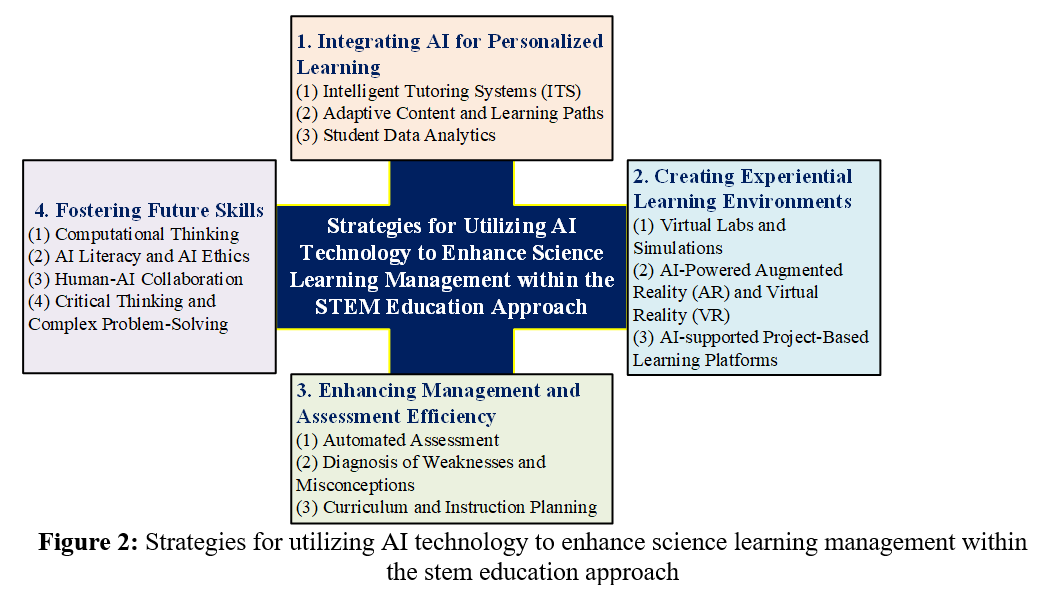
Strategies for Utilizing AI Technology to Enhance Science Learning Management within the STEM Education Approach
Article Sidebar
Main Article Content
Abstract
The integration of Artificial Intelligence (AI) to enhance science learning within the STEM education approach is a significant advancement with the potential to revolutionize education. This paper explores four main strategies for utilizing AI: personalized learning, creating experiential learning environments, enhancing management and assessment efficiency, and fostering future skills. These strategies focus on adapting content to individual learners through intelligent tutoring systems, leveraging AI-powered virtual labs and simulations for realistic hands-on learning, using AI to reduce teachers’ administrative burdens via automated assessment and deep learning analytics, and developing essential computational thinking and AI literacy for the 21st century. However, implementing AI in education presents significant challenges, including a lack of personnel knowledge and skills, infrastructure and budgetary constraints, and issues related to ethics, privacy, and data security. Furthermore, potential negative impacts include increased educational inequality if technology access is uneven, and the risk that over-reliance on AI might diminish students’ critical thinking skills. To maximize the benefits of AI integration and mitigate these risks, this paper recommends crucial approaches. These include substantial investment in professional development, meticulous planning of infrastructure and policies concerning data usage and ethics, promoting continuous research and evaluation, and fostering collaboration among all stakeholders. Comprehensive implementation of these recommendations will enable educational institutions to fully harness AI’s potential, creating high-quality and sustainable STEM learning for youth in the digital education era. While AI offers strategies to enhance STEM learning, its successful integration requires overcoming challenges like skill gaps and ethical concerns through professional development, careful planning, and stakeholder collaboration to create high-quality, sustainable education.
Article Details

This work is licensed under a Creative Commons Attribution-NonCommercial-NoDerivatives 4.0 International License.
License to Publish (LTP)
Upon acceptance of a manuscript, authors will be asked to complete a License to Publish (LTP) Agreement. Authors retain the copyright of their work and grant the International Journal of Science Education and Teaching (IJSET) a non-exclusive license to publish, distribute, and archive the article. All published articles are distributed under the Creative Commons Attribution 4.0 International (CC BY 4.0) License.
[!IMPORTANT]
The information provided here is for reference purposes only. Please do not complete or submit this form during the initial submission stage. If your paper is accepted, the editorial office will provide you with specific instructions on how to finalize and submit the formal agreement.
Download the License to Publish (LTP).
References
Aad, S., & Hardey, M. (2025). Generative AI: hopes, controversies and the future of faculty roles in education. Quality Assurance in Education, 33(2), 267-282. https://doi.org/10.1108/QAE-02-2024-0043
Abdekhoda, M., & Dehnad, A. (2024). Adopting artificial intelligence driven technology in medical education. Interactive Technology and Smart Education, 21(4), 535-545. https://doi.org/10.1108/ITSE-12-2023-0240
Alsobeh, A., & Woodward, B. (2024). An Integrative Review of AI-Powered STEM Education. International Journal of AI in Education and Applied Research, 7(1), 1-15. http://ijeais.org/wp-content/uploads/2024/4/IJAPR240420.pdf
Arslan, N., Haj Youssef, M., & Ghandour, R. (2025). AI and learning experiences of international students studying in the UK: an exploratory case study. Artificial Intelligence in Education, 1(1), 1-23. https://doi.org/10.1108/AIIE-10-2024-0019
Asad, M.M., & Ajaz, A. (2024). Impact of ChatGPT and generative AI on lifelong learning and upskilling learners in higher education: unveiling the challenges and opportunities globally. International Journal of Information and Learning Technology, 41(5), 507-523. https://doi.org/10.1108/IJILT-06-2024-0103
Assefa, Y., Gebremeskel, M.M., Moges, B.T., Tilwani, S.A., & Azmera, Y.A. (2025). Rethinking the digital divide and associated educational in(equity) in higher education in the context of developing countries: the social justice perspective. International Journal of Information and Learning Technology, 42(1), 15-32. https://doi.org/10.1108/IJILT-03-2024-0058
Baber, H., Nair, K., Gupta, R., & Gurjar, K. (2024). The beginning of ChatGPT – a systematic and bibliometric review of the literature. Information and Learning Sciences, 125(7/8), 587-614. https://doi.org/10.1108/ILS-04-2023-0035
Bilal, D., He, J., & Liu, J. (2025). Guest editorial: AI in education: transforming teaching and learning. Information and Learning Sciences, 126(1/2), 1-7. https://doi.org/10.1108/ILS-01-2025-268
Cahyono, S., Ardianto, A., & Nasih, M. (2024). Breaking barriers: CEOs STEM educational background and corporate climate change disclosure. International Journal of Accounting & Information Management, 32(4), 651-684. https://doi.org/10.1108/IJAIM-10-2023-0268
Chen, K., Tallant, A.C., & Selig, I. (2025). Exploring generative AI literacy in higher education: student adoption, interaction, evaluation and ethical perceptions. Information and Learning Sciences, 126(1/2), 132-148. https://doi.org/10.1108/ILS-10-2023-0160
Cook, J.S., & Cook, J. (2024). Artificial intelligence in management education: transformative potential and challenges. SAM Advanced Management Journal, 89(4), 340-355. https://doi.org/10.1108/SAMAMJ-05-2024-0026
Ebekozien, A., Aigbavboa, C., & Aliu, J. (2023). Built environment academics for 21st-century world of teaching: stakeholders’ perspective. International Journal of Building Pathology and Adaptation, 41(6), 119-138. https://doi.org/10.1108/IJBPA-04-2022-0062
Ellikkal, A., & Rajamohan, S. (2025). AI-enabled personalized learning: empowering management students for improving engagement and academic performance. Vilakshan - XIMB Journal of Management, 22(1), 28-44. https://doi.org/10.1108/XJM-02-2024-0023
Elbanna, S., & Armstrong, L. (2024). Exploring the integration of ChatGPT in education: adapting for the future. Management & Sustainability: An Arab Review, 3(1), 16-29. https://doi.org/10.1108/MSAR-03-2023-0016
Gafni, R., & Levy, Y. (2024). The role of artificial intelligence (AI) in improving technical and managerial cybersecurity tasks’ efficiency. Information and Computer Security, 32(5), 711-728. https://doi.org/10.1108/ICS-04-2024-0102
Hannan, E., & Liu, S. (2023). AI: new source of competitiveness in higher education. Competitiveness Review, 33(2), 265-279. https://doi.org/10.1108/CR-03-2021-0045
Hardaker, G., & Glenn, L.E. (2025). Artificial intelligence for personalized learning: a systematic literature review. International Journal of Information and Learning Technology, 42(1), 1-14. https://doi.org/10.1108/IJILT-07-2024-0160
Hur, J.W. (2025). Fostering AI literacy: overcoming concerns and nurturing confidence among preservice teachers. Information and Learning Sciences, 126(1/2), 56-74. https://doi.org/10.1108/ILS-11-2023-0170
Jafari, F., & Keykha, A. (2024). Identifying the opportunities and challenges of artificial intelligence in higher education: a qualitative study. Journal of Applied Research in Higher Education, 16(4), 1228-1245.
Kang, H. (2023). Artificial intelligence and its influence in adult learning in China. Higher Education, Skills and Work-Based Learning, 13(3), 450-464. https://doi.org/10.1108/HESWBL-01-2023-0017
Li, K.C., & Wong, B.T.-M. (2023). Artificial intelligence in personalised learning: a bibliometric analysis. Interactive Technology and Smart Education, 20(3), 422-445. https://doi.org/10.1108/ITSE-01-2023-0007
Lytras, M.D., & Ordonez De Pablos, P. (2024). Guest editorial: Active and transformative learning in higher education in times of artificial intelligence and ChatGPT. Interactive Technology and Smart Education, 21(4), 489-498. https://doi.org/10.1108/ITSE-11-2024-252
Marengo, A., Pagano, A., Pange, J., & Soomro, K.A. (2024). The educational value of artificial intelligence in higher education: a 10-year systematic literature review. Interactive Technology and Smart Education, 21(4), 625-644. https://doi.org/10.1108/ITSE-11-2023-0218
Mariyono, D., & Nur Alif Hd, A. (2025). AI’s role in transforming learning environments: a review of collaborative approaches and innovations. Quality Education for All, 2(1), 265-288. https://doi.org/10.1108/QEA-08-2024-0071
Mudkanna Gavhane, J., & Pagare, R. (2024). Artificial intelligence for education and its emphasis on assessment and adversity quotient: a review. Education + Training, 66(6), 609-645. https://doi.org/10.1108/ET-04-2023-0117
Narayanan, V. (2023). The transformative AI initiative: from process digitization to AI strategic digitalization. Strategy & Leadership, 51(2), 24-30. https://doi.org/10.1108/SL-01-2023-0009
Omran Zailuddin, M.F.N., Nik Harun, N.A., Abdul Rahim, H.A., Kamaruzaman, A.F., Berahim, M.H., Harun, M.H., & Ibrahim, Y. (2024). Redefining creative education: a case study analysis of AI in design courses. Journal of Research in Innovative Teaching & Learning, 17(2), 282-296. https://doi.org/10.1108/JRIT-01-2024-0019
Oyelude, A.A. (2024). Artificial intelligence (AI) tools for academic research. Library Hi Tech News, 41(8), 18-20. https://doi.org/10.1108/LHTN-08-2024-0131
Payadnya, I.P.A.A., Putri, G.A.M.A., Suwija, I.K., Saelee, S., & Jayantika, I.G.A.N.T. (2025). Cultural integration in AI-enhanced mathematics education: insights from Southeast Asian educators. Journal for Multicultural Education, 19(1), 58-72. https://doi.org/10.1108/JME-09-2024-0119
Phakamach, P. (2023). Educational innovation: elements and mechanisms for the development of Thai educational institutions towards internationalization. Journal of Education and Innovative Learning, 3(2), 161-179.
https://so06.tci-thaijo.org/index.php/jeil/article/view/261444
Phakamach, P., Panjarattanakorn, D., & Seenonlee, A. (2025). Innovative leadership for professional education administrators in the digital age. Journal of Education and Learning Reviews, 2(3), 153–170. https://doi.org/10.60027/jelr.2025.1765
Phakamach, P., Senarith, P., & Wachirawongpaisarn, S. (2022). The metaverse in education: The future of immersive teaching & learning. RICE Journal of Creative Entrepreneurship and Management, 3(2), 75-88. https://doi.org/10.14456/rjcm.2022.12
Retno, R.S., Purnomo, P., Hidayat, A., & Mashfufah, A. (2025). Conceptual framework design for STEM-integrated project-based learning (PjBL-STEM) for elementary schools. Asian Education and Development Studies, 14(3), 579-604. https://doi.org/10.1108/AEDS-08-2024-0188
Ronaghi, M.H., & Ronaghi, M. (2025). How does the use of artificial intelligence affect sustainability rating in Middle Eastern universities?. Asian Education and Development Studies, 14(2), 152-172. https://doi.org/10.1108/AEDS-08-2024-0182
Routray, R., & Khandelwal, K. (2024). Artificial intelligence (AI) adoption: do Generation Z students feel technostress in deploying AI for completing courses of study at universities?. Asian Education and Development Studies, 13(5), 534-545. https://doi.org/10.1108/AEDS-06-2024-0115
Sposato, M. (2025). A call for caution and evidence–based research on the impact of artificial intelligence in education. Quality Education for All, 2(1), 158-170. https://doi.org/10.1108/QEA-09-2024-0087
Vodenko, K.V., & Lyausheva, S.A. (2020). Science and education in the form 4.0: public policy and organization based on human and artificial intellectual capital. Journal of Intellectual Capital, 21(4), 549-564. https://doi.org/10.1108/JIC-11-2019-0274
Weinhandl, R., Lavicza, Z., & Houghton, T. (2020). Mathematics and STEM teacher development for flipped education. Journal of Research in Innovative Teaching & Learning, 13(1), 3-25. https://doi.org/10.1108/JRIT-01-2020-0006
Williamson, J.M., & Fernandez, P. (2025). “Through the looking glass: envisioning new library technologies” academic search using artificial intelligence tools. Library Hi Tech News, 42(2), 1-5. https://doi.org/10.1108/LHTN-01-2025-0014
Zhan, Z., Shen, W., Xu, Z., Niu, S., & You, G. (2022). A bibliometric analysis of the global landscape on STEM education (2004-2021), towards global distribution, subject integration, and research trends. Asia Pacific Journal of Innovation and Entrepreneurship, 16(2), 171-203. https://doi.org/10.1108/APJIE-08-2022-0090
