
Beyond Formula: Exploring Students’ Lived Experiences in Physics Problem-Solving
Article Sidebar
Main Article Content
Abstract
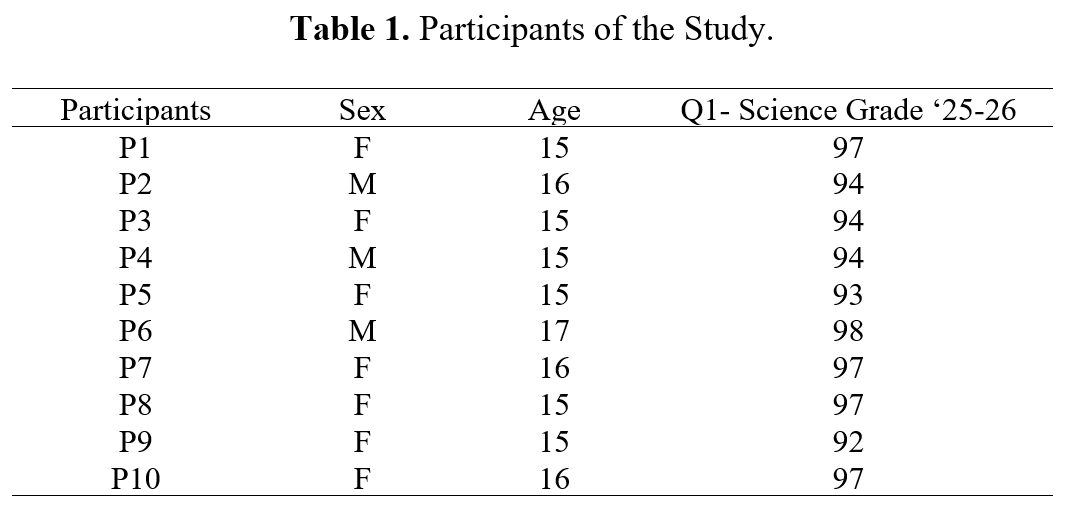
Understanding how students engage during physics problem-solving is crucial for improving learning outcomes. Despite efforts to enhance conceptual understanding and support meaningful learning, few studies have examined how strategic, emotional, and agentic engagement intersect in students’ lived experiences of solving physics problems. This study explored how high school STEM students from Baybay City, Leyte, experience and express these dimensions, highlighting engagement as extending beyond formulas into meaning-making and self-directed learning. Using a descriptive phenomenological design guided by Giorgi’s (2009) method, ten students were interviewed with semi-structured, open-ended questions that prompted them to narrate their problem-solving experiences. Interviews were audio-recorded, translated from Bisaya to English using AI-assisted tools, and analyzed through phenomenological reduction, segmentation into meaning units, and synthesis into essential psychological structures. Analysis revealed four interrelated constituents of engagement: (1) strategic engagement, reflected in deliberate, organized problem-solving methods such as GAFSA and visual representations; (2) emotional engagement, manifested in regulating anxiety, stress, and excitement into calmness and satisfaction; (3) agentic engagement, demonstrated through proactive self-direction and collaboration, including creating reviewers, clarifying concepts, and supporting peers; and (4) transformative impact, where students internalized clarity, reflection, and initiative as transferable skills. Physics problem-solving thus emerged as a lived experience integrating thought, emotion, and action. The study concludes that reflective, student-centered pedagogies that cultivate these three dimensions can humanize physics learning, fostering conceptual mastery, emotional resilience, and empowered, self-directed learners.
Article Details

This work is licensed under a Creative Commons Attribution-NonCommercial-NoDerivatives 4.0 International License.
License to Publish (LTP)
Upon acceptance of a manuscript, authors will be asked to complete a License to Publish (LTP) Agreement. Authors retain the copyright of their work and grant the International Journal of Science Education and Teaching (IJSET) a non-exclusive license to publish, distribute, and archive the article. All published articles are distributed under the Creative Commons Attribution 4.0 International (CC BY 4.0) License.
[!IMPORTANT]
The information provided here is for reference purposes only. Please do not complete or submit this form during the initial submission stage. If your paper is accepted, the editorial office will provide you with specific instructions on how to finalize and submit the formal agreement.
Download the License to Publish (LTP).
References
Bacarro, J. M., Galorport, A. E., Quimco, R. F. H., Rollon, M., Sua, A. J., Cabanilla, A., & Cortes, V. (2024). Graphic organizers pedagogy and retention skills of students with intellectual disability: A sequential explanatory mixed-methods inquiry. CNU Journal of Higher Education, 18(1), 35-47. https://doi.org/10.70997/2546-1796.1157
Bande, R. J., Cabahit, J. D., Macatual, K. M., Enero, C., Denden, R., & Bellen, J. (2025). Enhancing Grade 8 proficiency in analyzing Ohm’s law concepts through the GameMapPro method. Journal of Interdisciplinary Perspectives, 3(8), 670–681. https://doi.org/10.69569/jip.2025.428
Blegur, J., Wasak, M. R. P., & Rosari, R. (2019). Students’ self-confidence restoration with peer mentoring strategy. European Scientific Journal, 15(19), 129–138. https://doi.org/10.19044/esj.2019.v15n19p129
Bogador, C. J., Camarao, M. K. G., Matunding, C. G., & Sombria, K. J. F. (2024). Challenges and benefits of inquiry-based learning in physics. International Journal of Multidisciplinary: Applied Business and Education Research, 5(7), 2716–2732. https://doi.org/10.11594/ijmaber.05.07.26
Briones, M. R., Prudente, M., & Errabo, D. D. (2023). Characteristics of Filipino online learners: A survey of science education students’ engagement, self-regulation, and self-efficacy. Education Sciences, 13(11), 1131. https://doi.org/10.3390/educsci13111131
Cabugwason, M. R., Laoreno, B. G., Galoy, R. M. P., Valila, A. J., & Nobis, M. L. (2024). Math apps in math education: Experiences and challenges of pre-service teachers. Ignatian International Journal for Multidisciplinary Research, 2(5), 1909–1992. https://doi.org/10.5281/zenodo.11235604
Cagatan, A. N. P., & Quirap, E. A. (2024). Collaborative learning and learners’ academic performance. International Journal of Multidisciplinary Research and Analysis, 7(3), 1330–1337. https://doi.org/10.47191/ijmra/v7-i03-57
Creswell, J. W., & Plano Clark, V. L. (2018). Designing and conducting mixed methods research (3rd ed.). SAGE.
Donalie, N. B., Ordoña, M. B., Llorente, J. M., & Camarao, M. G. (2024). Teachers’ difficulties and coping strategies in physics. International Journal of Multidisciplinary: Applied Business and Education Research, 5(4), 1384–1389. https://doi.org/10.11594/ijmaber.05.04.22
Endiape, J. A., Lopez, J. F. V., Lastimosa, Z. T., Gecain, C. A. V., Herbieto, N. M. C., Sanchez, J. M. P., & Picardal, M. T. (2023). Students’ performance, satisfaction, and experiences in graphic-organizer-integrated online instruction of astronomy. Science Education International. https://www.icaseonline.net/journal/index.php/sei/article/view/546
Espinoza, F. (2020). Impact of guided inquiry with simulations on knowledge of electricity and wave phenomena. European Scientific Journal, 16(33), 1–15. https://doi.org/10.19044/esj.2020.v16n33p1
Esto, J. B., Acelar, C. R., Balungay, M. A. T., Neri, A. V., Bat-Og, R. V. N. D., Dollente, L. A. U., Ortiz, A. C. S., Ongcoy, P. J. B., Castilla, M. J. B., Mangindra, N. M., Pedro, M. E. S., & Tagare, R. L., Jr. (2025). Students’ distress level and its relationship with nonproductive thoughts: The case of premier universities in Mindanao, Philippines. Multidisciplinary Science Journal, 8(1), 2026120. https://doi.org/10.31893/multiscience.2026120
Favale, F., & Bondani, M. (2014). Misconceptions about optics: An effect of misleading explanations? Proceedings of SPIE, 9289, 92891A. https://doi.org/10.1117/12.2070520
Gardose, C. K. C., Castillo, A. A., & Madroñal, M. H. (2025). Comic-Polya method integration in physics: Enhancing students’ conceptual understanding and motivation. Indonesian Journal of Education Research, 6(1), 35–44. https://doi.org/10.37251/ijoer.v6i1.1216
Haberlin, S. (2024). Calming student stress: Mindfulness, meditation, and other strategies to reduce anxiety and enhance learning in K–12 classrooms. Rowman & Littlefield.
Lincoln, Y. S., & Guba, E. G. (1985). Naturalistic inquiry. SAGE.
Merriam, S. B., & Tisdell, E. J. (2016). Qualitative research: A guide to design and implementation (4th ed.). Jossey-Bass.
Mestre, J. P., Docktor, J. L., Strand, N. E., & Ross, B. H. (2011). Conceptual problem solving in physics. In B. H. Ross (Ed.), Psychology of learning and motivation (Vol. 55, pp. 269–298). Elsevier. https://doi.org/10.1016/B978-0-12-387691-1.00009-0
Tomas, L., Rigano, D., & Ritchie, S. M. (2016). Students’ regulation of their emotions in a science classroom. Journal of Research in Science Teaching, 53(2), 234–260. https://doi.org/10.1002/tea.21304
Yusefzadeh, H., Iranagh, J. A., & Nabilou, B. (2019). The effect of study preparation on test anxiety and performance: A quasi-experimental study. Advances in Medical Education and Practice, 10, 245–251. https://doi.org/10.2147/AMEP.S192053
