
Enhancing Conceptual Understanding of Climate Change in Non-Science Preservice Teachers Using DIY Model Kits
Article Sidebar
Main Article Content
Abstract
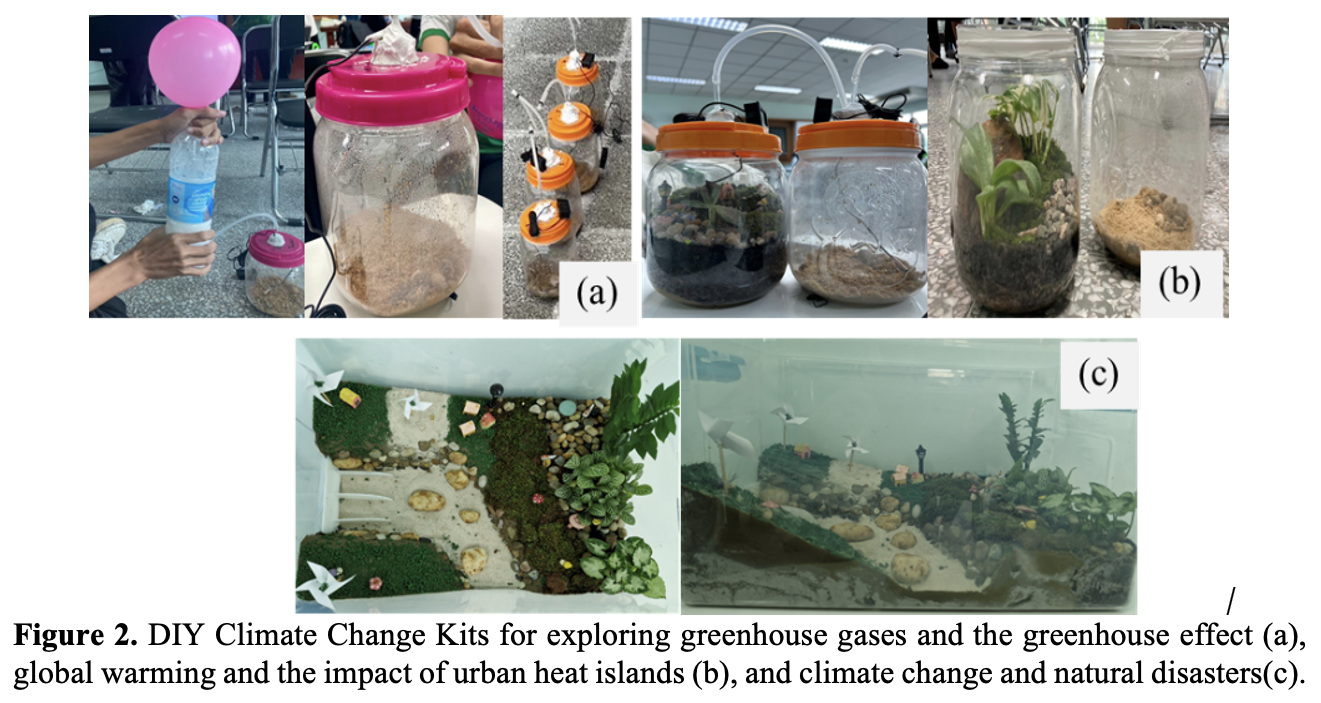
Climate change education is critical for improving climate literacy; however, non-science preservice teachers often hold persistent misconceptions that limit their instructional readiness. This study examined the effectiveness of low-cost DIY Model Kits in enhancing conceptual understanding of climate change among 45 non-science preservice teachers with limited exposure to climate science. Participants engaged in three inquiry-based activities via DIY model kits addressing greenhouse gases and the greenhouse effect, global warming and urban heat islands, and climate change–related natural disasters. The experimental models revealed clear cause–effect patterns, including progressively greater temperature increases with increasing CO₂ concentration, minimal temperature change in non-greenhouse gas conditions, and higher heat accumulation in built environments compared with vegetated models. The statistical methods used for data analysis were clearly specified, including the dependent samples t-test and normalized gain. Conceptual understanding was assessed using 10 items of the Conceptual Test of Climate Change (CTCC) through a one-group pretest–posttest design. Results showed a statistically significant increase in total CTCC scores from 28.64% (mean = 8.02, S.D. = 2.59) on the pretest to 84.93% (mean = 23.78, S.D. = 2.27) on the posttest (p < 0.05), with a high normalized gain (<g> = 0.79). These findings demonstrate that inquiry-based DIY model kits can effectively support conceptual change and strengthen climate literacy among non-science preservice teachers.
Article Details

This work is licensed under a Creative Commons Attribution-NonCommercial-NoDerivatives 4.0 International License.
License to Publish (LTP)
Upon acceptance of a manuscript, authors will be asked to complete a License to Publish (LTP) Agreement. Authors retain the copyright of their work and grant the International Journal of Science Education and Teaching (IJSET) a non-exclusive license to publish, distribute, and archive the article. All published articles are distributed under the Creative Commons Attribution 4.0 International (CC BY 4.0) License.
[!IMPORTANT]
The information provided here is for reference purposes only. Please do not complete or submit this form during the initial submission stage. If your paper is accepted, the editorial office will provide you with specific instructions on how to finalize and submit the formal agreement.
Download the License to Publish (LTP).
References
Abbass, K., Qasim, M. Z., Song, H., Murshed, M., Mahmood, H., & Younis, I. (2022). A review of the global climate change impacts, adaptation, and sustainable mitigation measures. Environmental Science and Pollution Research, 29(28), 42539–42559. https://doi.org/10.1007/s11356-022-19718-6
Abriata, L. A. (2022). How technologies assisted science learning at home during the COVID-19 pandemic. Journal of Chemical Education, 99(1), 59–67. https://doi.org/10.1021/acs.jchemed.1c00710
Alexandra, J. (2021). How do the cultural dimensions of climate shape our understanding of climate change? Climate, 9(63), 1–15. https://doi.org/10.3390/cli9040063
Bajracharya, B., Gondi, V., & Hua, D. (2021). IoT education using learning kits of IoT devices. Information Systems Education Journal, 19(6), 40–49.
Boon, H. J. (2016). Climate change? Who knows? A comparison of secondary students and preservice teachers. Australian Journal of Teacher Education, 41(3), 39-54.
Bruine de Bruin, W., Rabinovich, L., Weber, K., Babboni, M., Dean, M., & Ignon, L. (2021). Public understanding of climate change terminology. Climatic Change, 167(37), 1–21. https://doi.org/10.1007/s10584-021-03183-0
Bybee, R. W. (2014). The BSCS 5E Instructional Model: Personal Reflections and Contemporary Implications. Science and Children, 51(8), 10–13.
Çelikler, D. (2011). The effects of model-based teaching on students’ conceptual understanding of the greenhouse effect. International Journal of Environmental and Science Education, 6(1), 35–54.
Christman, E., Miller, P., & Stewart, J. (2024). Beyond normalized gain: Improved comparison of physics educational outcomes. Physical Review Physics Education Research, 20(1), 010123. https://doi.org/10.1103/PhysRevPhysEducRes.20.010123
Department of Climate Change and Environment (DCCE). (2020). Environmental studies activity guide: climate change. Department of Environmental Quality Promotion, Environmental Education Group, 1-231.
Feldbacher, E., Waberer, M., Campostrini, L., & Weigelhofer, G. (2024). Identifying gaps in climate change education: A case study in Austrian schools. International Research in Geographical and Environmental Education, 33(2), 109–124. https://doi.org/10.1080/10382046.2023.2214042
Foley, J. M., Bruno, B. C., Tolman, R. T., Kagami, R. S., Hsia, M. H., Mayer, B., & Inazu, J. K. (2013). C- MORE science kits as a classroom learning tool. Journal of Geoscience Education, 61(3), 256–267. https://doi.org/10.5408/12-336.1
Khalid, H. M. (2001). Policy implementation models: the case of library and documentation services in Pakistan, 1998‐2008. New library world, 102(3), 87-92.
Lee, K., Gjersoe, N., O’Neill, S., & Barnett, J. (2020). Youth perceptions of climate change: A narrative synthesis. WIREs Climate Change, 11(3), e641. https://doi.org/10.1002/wcc.641
Leiserowitz, A., Smith, N., & Marlon, J. R. (2011). American teens’ knowledge of climate change. Yale University. New Haven, CT: Yale project on climate change communication, 5.
Li, E., Lam, A. T., Fuhrmann, T., Erikson, L., Wirth, M., Miller, M. L., & Riedel-Kruse, I. H. (2022). DIY liquid handling robots for integrated STEM education and life science research. PLoS ONE, 17(11), e0275688. https://doi.org/10.1371/journal.pone.0275688
Luthfia, S. (2025). Learning approach to climate change education as a framework for sustainability education: A systematic review of literature. International Journal of Chemistry Education Research, 9(1), 31– 41. https://doi.org/10.20885/ijcer.vol9.iss1.art4
Monroe, M. C., Plate, R. R., Oxarart, A., Bowers, A., & Chaves, W. A. (2017). Identifying effective climate change education strategies: A systematic review of the research. Environmental Education Research, 25(6), 791–812.
Office of the Basic Education Commission. (2017). Basic Education Core Curriculum B.E. 2551 (Revised edition B.E. 2560). Ministry of Education, Thailand.
Posner, G. J., Strike, K. A., Hewson, P. W., & Gertzog, W. A. (1982). Accommodation of a scientific conception: Toward a theory of conceptual change. Science Education, 66(2), 211–227. https://doi.org/10.1002/sce.3730660207
Ramos, R., & Rodrigues, M. J. (2024). Climate change education: A systematic review. Brazilian Journal of Education, Technology and Society, 17(4), 1229–1239. https://doi.org/10.14571/brajets.v17.n4.1229- 1239
Rousell, D., & Cutter-Mackenzie-Knowles, A. (2020). A systematic review of climate change education: Giving children and young people a ‘voice’ and a ‘hand’ in redressing climate change. Children’s Geographies, 18(2), 191–208. https://doi.org/10.1080/14733285.2019.161453
Tolppanen, S., Cantell, H., Aarnio-Linnanvuori, E., & Lehtonen, A. (2021). Climate change education and pre-service teachers’ sense of professional agency. Environmental Education Research, 27(2), 260–277.
