
Creative Capacity Development of Community-Based Entrepreneurs to Support the Local Creative Economy in San Pong Subdistrict, Mae Rim District, Chiang Mai Province
Article Sidebar
Main Article Content
Abstract
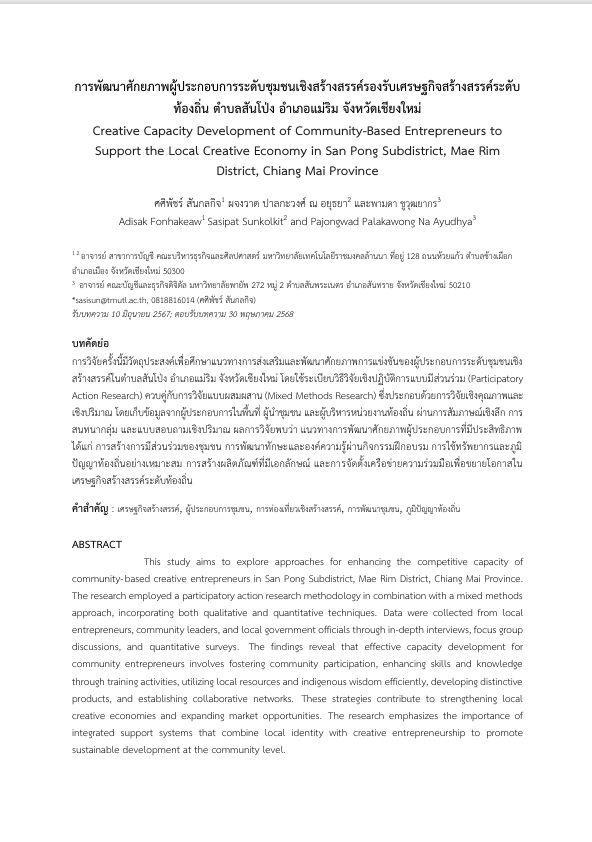
This study aims to explore approaches for enhancing the competitive capacity of community-based creative entrepreneurs in San Pong Subdistrict, Mae Rim District, Chiang Mai Province. The research employed a participatory action research methodology in combination with a mixed methods approach, incorporating both qualitative and quantitative techniques. Data were collected from local entrepreneurs, community leaders, and local government officials through in-depth interviews, focus group discussions, and quantitative surveys. The findings reveal that effective capacity development for community entrepreneurs involves fostering community participation, enhancing skills and knowledge through training activities, utilizing local resources and indigenous wisdom efficiently, developing distinctive products, and establishing collaborative networks. These strategies contribute to strengthening local creative economies and expanding market opportunities. The research emphasizes the importance of integrated support systems that combine local identity with creative entrepreneurship to promote sustainable development at the community level.
Article Details

This work is licensed under a Creative Commons Attribution-NonCommercial-NoDerivatives 4.0 International License.
This article is published under a Creative Commons Attribution-NonCommercial-NoDerivatives 4.0 International License (CC BY-NC-ND 4.0), which allows others to share the article with proper attribution to the authors and prohibits commercial use or modification. For any other reuse or republication, permission from the journal and the authors is required.
References
เทศบาลตำบลสันโป่ง. (2020). แผนพัฒนาเศรษฐกิจสร้างสรรค์ตำบลสันโป่ง. รายงานประจำปีเทศบาลตำบลสันโป่ง, 20-35.
ทิพย์วรรณ สุขใจรุ่งวัฒนา. (2561). กระบวนทัศน์กระแสทางเลือก: ยุทธศาสตร์การขับเคลื่อนเศรษฐกิจสร้างสรรค์ในสังคมไ ทย. Veridian E-Journal ฉบับภาษาไทย สาขามนุษยศาสตร์ สังคมศาสตร์ และศิลปะ มหาวิทยาลัยศิลปากร, 11(1), 411-427.
ทักษญา สง่าโยธิน. (2560). ปัจจัยแห่งความสำเร็จของการด าเนินงานวิสาหกิจชุมชน. วารสารวิทยาลัยพณิชยศาสตร์บูรพาปริทัศน์, 12(2),11-25.
ธัญญารัตน์ พรหมสุทธิ์ และคณะ. (2564). การพัฒนาสมรรถนะทรัพยากรมนุษย์เพื่อรองรับยุคประเทศไทย 4.0. วารสารวิทยาลัยสงฆ์นครลําปาง, 10(1), 228-243.
นิภาภรณ์ จงวุฒิเวศย์, รังสรรค์ สิงหเลิศ, สมสงวน ปัสสาโก. (2563). ปัจจัยที่ส่งผลต่อความสำเร็จในการดำเนินงานของธุรกิจชุมชน ในเขตอำเภอเมือง จังหวัดร้อยเอ็ด. วารสารมหาวิทยาลัย ราชภัฏมหาสารคาม; ว.มรม,ปีที่ 4(ฉบับ 2)
Howkins, J. (2001). The Creative Economy: How People Make Money from Ideas. Penguin.
Kotler, P. (1997). Marketing Management: Analysis, planning, implementation and control, (9thed.). New Jersey: A Simon & Schuster Company.
Kotler, P. (2003). Marketing management. (11thed.). New Jersey: Pearson Education.
Kotas, M. (2015). Key success factors for social services organizations in Poland. Management, 19(2), 122-135.
Nanyarath Niyompong. (2017). Creative Economy: Concepts and Applications. Journal of Cultural Economics, 41(2), 123-135.
Pannita Mitpakdee. (2018). National Strategy for Enhancing Competitive Advantage through Creative Economy. Thailand Journal of Public Policy, 5(1), 45-60.
UNESCO. (2020). The Impact of the COVID-19 Pandemic on the Creative Economy. United Nations Educational, Scientific and Cultural Organization.
