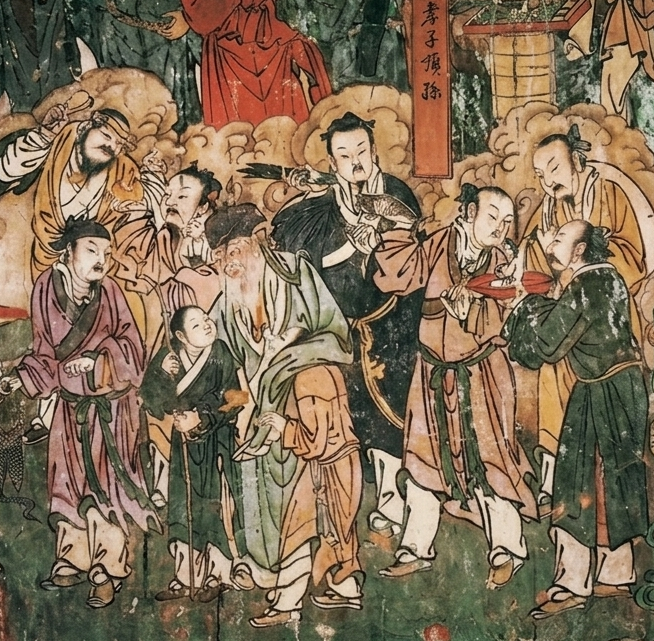
Contemporary Expressions of the Pilu Temple Murals, Shijiazhuang, Hebei, China: A Visual Dialogue Between Intangible Cultural Heritage and Modern Art
บทคัดย่อ
As important residua of ancient Chinese religious art, the murals of Pilu Temple reflect a distinct visual language and great cultural significance. Based on the Buddhist Water-Land ritual and combining with Confucian, Buddhist, and Daoist imagery, folk beliefs and social psychology. Having lost primary ritual functions, the murals now stand as core intangible cultural heritage symbols and critical visual resources for modern artistic creation. Through field surveys, on-site sketching, archival research, and iconographical analysis, combined with the frameworks of semiotics, iconography, and folklore, this study analyzes the visual characteristics and aesthetic value of the Pilu Temple murals, and further explores their potential for transformation within contemporary art.
Downloads
Article Details
รูปแบบการอ้างอิง
ประเภทบทความ
บทความวิจัย
Copyright & License
ลิขสิทธิ์ (c) 2026 วารสารศิลปะและวัฒนธรรมลุ่มแม่น้ำมูล

อนุญาตภายใต้เงื่อนไข Creative Commons Attribution-NonCommercial-NoDerivatives 4.0 International License.
บทความทุกเรื่องที่ตีพิมพ์ในรูปแบบ เปิดให้เข้าถึง (Open Access) ภายใต้สัญญาอนุญาต CC BY-NC-ND 4.0 จะสามารถเข้าถึงได้ฟรีทันทีและอย่างถาวรสำหรับทุกคน โดยผู้อ่านสามารถอ่าน ดาวน์โหลด ทำสำเนา แจกจ่าย พิมพ์ ค้นหา หรือเชื่อมโยงไปยังบทความได้โดยไม่เสียค่าใช้จ่าย การใช้งานอนุญาตเฉพาะเพื่อวัตถุประสงค์ที่ไม่แสวงหากำไร (ไม่อนุญาตการใช้เพื่อการค้า) และต้องไม่ทำการดัดแปลงแก้ไขผลงาน (ไม่อนุญาตการดัดแปลง) การเข้าถึงไม่จำเป็นต้องขออนุญาตล่วงหน้าจากสำนักพิมพ์หรือผู้แต่ง ทั้งนี้ต้องมีการอ้างอิงถึงแหล่งตีพิมพ์ต้นฉบับอย่างถูกต้องและเหมาะสม




เอกสารอ้างอิง
Barthes, R. (1972). Mythologies. Hill and Wang.
Chen, Y. L. (1982). The Historical and Cultural Value of Pilu Temple and its Water-Land Murals. Cultural Relics Press. (In Chinese)
Eco, U. (1976). A Theory of Semiotics. Indiana University Press. DOI: https://doi.org/10.1007/978-1-349-15849-2
Hebei Provincial Cultural Heritage Research Center. (2021). Cultural heritage and historical sites in Shijiazhuang area. Hebei Cultural Heritage, 10(4), 33 - 40. (In Chinese)
Hebei Provincial Cultural Heritage Research Center. (2023). Architectural style and historical restoration of Pilu Temple. Hebei Architecture and Historical Culture, 19(3), 55 - 68. (In Chinese)
Kong, X. F., & Meng, X. Z. (2021). Discussion on the Artistic Characteristics and Inheritance Value of the Murals of Pilu Temple. Art Research Journal. (In Chinese)
Liang, Y. (2020). Research on the Techniques of Restoring Traditional Murals in Taiyuan. Historical Art Review. (In Chinese)
Ma, W. (2024). The Application of Traditional Chinese Cultural Symbols in Contemporary Art: A case Study of Dunhuang Mural Symbols. Daguan (Forum), (3), 18 - 20. (In Chinese)
Martyka, A. M., Rościecha-Kanownik, A., & Torres, I. F. (2025). Mural Painting Across Eras: From Prehistoric Caves to Contemporary Street Art. Arts, 14(4), 77. https://doi.org/10.3390/arts14040077. DOI: https://doi.org/10.3390/arts14040077
Meng, B., & Wang, P. (2025). The Influence of Traditional Mural Art on Contemporary Artistic Creation. Zhongzhou Academic Journal, (3), 154 - 159. (In Chinese)
Peirce, C. S. (1934). Collected Papers of Charles Sanders Peirce (Vol. 5). Harvard University Press.
Su, J. C. (2006). The Artistic Characteristics and Religious Functions of the Pilu Temple Murals. China Social Sciences Press. (In Chinese)
Xia, J. (2023). Phenomenon, Representation, and Micro-meaning: A Brief Explanation of Panofsky’s Iconological Terminology. World Art, 2, 71-77. (In Chinese)
Zhengding Institute of Cultural Heritage Research. (2022a). Historical Changes and Restoration Records of Pilu Temple. Hebei Cultural Heritage Studies, 16(3), 12 - 27. (In Chinese)
Zhengding Institute of Cultural Heritage Research. (2022b). History and Religious Background of Pilu Temple. Hebei Cultural Heritage Studies, 15(2), 45 - 58. (In Chinese)
Zhong, J.S. (1988). An Introduction to Folklore. Beijing Normal University Press. (In Chinese)
