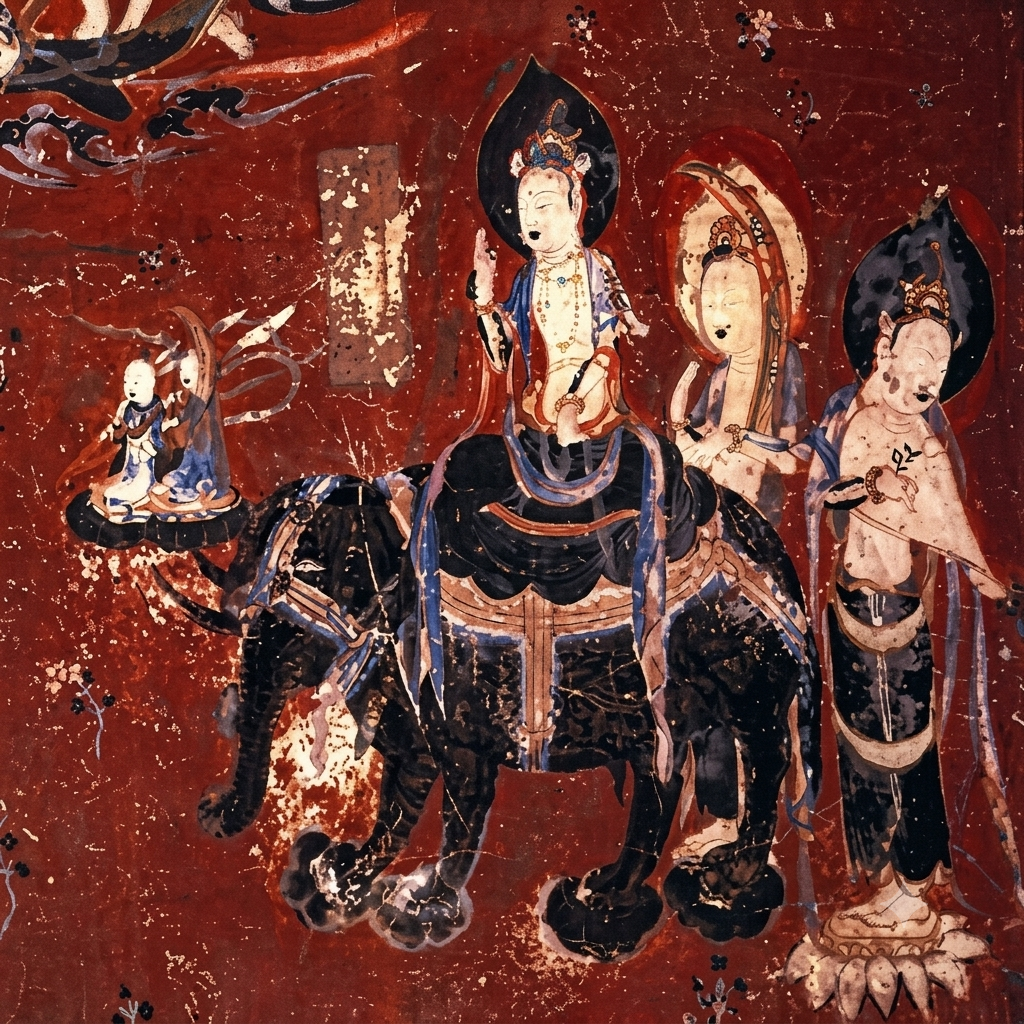
Innovative Application of the Six-Tusked White Elephant in Dunhuang Murals in Cultural and Creative Design
บทคัดย่อ
This study examines the Six-Tusked White Elephant depicted in Dunhuang murals and explores its reinterpretation in contemporary cultural and creative design. As a Buddhist symbol embodying compassion, wisdom, and enlightenment, the white elephant holds strong visual and cultural significance in Dunhuang art. Through image analysis and literature review, the study identifies its key formal characteristics—side-view composition, forward-tilting head, prominent six tusks, and square limb structure—and extracts major decorative elements such as lotus patterns, auspicious clouds, reins, and flowing ribbons, providing transferable visual resources for modern design.
In the context of the rising “Guochao” (Chinese-chic) trend, the white elephant is reimagined with greater emotional warmth and visual accessibility. Its contemporary expressions—pattern stylization, cartoonization, and narrative-based design—demonstrate broad potential across creative industries. Market research shows, however, that current cultural products remain limited by homogeneous designs, insufficient diversity, and weak communication channels, while high aesthetic quality and emotional resonance emerge as key drivers of consumer purchasing.
Based on user-centered insights, the study proposes three design strategies: enhancing visual appeal through “cute aesthetics,” embedding healing and comforting emotional experiences to meet the psychological needs of young users, and adopting gamified mechanisms such as blind boxes to strengthen engagement and cultural interaction. This research offers a new design framework for the contemporary transformation of the Dunhuang Six-Tusked White Elephant and contributes to the modern dissemination of traditional Chinese culture.
Downloads
Article Details
รูปแบบการอ้างอิง
ประเภทบทความ
บทความวิจัย
Copyright & License
ลิขสิทธิ์ (c) 2026 วารสารศิลปะและวัฒนธรรมลุ่มแม่น้ำมูล

อนุญาตภายใต้เงื่อนไข Creative Commons Attribution-NonCommercial-NoDerivatives 4.0 International License.
บทความทุกเรื่องที่ตีพิมพ์ในรูปแบบ เปิดให้เข้าถึง (Open Access) ภายใต้สัญญาอนุญาต CC BY-NC-ND 4.0 จะสามารถเข้าถึงได้ฟรีทันทีและอย่างถาวรสำหรับทุกคน โดยผู้อ่านสามารถอ่าน ดาวน์โหลด ทำสำเนา แจกจ่าย พิมพ์ ค้นหา หรือเชื่อมโยงไปยังบทความได้โดยไม่เสียค่าใช้จ่าย การใช้งานอนุญาตเฉพาะเพื่อวัตถุประสงค์ที่ไม่แสวงหากำไร (ไม่อนุญาตการใช้เพื่อการค้า) และต้องไม่ทำการดัดแปลงแก้ไขผลงาน (ไม่อนุญาตการดัดแปลง) การเข้าถึงไม่จำเป็นต้องขออนุญาตล่วงหน้าจากสำนักพิมพ์หรือผู้แต่ง ทั้งนี้ต้องมีการอ้างอิงถึงแหล่งตีพิมพ์ต้นฉบับอย่างถูกต้องและเหมาะสม




เอกสารอ้างอิง
Cha, Z. (2012). Zoomorphic Imagery and Symbolic Structures in Chinese Visual Culture. Art Research, 4, 56 - 62. (In Chinese)
Du, J., & Zhang, W. Q. (2023). Dunhuang Mogao Caves Impact on Adolescent Cultural Heritage Education with New Media: A Case Study on The Deer and the Snitch. ISPRS Annals of the Photogrammetry, Remote Sensing and Spatial Information Sciences, X-M-1, 71–78. https://doi.org/10.5194/isprs-annals-X-M-1-2023-71-2023 DOI: https://doi.org/10.5194/isprs-annals-X-M-1-2023-71-2023
Dong, Y., Lyu, Y., & Tian, Y. (2023, March 1). The influence of Dunhuang Frescoes on Chinese-style Animation, from the Representation of Plastic Art, Cultural Core to Digital Transmission: A Case Study of “Nine-Coloured Deer”. Proceedings of the 2nd International Conference on Culture, Design and Social Development (169 - 178). Atlantis Press. https://doi.org/10.2991/978-2-38476-018-3_17 DOI: https://doi.org/10.2991/978-2-38476-018-3_17
Dunhuang Academy. (2000). Complete collection of Dunhuang Grottoes (Vols. 5–9). Shanghai Century Publishing Group; Shanghai People’s Publishing House. (In Chinese)
Dunhuang Academy, Fan, J. S., & Guan, Y. H. (2010). Interpreting Dunhuang: Decorative Patterns (Vol. 10). East China Normal University Press. (In Chinese)
Hou, Y. (2020). Research on the Application of Emotional Design in Cultural Creative Product Design. E3S Web of Conferences, 179, 02119. https://doi.org/10.1051/e3sconf/202017902119. DOI: https://doi.org/10.1051/e3sconf/202017902119
Jin, M. Y. (2012). A Study on Chinese Elephant Culture [Master’s thesis]. Northwest A&F University. (In Chinese)
Jin, S. Y. (2018). Cultural Transition: The Samantabhadra Transformation at Dunhuang and the Chinese Translation of Buddhist Scriptures. Buddhist Studies, (1), 53 - 60. (In Chinese)
Kim, N. (2006). A History of Design Theory in Art Education. Journal of Aesthetic Education, 40(2), 12 - 28. DOI: https://doi.org/10.1353/jae.2006.0015
Lin, L. (2024). Creative Transformation of Chinese Traditional Culture from the Perspective of Urban Cultural Symbols. Cultura: International Journal of Philosophy of Culture and Axiology, 21(5), 1 - 19.
Liu, Q., Zainol, A. S., & Mohd Din, N. H. (2024). Research on Dunhuang Cultural and Creative Product Design. Journal of Creative Arts, 1(2), 23 - 36. https://doi.org/10.24191/jca.v1i2.1496. DOI: https://doi.org/10.24191/jca.v1i2.1496
Liu, L., & Zhao, H. (2024). Research on Consumers’ Purchase Intention of Cultural and Creative Products: Metaphor Design Based on Traditional Cultural Symbols. PLOS ONE, 19(5), e0301678. https://doi.org/10.1371/journal.pone.0301678 DOI: https://doi.org/10.1371/journal.pone.0301678
Li, X. M., Liu, H., Xu, B. X., Guo, Y. L., Sun, H. J., & Li, R. T. (2018). Analysis of Online Sales Channels for Dunhuang Cultural and Creative Products. Information Recording Materials, 19. https://doi.org/10.16009/j.cnki.cn13-1295/tq.2018.03144 (In Chinese)
Ru, Y. (2024). Design applications of auspicious animal imagery from Dunhuang murals in cultural and creative products [Master’s thesis]. Xi’an Academy of Fine Arts. (In chinese)
Sun, L., & Cao, Y. (2024). Innovative Practice of Jingdezhen Linglong Porcelain Lamps Based on Dunhuang Mural “Three Rabbits with the Same Ear”. Art and Performance Letters, 5(1), 21 - 24. https://doi.org/10.23977/artpl.2024.050104 DOI: https://doi.org/10.23977/artpl.2024.050104
Sun, Z., Zhao, D., & Zhang, H. (2022). The Innovative Application of Dunhuang Mural Patterns in Cultural Creation Design: Taking the “Tiger” Element as an Example. Journal of Education, Humanities and Social Sciences, 5. (In Chinese) DOI: https://doi.org/10.54097/ehss.v5i.2897
Wang, X. C. (2022). Application and Research of Dunhuang Mythical Animal Imagery in Digital Illustration Design: A Case Study of the Miaoyin Bird [Master’s thesis]. Anhui University. (In Chinese)
Wang, Y. (2005). Forms and Meanings of Chinese Buddhist Narrative Murals. [Master’s thesis]. Ohio University. (In Chinese)
Yan, X. Z. (2021). IP character design of auspicious animal imagery in Dunhuang murals [Master’s thesis]. Xi’an Academy of Fine Arts. (In chinese)
Yin, L. Y. (2020). A Study of Animal Imagery in the Dunhuang Grottoes [Master’s thesis]. Northwest Normal University. (In Chinese)
Zhao, Z. Y. (2023). Visual Expression of Animal Imagery in Dunhuang Murals. Journal of Dunhuang Studies, 2, 88–97. (In Chinese)
Zhao, S. L. (2012). General Introduction to Dunhuang Grotto Art. Gansu Education Press. (In Chinese)
