Analysis and Theoretical Support for Polyphonic Folk Songs : A Comparative Study Between Zhuang and Dong People in Guangxi, China
บทคัดย่อ
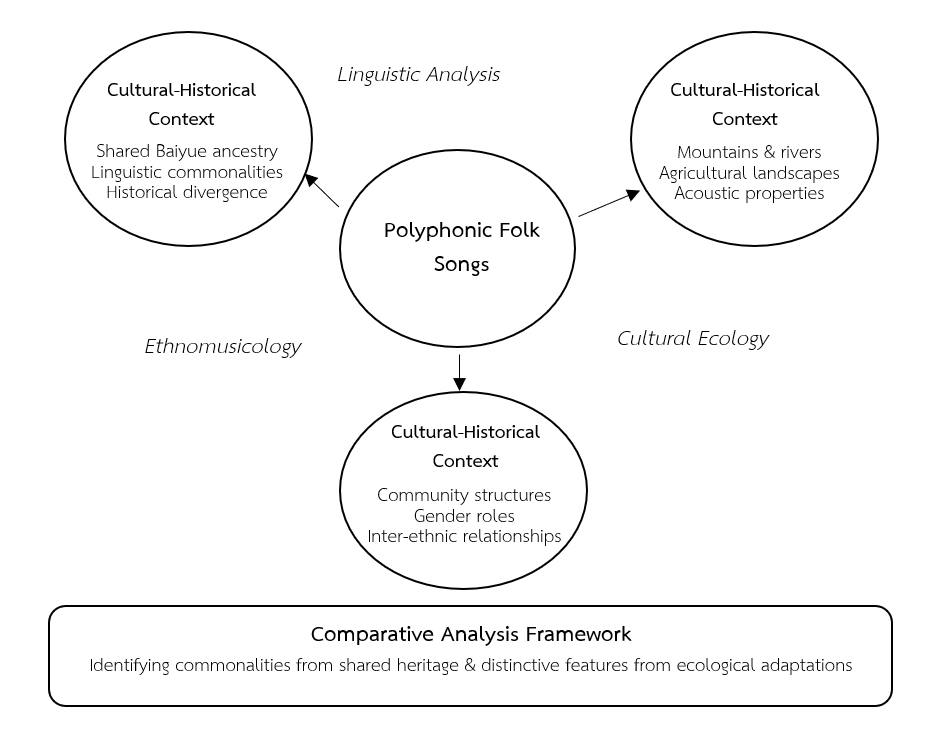
This study investigates the polyphonic folk songs of the Zhuang and Dong ethnic groups in Guangxi, China, focusing on their evolution, structure, and cultural significance. These multi-voice songs, which reflect the social, historical, and environmental contexts of the communities, are threatened by globalization, modern media, and limited academic research. Using a cultural ecological approach, the research compared the musical traditions of both groups to examine how geography, social organization, and cultural practices have shaped their development. Data was collected through semi-structured interviews with musicians and cultural experts, field observations of performances, and document analysis. Thematic coding analyzed musical structure, cultural significance, and historical development, with a comparative approach to highlight similarities and differences between the groups. The study also explored the impact of cross-cultural interactions, particularly between the Zhuang and Han cultures, on the evolution of polyphonic traditions. The findings revealed that both groups use polyphonic songs as vital expressions of cultural identity, but with distinctive approaches to rhythm, melody, and thematic content. Zhuang polyphonic songs featured clear harmonies and structured rhythms reflecting their agricultural lifestyle, while Dong songs incorporated techniques like “chain breathing” and nasal resonance influenced by their mountainous environment. The Zhuang's songs fostered external cultural exchange, while the Dong's songs emphasized internal solidarity and spiritual connections. This research contributes to understanding how traditional music adapts to its cultural and ecological context, offering insights into cultural preservation and cross-cultural exchange in an increasingly globalized world.
Downloads
Article Details
รูปแบบการอ้างอิง
ประเภทบทความ
บทความวิจัย
Copyright & License
ลิขสิทธิ์ (c) 2025 วารสารศิลปะและวัฒนธรรมลุ่มแม่น้ำมูล

อนุญาตภายใต้เงื่อนไข Creative Commons Attribution-NonCommercial-NoDerivatives 4.0 International License.
บทความทุกเรื่องที่ตีพิมพ์ในรูปแบบ เปิดให้เข้าถึง (Open Access) ภายใต้สัญญาอนุญาต CC BY-NC-ND 4.0 จะสามารถเข้าถึงได้ฟรีทันทีและอย่างถาวรสำหรับทุกคน โดยผู้อ่านสามารถอ่าน ดาวน์โหลด ทำสำเนา แจกจ่าย พิมพ์ ค้นหา หรือเชื่อมโยงไปยังบทความได้โดยไม่เสียค่าใช้จ่าย การใช้งานอนุญาตเฉพาะเพื่อวัตถุประสงค์ที่ไม่แสวงหากำไร (ไม่อนุญาตการใช้เพื่อการค้า) และต้องไม่ทำการดัดแปลงแก้ไขผลงาน (ไม่อนุญาตการดัดแปลง) การเข้าถึงไม่จำเป็นต้องขออนุญาตล่วงหน้าจากสำนักพิมพ์หรือผู้แต่ง ทั้งนี้ต้องมีการอ้างอิงถึงแหล่งตีพิมพ์ต้นฉบับอย่างถูกต้องและเหมาะสม




เอกสารอ้างอิง
Chen, R. (2023). Contemporary Applications of Traditional Polyphonic Techniques : Innovation within the Zhuang Musical Framework. Journal of Applied Ethnomusicology, 5(2), 87 - 102. (In Chinese)
Fan, Z. (1987). Comparative Study of Polyphonic Songs of the Buyi and Zhuang : Harmony, Structure, and Tuning. Chinese Folk Music Review, 20(3), 109 - 124. (In Chinese)
Fan, Z. (2014). Musical Form of Dong Polyphonic Folk Songs : Multipart Harmonies and Call-and-Response Techniques. Dong Ethnographic Studies, 12(1), 54 - 67. (In Chinese)
Feng, M. (2009). Cultural and Spiritual Roles of Dong Polyphonic Music : Tracing the Origins of Yue Song. Journal of Regional Music Cultures, 15(3), 230 - 245. (In Chinese)
Huang, Y. (2017a). Comparing Polyphonic Traditions of North and South Ethnic Groups : The Dong “Da Song” as Cultural Identity in Music. International Journal of Ethnomusicology, 42(4), 210 - 225. (In Chinese)
Huang, Y. B. (2017b). Cultural Identity and Geographical Shaping of Polyphony in China : A Study of the Dong People’s Musical Heritage. Journal of Chinese Cultural Studies, 13(3), 185 - 204. (In Chinese)
Jiang, B. (1988). The Cultural Significance of Polyphonic Music in the Baiyue Region : Ethnic Unity and Agricultural Practices of the Dong People. Ethnomusicology Review, 22(4), 134 - 149. (In Chinese)
Li, S. (2014). Social and Cultural Contexts in Mongolian and Dong Polyphony : A Comparative Analysis. Central Asian Musicology, 16(2), 79 - 95. (In Chinese)
Li, Y. (2007). Collective Performance in the Kam Grand Choir : Community Events, Weddings, and Agricultural Rituals. Social Music Practices, 10(1), 62 - 79. (In Chinese)
Liao, J. (2019). Zhuang and Dong Polyphonic Songs : A Comparative Review and the Need for Ethnographic Approaches. Ethnomusicology Journal, 21(1), 55 - 70. (In Chinese)
Liu, K. (2020). Cultural Tourism and the Preservation of Folk Music Traditions : Case Studies from Guangxi Zhuang Autonomous Region. Tourism and Cultural Heritage, 15(3), 142 - 159. (In Chinese)
Pan, Y. (2012). The Dong Great Song : Lyrics, Melody, Rhythm, and Collective Cultural Expression. Music and Cultural History, 33(2), 98 - 115. (In Chinese)
Rodriguez, M. (2021). Comparative Traditions : East Asian Polyphonic Folk Music in Global Context. International Journal of Musical Heritage, 18(2), 229 - 245. (In Chinese)
Wang, J. (2021). Linguistic Influences on Polyphonic Structures : Tonal Patterns in Zhuang-Dong Language Family and Their Musical Expressions. Language and Music, 12(3), 305 - 321. (In Chinese)
Xu, L. (2021). The Kam Grand Choir : Shaping Dong Polyphonic Choral Music through Agricultural and Water-Based Farming Systems. Journal of Chinese Ethnomusicology, 48(3), 221 - 240. (In Chinese)
Xue, L., & Hu, D. S. (1950). Documenting Polyphonic Songs of the Dong People : A Turning Point in Recognition. Chinese Folk Music Studies, 8(2), 53 - 67. (In Chinese)
Yang, C. (2020). Kam Grand Choir : Transmitting Cultural Values and Social Cohesion in the Dong Community. International Journal of Music and Anthropology, 27(4), 103 - 117. (In Chinese)
Yang, Y. (2015). Kam Grand Choir as a Communal Ritual : A Study on Social Norms and Ethnic Identity in the Dong Community. Journal of East Asian Music Studies, 6(2), 143 - 158. (In Chinese)
Zhang, T. (2022). Digital Preservation of Ethnic Minority Music : Challenges and Opportunities for Zhuang and Dong Traditions. Journal of Cultural Informatics, 7(1), 53 - 68. (In Chinese)
