Form, Atmosphere, Rhythm : A Qualitative Semiotic Study into Spiritual and Affective Experiences of Non-Figurative Light-and-Shadow Installations
บทคัดย่อ
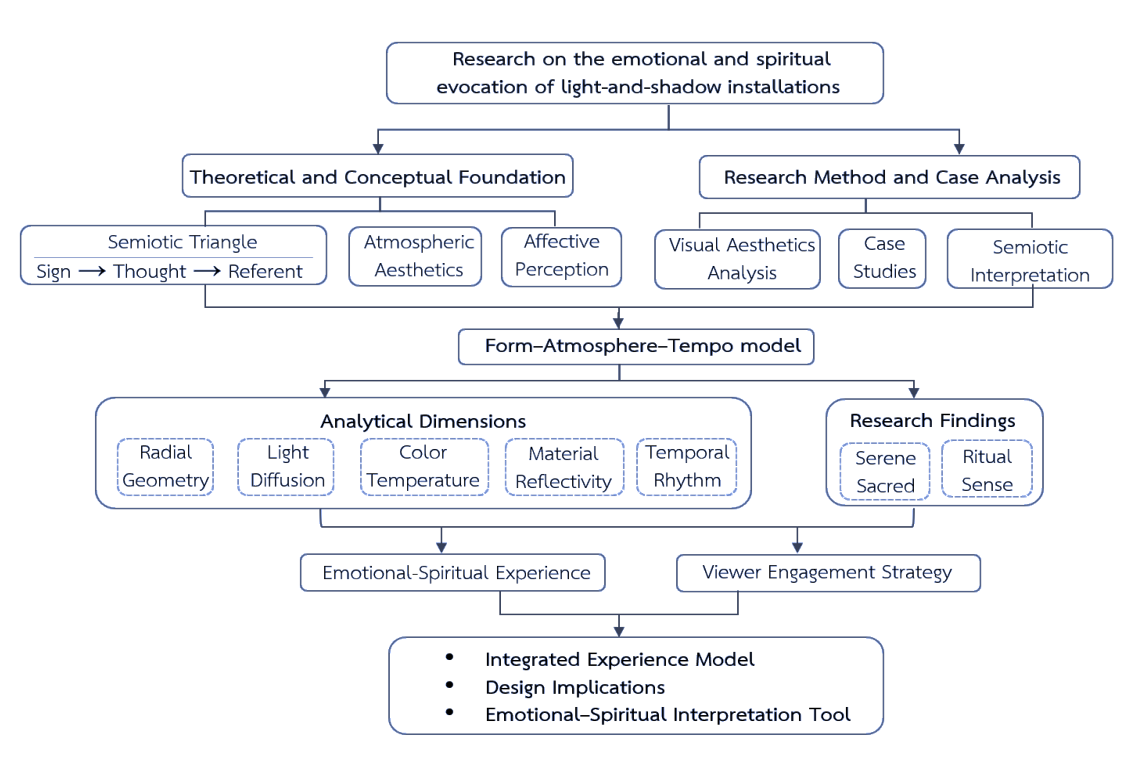
This study examines how non-figurative light-and-shadow installations elicit spiritual perception and affective responses through the coordinated interaction of form, atmosphere, and tempo. Employing a qualitative approach that integrates visual analysis with semiotic interpretation, the research systematically interprets representative cases by drawing on high-quality images, curatorial texts, and critical reviews. Findings indicate that, even without religious iconography or architectural semantics, coherent and well-structured configurations of geometric order, material surface, illuminance contrast, color temperature, and temporal rhythm can reliably elicit experiences characterized by calmness, contemplation, and a sense of sacredness. Building on these ideas, the paper suggests that a three-part structure functions similarly to the “semiotic triangle”: visible shapes are signs (form), the perceptible spatial climate is the referent (atmosphere), and temporal modulation is the interpretant (tempo), which helps people make sense of their experience and evoke feelings. This structure directly links controllable design parameters to anticipated experiential outcomes, providing an operational basis for prototyping and evaluation. In general, the study comprehensively clarifies the mechanism by which non-figurative light and shadow installations produce spiritual and emotional experiences, while also providing practical guidance for art creation and exhibition practice.
Downloads
Article Details
รูปแบบการอ้างอิง
ประเภทบทความ
บทความวิจัย
Copyright & License
ลิขสิทธิ์ (c) 2025 วารสารศิลปะและวัฒนธรรมลุ่มแม่น้ำมูล

อนุญาตภายใต้เงื่อนไข Creative Commons Attribution-NonCommercial-NoDerivatives 4.0 International License.
บทความทุกเรื่องที่ตีพิมพ์ในรูปแบบ เปิดให้เข้าถึง (Open Access) ภายใต้สัญญาอนุญาต CC BY-NC-ND 4.0 จะสามารถเข้าถึงได้ฟรีทันทีและอย่างถาวรสำหรับทุกคน โดยผู้อ่านสามารถอ่าน ดาวน์โหลด ทำสำเนา แจกจ่าย พิมพ์ ค้นหา หรือเชื่อมโยงไปยังบทความได้โดยไม่เสียค่าใช้จ่าย การใช้งานอนุญาตเฉพาะเพื่อวัตถุประสงค์ที่ไม่แสวงหากำไร (ไม่อนุญาตการใช้เพื่อการค้า) และต้องไม่ทำการดัดแปลงแก้ไขผลงาน (ไม่อนุญาตการดัดแปลง) การเข้าถึงไม่จำเป็นต้องขออนุญาตล่วงหน้าจากสำนักพิมพ์หรือผู้แต่ง ทั้งนี้ต้องมีการอ้างอิงถึงแหล่งตีพิมพ์ต้นฉบับอย่างถูกต้องและเหมาะสม




เอกสารอ้างอิง
Anila Quayyum Agha. (2013). Intersections [Installation]. Anila Quayyum Agha. https://www.anilaagha.com/intersections.
Bergmann. (2006). Ibaraki Kasugaoka Church Light Cross [Image]. https://en.wikipedia.org/wiki/Church_of_the_Light#/media/File:Ibaraki_Kasugaoka_Church_light_cross.jpg.
Bishop, C. (2005). Installation Art : A Critical History. Routledge.
Böhme, G. (2017). The Aesthetics of Atmospheres. Routledge.
Brady, E. (2003). Aesthetics of the Natural Environment. Edinburgh University Press.
Chernyshov, E. (2008). Light, Dark, and All That’s in Between : Revisiting the Role of Light in Architecture [Unpublished Master’s dissertation]. University of Waterloo.
Eliasson, O. (1993). Beauty [Installation]. Olafur Eliasson Studio. https://olafureliasson.net/artwork/beauty-1993.
Eliasson, O. (2003). The Weather Project [Installation]. Olafur Eliasson Studio. https://olafureliasson.net/artwork/the-weather-project-2003.
Eliasson, O. (2010). Your Uncertain Shadow (Colour) [Installation]. Olafur Eliasson Studio. https://olafureliasson.net/artwork/your-uncertain-shadow-colour-2010.
Health & Life. (2525). Color Temperature [Infographic]. https://hl-life.com/what-is-color-temperature-2700k-3000k-4000k-6500k/?srsltid=AfmBOor9i7App6uiHJJ-rexN2bUuWbvKdmL6qPLez_l6yd3us2JSTPQt. (In Chinese)
Lee, K. (2022). The Interior Experience of Architecture : An Emotional Connection between Space and the Body. Buildings, 12(3), 326. https://doi.org/10.3390/buildings12030326.
Lozano-Hemmer, R. (n.d.). Pulse Room [Installation]. https://www.lozano-hemmer.com/pulse_room.php.
Mostafavi, A., Xu, T. B., & Kalantari, S. (2024). Effects of Illuminance and Correlated Color Temperature on Emotional Responses and Lighting Adjustment Behaviors. Journal of Building Engineering, 86, 108833. https://doi.org/10.1016/j.jobe.2024.108833.
Ogden, C. K., & Richards, I. A. (1923). The Meaning of Meaning : A Study of the Influence of Language on Thought and the Science of Symbolism. Harcourt, Brace & World.
Orr, D. M. (2008). Into His Marvellous Light [Doctoral dissertation, University of Glasgow]. Enlighten Theses. https://theses.gla.ac.uk/id/eprint/588.
Prasetyo, D., Ramadhani, N., Hariadi, M., & Mutiaz, R. I. (2025). Lighting Dynamics for Emotional Perception: A Technology - Driven Virtual Simulation Approach. Engineering, Technology & Applied Science Research, 15(2), 22196 - 22202. https://doi.org/10.48084/etasr.10434.
Random International. (2012). Rain Room [Installation]. Random International Studio. https://www.random-international.com/rain-room.
Rose, G. (2016). Visual Methodologies : An Introduction to Researching with Visual Materials (4th ed.). Sage Publications.
Tavani, E. (2018). The Construction of Situations and Atmospheres in Installation Art. In Böhme, G., & Griffero, A. (Eds.), Atmosphere/Atmospheres : Testing a New Paradigm (129 - 145). Mimesis International.
teamLab. (2016). Forest of Resonating Lamps - One Stroke [Light installation]. https://www.teamlab.art/w/forest_of_resonating_lamps.
teamLab. (2020). Solid Geometry [Light installation]. https://www.teamlab.art/ew/solidgeometry_macao.
teamLab. (2020). Sphere [Image]. https://www.teamlab.art/ew/sphere_macao/#modal-1.
Turrell, J. (2013). Aten Reign [Vedio]. Solomon R. Guggenheim Museum. https://www.guggenheim.org/video/james-turrell.
Wood, C. (2020). Heli [Light Installation]. Artsy. https://www.artsy.net/artwork/chris-wood-heli.
Zhong, L., Punyalikhit, R., Sirivesmas, V. (2025). A Semiotic Triaxial Model of Form, Atmosphere, and Tempo in Light & Shadow Installations [Infographic]. Personal Collection.

