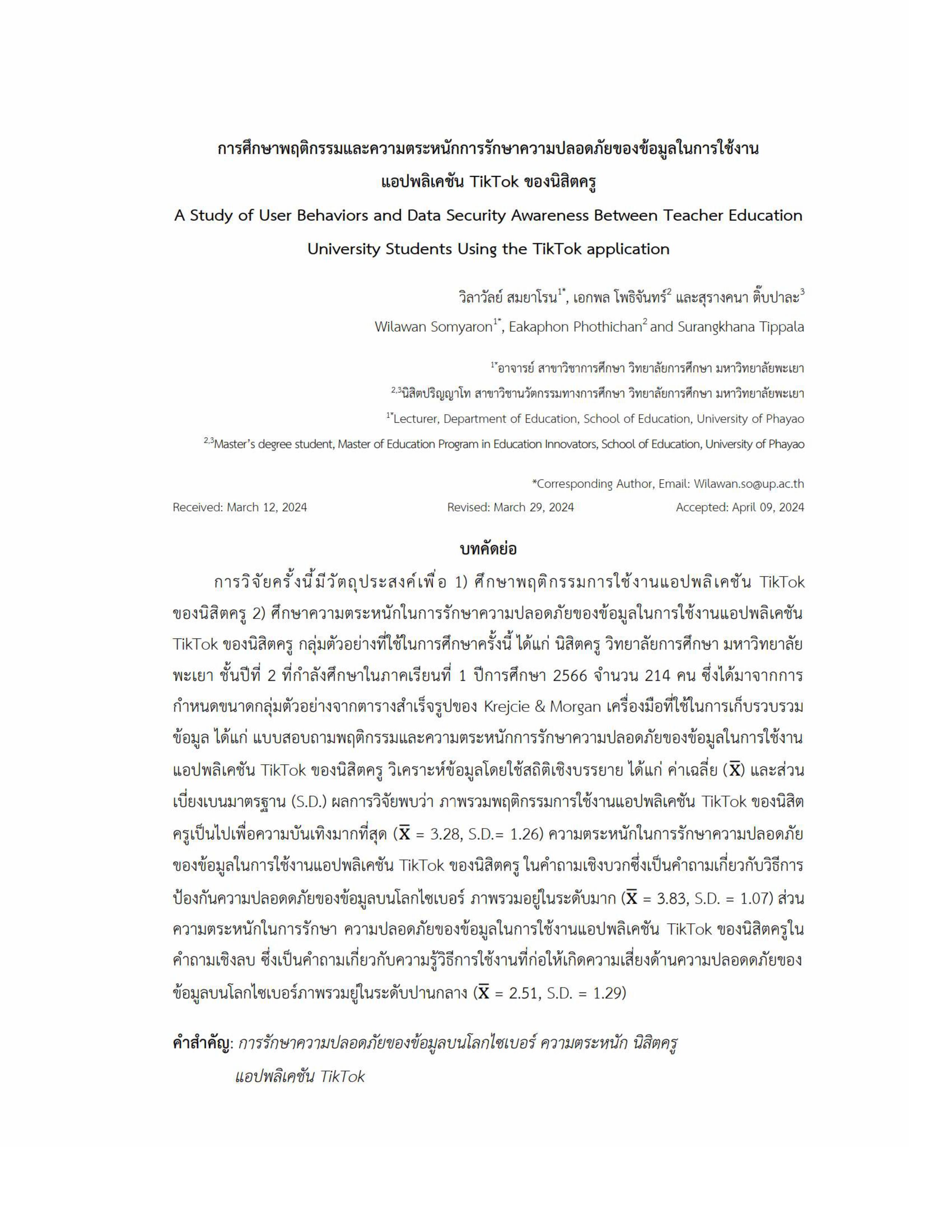
A Study of User Behaviors and Data Security Awareness between Teacher Education, University Students Using the TikTok Application
Keywords:
Cybersecurity, awareness, teacher education students, TikTok applicationAbstract
This study aimed to 1) investigate behavior the teacher education students’ s using the TikTok application, and 2) study the cybersecurity awareness in the use of the TikTok application. The sample group for this study consisted of the second-year teacher education students studying at the College of Education, University of Phayao, during the first semester of the academic year 2023, totaling 214 respondents. This sample size was randomized by using Krejcie and Morgan's table for determining sample size. The tool used for data collection was a questionnaire investigating the teacher education students’s behavior and awareness of data security in using the TikTok application. Data was analyzed by using the descriptive statistics, including mean (x̄) and standard deviation (S.D.). The research revealed that the overall the teacher education students’ s behavior using the TikTok application was primarily for their entertainment purposes at the highest level (x̄ = 3.28, S.D. = 1.26). the teacher education students’s cybersecurity awareness using the TikTok application, in positive questions related to data security prevention methods on the cyber world overall was at a high level (x̄ = 3.83, S.D. = 1.07). Meanwhile, their awareness of data security in negative questions, regarding the knowledge of usage that could lead to security risks in the cyber world, was at a moderate level (x̄ = 2.51, S.D. = 1.29).
References
กิติยา วิสิฐพงศ์พันธ์ และคณะ. (2565). ปัจจัยที่ส่งต่อการตระหนักรู้ถึงความปลอดภัยทางไซเบอร์ของนักศึกษามหาวิทยาลัย. วารสารวิชาการวิทยาศาสตร์ มหาวิทยาลัยราชภัฏจันทรเกษม, 32(1), 33-38.
แจ่มจันทร์ บุญโญปกรณ์. (2565). การพัฒนาทักษะการสื่อสารภาษาอังกฤษของผู้ประกอบการการท่องเที่ยวเพื่อยกระดับการให้บริการการท่องเที่ยวบนชีวิตวิถีใหม่ด้วยแอปพลิเคชันบนโทรศัพท์มือถือ. วารสารศิลปศาสตร์ราชมงคลสุวรรณภูมิ, 4(2), 402-412.
ทิศนา แขมมณี. (2555). บัณฑิตศึกษาในศตวรรษที่ 21: การปรับหลักสูตรการสอน. ในเอกสารประกอบการสัมมนาการสอน วิจัยและผลิตผลงานวิชาการในสาขาวิชาหลักสูตรและการสอน: ประสบการณ์จากอดีตสู่อนาคตที่ยั่งยืน. จุฬาลงกรณ์มหาวิทยาลัย.
ภรภัทร ธัญญเจริญ. (2563). พฤติกรรมการเปิดรับ ทัศนคติ และการตัดสินใจใช้งานแอปพลิเคชัน TikTok [วิทยานิพนธ์ปริญญามหาบัณฑิต]. มหาวิทยาลัยธุรกิจบัณฑิตย์.
มูลนิธิส่งเสริมสื่อเด็กและเยาวชน. (2563). ความฉลาดทางดิจิทัล. http://cclickthailand.com/wp content/uploads/2020/04/dq_FINAL.pdf
สมาคมธนาคารไทย. (2566). ไทยติดอันดับ 6 ของโลก เกิด “ภัยทางการเงิน” มากที่สุด. https://www.tba.or.th/ไทยติดอันดับ-6-ของโลก-เกิ/.
สุทิพย์ ประทุม และสรัญณี อุเส็นยาง. (2565). การยอมรับเทคโนโลยีสารสนเทศในยุควิถีชีวิตใหม่. วารสารลวะศรีมหาวิทยาลัยราชภัฏเทพสตรี, 6(1), 1-18.
เสกสรร สายสีสด. (2564). การศึกษาพฤติกรรมการใช้และความพึงพอใจในการใช้แอปพลิเคชัน TikTok ของนักเรียน นักศึกษาในเขตเทศบาลนครอุดรธานี. วารสารวิทยาการจัดการ คณะวิทยาการจัดการ มหาวิทยาลัยราชภัฏพิบูลสงคราม, 2(3), 402-412.
สำนักงานเลขาธิการสภาผู้แทนราษฎร. (2563). ศูนย์ต่อต้านข่าวปลอม (Anti-Fake News Center). https://library.parliament.go.th/sites/default/files/assets/files/works/academic%20office/radio%20scripts/pdf/2563-04/NALT-radioscript-rr2563-apr2.pdf
อินดิจิทัล. (2563). สถิติของ TikTok ที่นักการตลาดควรรู้. https://www.indigital.co.th/TikTok-stats/
Katherine, S., & Lipford, H. R. (2008). Strategies and struggles with privacy in an online social networking community. Proceedings of the 22nd British HCI Group Annual Conference on HCI 2008: People and Computers XXII: Culture, Creativity, 1, 111-119.
Krejcie, R. V., & Morgan, D. W. (1970). Determining sample size for research activities. Educational and Psychological Measurement, 30, 607-610.
Likert, R. (1932). A technique for the measurement of attitude. Archives of Psychology, 140, 1-55.
Ribble, M. (2015). Digital citizenship in schools: Nine elements all students should know (3rd ed.). International Society for Technology in Education
Downloads
Published
How to Cite
Issue
Section
License
Copyright (c) 2025 Journal of Humanities and Social Sciences Nakhon Pathom Rajabhat University

This work is licensed under a Creative Commons Attribution-NonCommercial-NoDerivatives 4.0 International License.
Journal of Humanities and Social Sciences Nakhon Pathom Rajabhat University



