
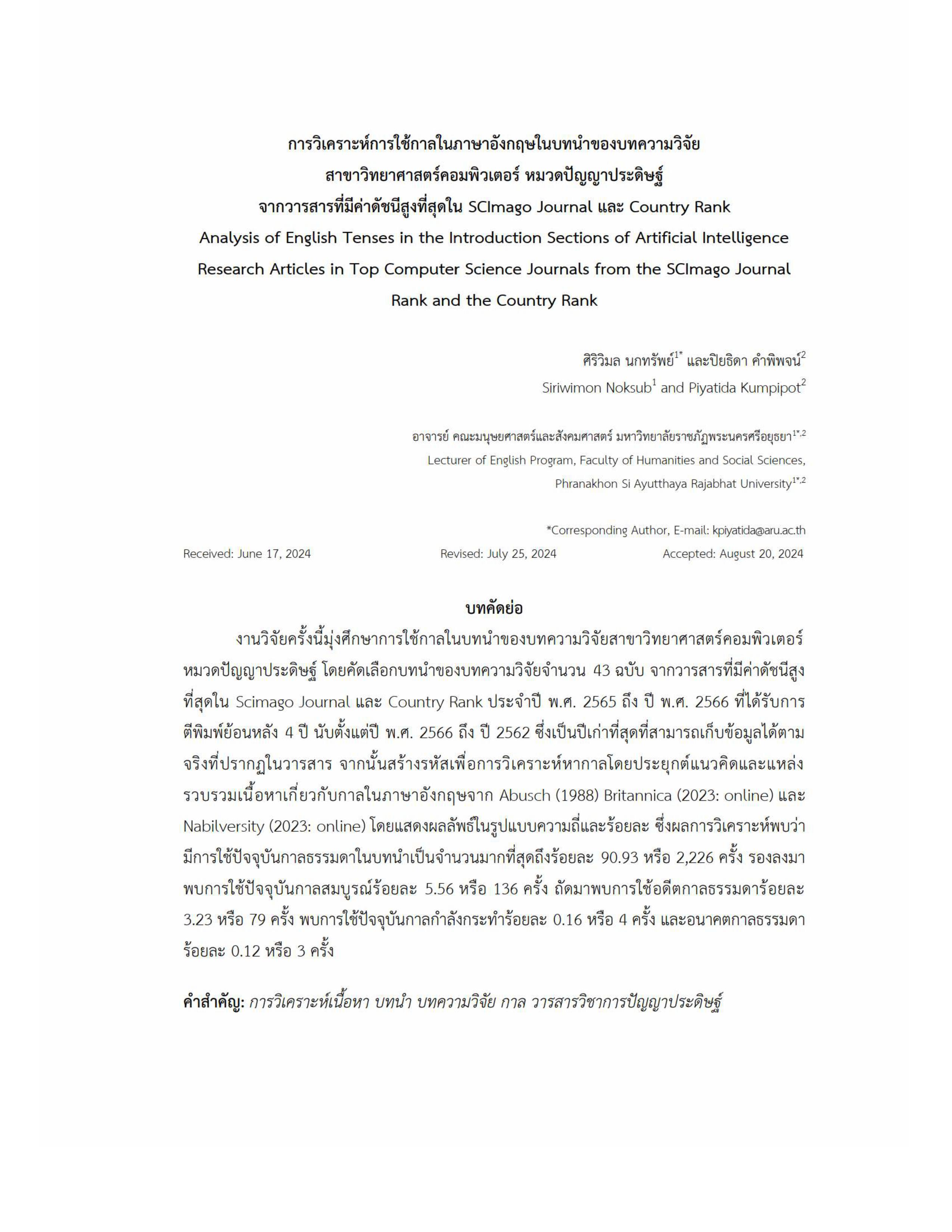
Analysis of English Tenses in the Introduction Sections of Artificial Intelligence Research Articles in Top Computer Science Journals from the SCImago Journal Rank and the Country Rank
Keywords:
Content Analysis, Introduction Section, Research Article, Tense, Artificial Intelligence Academic JournalAbstract
Objective of this study was to identify tenses in English occurred in the actual amount of 43 introduction sections of research articles in the field of computer science published in 2023 in a journal which was chosen based on the highest index from Scimago & Country Rank from 2022 to 2023. The concepts and sources about tenses were adapted from Abusch (1988), Britannica (2023: online), and Nabilversity (2023: online)’s study, which was used as a set of codes to identify tenses in English. The findings showed that the most frequently used tense was Present Simple Tense as 90.93% or 2,226 times, followed by Present Perfect Tense was used as 5.56% or 136 times and Past Simple Tense as 3.23% or 79 times. The least frequently used tenses were Present Continuous Tense as 0.16% or 4 times and Future Simple Tense as 0.12% or 3 times.
References
ชนิภรณ์ ภู่มณี, และทรงศรี สรณสถาพร. (2560). การศึกษาการเรียงลำดับของอัตถภาคและการใช้
ภาษาในบทคัดย่อของบทความปริทัศน์ในสาขาวิชาสัตว์ทดลอง. ภาษาปริทัศน์, (21), 1-28.
ดารารัตน์ คำภูแสน. (ม.ป.ป.). การเขียนภาษาอังกฤษเชิงวิชาการ. มหาวิทยาลัยขอนแก่น. https://hs.kku.ac.th/Publications/book/08ภาษาอังกฤษ/25_การเขียนภาษาอังกฤษเชิงวิชาการ_ดารารัตน์คำภูแสน.pdf
ไทยพีบีเอส. (2561). ย้อนวิวัฒนาการในรอบ 75 ปี ปัญญาประดิษฐ์. https://www.thaipbs.or.th/ news/content/272538
นงลักษณ์ วิรัชชัย. (2555). รูปแบบ และลักษณะของบทความวิจัยที่ตีพิมพ์ในวารสารตาม
มาตรฐานสากล. วารสารศิลปากรศึกษาศาสตร์วิจัย, 4(1), 7-16.
พิชิต ฤทธิ์จรูญ. (2552). รายงานการวิจัย: เขียนอย่างไรให้มีคุณภาพ. ใน สำนักงานเลขาธิการคุรุสภา (บ.ก.), การวิจัยเพื่อพัฒนาวิชาชีพทางการศึกษา: แนวคิดสู่การปฏิบัติ. (หน้า 194-228). บริษัทศรีอนันต์การพิมพ์.
สมาคมโปรแกรมเมอร์ไทย. (2561). ปัญญาประดิษฐ์. https://www.thaiprogrammer.org/ 2018/12/whatisai/
สุเนตร สืบค้า, และสุจิตรา รตมะโน. (2557). การเขียนบทความวิจัยภาษาอังกฤษด้านวิทยาศาสตร์และ เทคโนโลยี. มหาวิทยาลัยแม่โจ้. http://mdc.library.mju.ac.th/article/90984/297632/ 292033.pdf
สุภางค์ จันทวานิช. (2553). การวิเคราะห์ข้อมูลในการวิจัยเชิงคุณภาพ (พิมพ์ครั้งที่ 9). สำนักพิมพ์แห่ง จุฬาลงกรณ์มหาวิทยาลัย.
สพลเชษฐ์ ประชุมชัย. (2563). การวิเคราะห์อัตถภาคในบทคัดย่อของวารสารวิชาการด้านวิทยาศาสตร์. วารสารราชภัฏเพชรบูรณ์สาร, 22(1), 35-43.
ศิริวิมล นกทรัพย์. (2566). การใช้ภาษาในบทคัดย่อของบทความปริทัศน์สาขาโมเลกุลและชีววิทยาของ เซลล์ในวารสารฐานข้อมูล Scopus. วารสารวิชาการมนุษยศาสตร์และสังคมศาสตร์ มหาวิทยาลัยราชภัฏนครปฐม, 13(1), 51-65.
อลิสา วาณิชดี. (2553) . Academic article writing หลักการเขียนส่วนต่างๆ ของบทความ. https://shorturl.at/6Fexi
เอื้อมพร หลินเจริญ. (2555). เทคนิคการวิเคราะห์ข้อมูลเชิงคุณภาพ. วารสารการวัดผลการศึกษา, 17(1), 17-29.
Abusch, D. (1988). Sequence of tense, Intentionality and scope. in H. Borer (Ed)., Proceedings of WCCFL 7. CSLI (pp. 1-14). Stanford University
Alex, D. (2023). How to write a research paper introduction. Paperpal. https://paperpal.com/blog/researcher-resources/how-to-write-a-research-paper- introduction-with-examples
Anyoha, R. (2017). The history of Artificial Intelligence. Science in the News. https://sitn.hms.harvard.edu/flash/2017/history-artificial-intelligence/
Archana, S. (2023). Importance of English in the media around the World. Research Highlights in Language, Literature and Education, 6, 61–68. https://doi.org/10.9734/bpi/rhlle/v6/9936F
Berelson, B. (1952). Content analysis in communication research. Free Press.
Britannica. (2023). Tense. https://www.britannica.com/topic/tense
Duggal, N. (2023). What is Artificial Intelligence and why It matters in 2024. Simplilearn
Karjian, R. (2023). The history of Artificial Intelligence: Complete AI timeline. TechTaget.
https://www.techtarget.com/searchenterpriseai/tip/The-history-of-artificial- intelligence-Complete-AI-timeline
Folse, K. (2009). Keys to teaching grammar to English language learners: A practical handbook. University of Michigan Press.
EF English Live. (2023). English verb tenses the ultimate guide.
https://englishlive.ef.com/en/blog/language-lab/english-verb-tenses-guide/
EF English Proficiency Index. (2022). English proficiency score for Thailand.
https://www.ef.com/wwen/epi/regions/asia/thailand/
Graddol, D. (2006). English next. British Council. https://www.teachingenglish.org.uk/ sites/teacheng/files/pub_english_next.pdf
Gupta, A. (2023). Mastering the use of tenses in your research paper. Paperpal. https://paperpal.com/blog/academic-writing-guides/language-grammar/tenses-in-research-paper
Howard, R. M. (2011). Writing matters: A handbook for writing and research. McGraw-Hill.
Nabilversity (2023). Baccalaureate National Exam 2023 Arts June Session. Scribd. https://www.scribd.com/document/720859882/Baccalaureate-National-Exam- 2023-Arts-June-session
Nature Education. (2024). Effective writing. https://www.nature.com/scitable/topicpage/ effective-writing-13815989/
Noksub, S. (2017). A comparative study of the introduction sections of research
articles in the fields of cell biology and laboratory animal [Master’s thesis]. Mahidol University.
Öztürk, İ. (2019). A function-first approach to verbs tense usage in research article introductions in applied linguistics. Dil Dergisi Language Journal, 170(2), 30-52.
Panday, S. (2023). Importance of computer science education in 21st Century. Medium.
https://medium.com/@saloni.panday01/importance-of-computer-science- education-in-21st-century-612284c2ca2c
Rahman, M. S., & Ali, M. (2015). Problems in mastering English tense and aspect and the role of the practitioners. IOSR Journal of Humanities and Social Science, 20(1), 131-135.
Ramesh, V., Glass, R. L., & Vessey, I. (2004). Research in computer science: An empirical study. Journal of Systems and Software, 70(1-2), 165-176.
Santos, M. B. (1996). The textual organization of research paper abstracts in applied linguistics. Text & Talk, 16(4), 481-500.
Stowell, T. (1995). What is the meaning of the present and past tenses? In P. M. Bertinetto, V. Bianchi, & Squartini, M. (Eds.), Temporal reference: Aspect and actionality vol. 1: Semantic and syntactic perspectives (pp. 381-396). Rosenberg & Sellier.
Stowell, T.(2008). Where the past is in the perfect in A. C. Gutierrez (Ed.), Tiempos compuestos y formas verbales compuestas (pp. 103-118). Iberoamericana Vervuert.
Swales, J. M., & Feak, C. (2012). Academic writing for Graduate Students (3rd ed.). Michigan University Press.
Swales, J. M. (1990). Genre analysis: English in academic and research aettings.
Cambridge University Press.
Timyam, N. (2021). English for academic writing. Chulalongkorn University Press.
Downloads
Published
How to Cite
Issue
Section
License
Copyright (c) 2026 Journal of Humanities and Social Sciences Nakhon Pathom Rajabhat University

This work is licensed under a Creative Commons Attribution-NonCommercial-NoDerivatives 4.0 International License.
Journal of Humanities and Social Sciences Nakhon Pathom Rajabhat University



