A Study of Thai Tea as the National Beverage
Keywords:
Thai tea, culture, national drink, identityAbstract
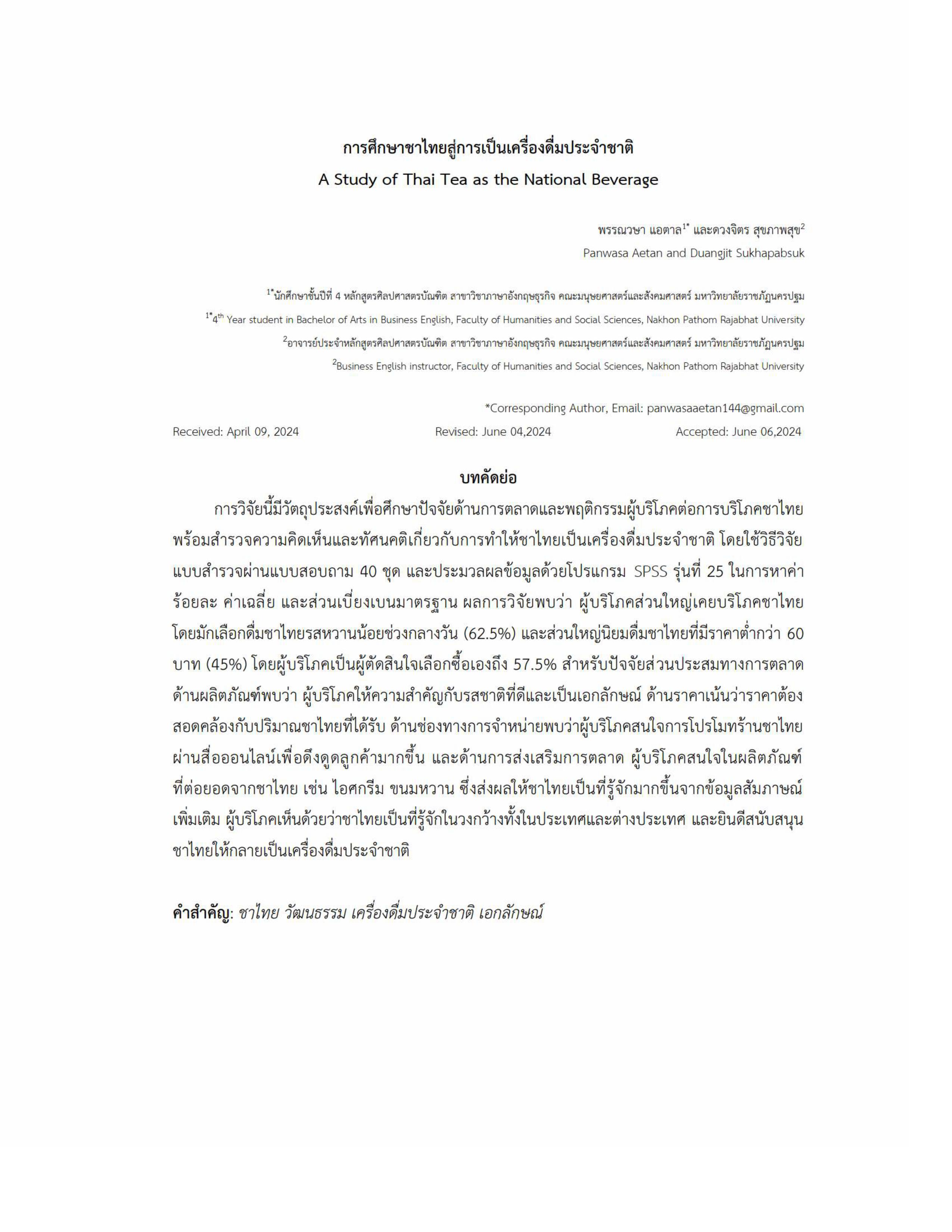
This research aims to study marketing factors and consumer behavior regarding Thai tea consumption and to survey opinions and attitudes toward establishing Thai tea as a national beverage. Data was collected through a survey research approach, gathering information from 40 completed questionnaires. This data was analyzed using SPSS software Version 25 to calculate percentages, means, and standard deviations. The findings indicate that most consumers have previously tried Thai tea, with a significant majority preferring less sweet Thai tea in the afternoon (62.5%) and typically choosing Thai tea priced below 60 baht (45%). Consumers made purchasing decisions in 57.5% of cases.
Regarding the marketing mix factors, results reveal that consumers place high value on good, unique flavors in products. In terms of pricing, they prefer prices that reflect the quantity of tea received. For distribution channels, consumers show interest in Thai tea shops promoted through online media to attract more customers. Furthermore, in terms of promotional activities, consumers are drawn to Thai tea-based products, such as ice cream and desserts, which help increase the recognition of Thai tea. Additional interview data reveals that consumers agree that Thai tea is widely known domestically and internationally and are willing to support Thai tea as the national beverage.
References
กระทรวงพาณิชย์. (2567). สถานการณ์การค้าระหว่างประเทศของไทยในเดือนเมษายน 2567. https://www.moc.go.th
กัญญ์พิชา วรไพสิฐกุล. (2560). ปัจจัยที่มีผลต่อความคาดหวังของผู้บริโภคในการเลือกซื้อเครื่องดื่ม พร้อมดื่มที่ช่วยควบคุมน้ำหนักในเขตกรุงเทพมหานคร [วิทยานิพนธ์ปริญญามหาบัณฑิต]. มหาวิทยาลัยธรรมศาสตร์.
ชัยวุฑฒิ เกตุอุดม. (2565). ปัจจัยที่มีผลต่อความภักดีต่อแบรนด์ผลิตภัณฑ์ชาสมุนไพรในหมู่ผู้บริโภคในกรุงเทพและพื้นที่ใกล้เคียง [วิทยานิพนธ์ปริญญามหาบัณฑิต]. มหาวิทยาลัยมหิดล.
ฐานเศรษฐกิจ. (2565, กุมภาพันธ์ 21). พาณิชย์” ผลักดันชาไทยสู่ตลาดโลกผ่าน FTA. ฐานเศรษฐกิจ. https://www.thansettakij.com
ธนาคารเพื่อการส่งออกและนำเข้าแห่งประเทศไทย. (2563). รายงานการตลาดชาไทยในตลาดต่างประเทศ. https://www.exim.go.th
ธิติมา เพ็ญสุข. (2560). การตัดสินใจของผู้บริโภคในการซื้อชาตรามือในกรุงเทพฯ และพื้นที่ใกล้เคียง [วิทยานิพนธ์ปริญญาโท]. มหาวิทยาลัยธรรมศาสตร์.
ธีรพงษ์ เทพกรณ์. (2555). ชา: กระบวนการผลิตและส่วนประกอบทางเคมีจากการหมัก. วารสารวิทยาศาสตร์บูรพา, 17(2), 189-196. https://ojs.lib.buu.ac.th/index.php/science/article/view/2673
นพรัตน์ อาฒยะพันธ์. (2560). อิทธิพลของแหล่งที่มาของชาในการรับรู้ของผู้บริโภค [วิทยานิพนธ์ปริญญามหาบัณฑิต]. มหาวิทยาลัยมหิดล.
ปวีณา พานิชชัยกุล, และธิตินันธุ์ ชาญโกศล. (2562). รูปแบบคุณภาพการให้บริการของธุรกิจเครื่องดื่มชานมไข่มุกกลุ่มเจนเนอเรชั่นวายในกรุงเทพมหานคร [วิทยานิพนธ์ปริญญา มหาบัณฑิต]. มหาวิทยาลัยศรีนครินทรวิโรฒ.
มหาวิทยาลัยรามคำแหง, คณะศึกษาศาสตร์. (2557). สูตรการหาขนาดกลุ่มตัวอย่างกรณีไม่ทราบจํานวนประชากร. http://www.edu.ru.ac.th/images/edu_files/formulation_ example.pdf
ศรุดา นิติวรการ. (2557). อาหารไทย: มรดกทางวัฒนธรรมของชาติ. วารสารวิชาการ มหาวิทยาลัยราชภัฏพระนคร, 5(1), 171-179.
สปริงนิวส์. (2566, ธันวาคม 7). ชาไทย: Soft Power ของประเทศไทยที่สามารถแข่งขันกับชาติใดในโลก—แบรนด์ใดบ้างที่เติบโตในช่วงปลายปี. Nation Group. https://www.springnews.co.th/news/hot-issue/845869
สำนักงานการวิจัยแห่งชาติ. (2564). บทบาทของ Soft Power และการสร้างภาพลักษณ์ประเทศ https://www.nrct.go.th
สำนักงานคณะกรรมการวัฒนธรรมแห่งชาติ. (2561). การศึกษาและส่งเสริมวัฒนธรรมการดื่มชาในประเทศไทย. https://www.m-culture.go.th
ห้องสมุดมหาวิทยาลัยสุโขทัยธรรมาธิราช. (2565). อาหารไทย. https://library.stou.ac.th/ 2022/05/thaifood
เหมือนดาว วาสุเทพรังสรรค์. (2559). ปัจจัยที่มีผลต่อการตัดสินใจซื้อชาเขียวโออิชิและอิชิตัน [วิทยานิพนธ์ปริญญามหาบัณฑิต]. มหาวิทยาลัยธรรมศาสตร์.
อาชิรญา บุญเพิ่ม. (2564). พฤติกรรมผู้บริโภคและกลยุทธ์การตลาดของผลิตภัณฑ์ชาในประเทศไทย [วิทยานิพนธ์ปริญญามหาบัณฑิต]. มหาวิทยาลัยมหิดล.
Nye, J. (1993). Soft power: The means to success in world politics. Harvard University Press.
Thaiger. (2567). Thai tea tales: The history of Thai iced tea https://thethaiger.com/ guides/best-of/food/thai-tea-tales-the-history-of-thai-iced-tea
Downloads
Published
How to Cite
Issue
Section
License
Copyright (c) 2025 Journal of Humanities and Social Sciences Nakhon Pathom Rajabhat University

This work is licensed under a Creative Commons Attribution-NonCommercial-NoDerivatives 4.0 International License.
Journal of Humanities and Social Sciences Nakhon Pathom Rajabhat University



