
Learning Management Platform to Enhance Computational Thinking in Computer Science Using a Flipped Classroom Technique for 6th Grade Students
Article Sidebar
Main Article Content
Abstract
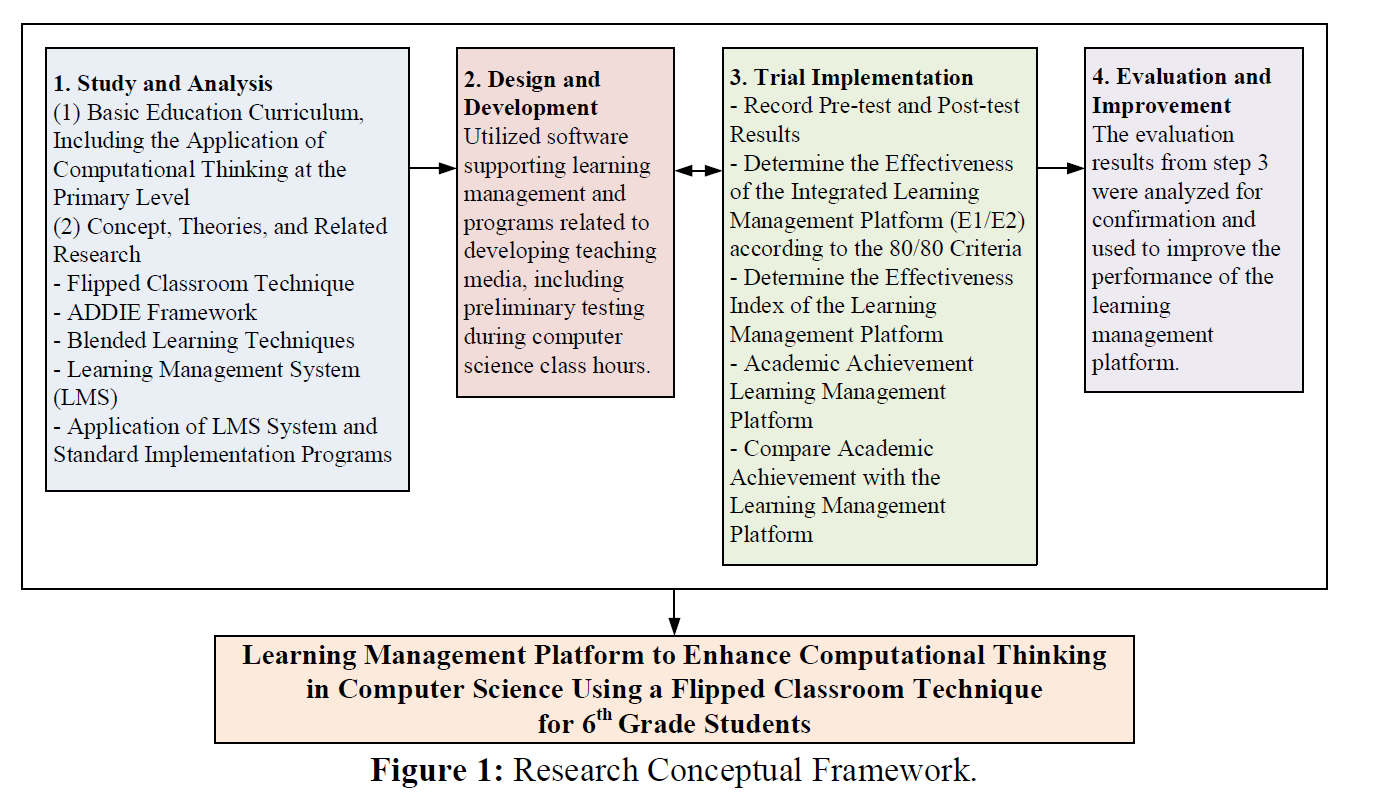
The objectives of this research were: 1) to develop a learning management platform to enhance computational thinking in computer science using a flipped classroom technique for 6th grade students; 2) to evaluate the efficiency of the learning management platform for enhancing computational thinking in computer science using a flipped classroom technique, according to the 80/80 standard criteria; 3) to determine the effectiveness index and learning achievement of the developed platform; and 4) to study the level of expert opinion on learning with the developed platform. The sample group consisted of 50 6th grade students from Assumption College Thonburi, Bangkok, selected through cluster random sampling with classrooms as the sampling unit, and 10 experts in educational innovation and technology selected using purposive sampling. The research instruments used were: 1) the learning management platform for enhancing computational thinking in computer science using a flipped classroom technique, 2) a learning achievement test, and 3) a platform quality evaluation form by experts. The statistics used for data analysis were percentage, mean, standard deviation, and t-test. The research revealed that the developed learning management platform for enhancing computational thinking in computer science using a flipped classroom technique had an efficiency of 81.55/83.98, which aligns with the 80/80 standard criteria. The effectiveness index was 0.8314. Students who learned with the system showed significantly higher post-test learning achievement than pre-test learning achievement at a statistical significance level of 0.05. Experts had a high level of opinion regarding the learning management platform for enhancing computational thinking in computer science using a flipped classroom technique. The research results yielded a prototype learning management platform to enhance computational thinking in computer science for 6th grade students that is efficient, can be practically used in teaching and learning, and enables learners to acquire skills and develop learning in computer science for subsequent science learning.
Article Details

This work is licensed under a Creative Commons Attribution-NonCommercial-NoDerivatives 4.0 International License.
License to Publish (LTP)
Upon acceptance of a manuscript, authors will be asked to complete a License to Publish (LTP) Agreement. Authors retain the copyright of their work and grant the International Journal of Science Education and Teaching (IJSET) a non-exclusive license to publish, distribute, and archive the article. All published articles are distributed under the Creative Commons Attribution 4.0 International (CC BY 4.0) License.
[!IMPORTANT]
The information provided here is for reference purposes only. Please do not complete or submit this form during the initial submission stage. If your paper is accepted, the editorial office will provide you with specific instructions on how to finalize and submit the formal agreement.
Download the License to Publish (LTP).
References
Bin-Hady, W.R.A., & Hazaea, A.N. (2022). EFL students’ achievement and attitudes towards flipped pronunciation class: correlational study. PSU Research Review, 6(3), 175-189.
Chaisena, A., Wachirawongpaisarn, S., & Phakamach, P. (2022). Online learning management system on visual arts using flipped classroom technique for prathomsuksa 4 students. Journal of Education and Innovative Learning, 2(1), 51–67.
Champion, D.N., Tucker-Raymond, E., Millner, A., Gravel, B., Wright, C.G., Likely, R., Allen-Handy, A., & Dandridge, T.M. (2020). Designing for learning computational STEM and arts integration in culturally sustaining learning ecologies. Information and Learning Sciences, 121(9/10), 785-804. https://doi.org/10.1108/ILS-01-2020-0018
Errabo, D.D., Paguio, A.J., & Enriquez, P.A. (2024). Epistemic fluency in virtual laboratories as flipped classroom’s innovative learning delivery. Journal of Research in Innovative Teaching & Learning, 17(2), 256-281. https://doi.org/10.1108/JRIT-03-2024-0052
Fernández Cruz, F.J., Egido Gálvez, I., & Carballo Santaolalla, R. (2016). Impact of quality management systems on teaching-learning processes. Quality Assurance in Education, 24(3), 394-415. https://doi.org/10.1108/QAE-09-2013-0037
Hidayat, R., Nugroho, I., Zainuddin, Z., & Ingai, T.A. (2024). A systematic review of analytical thinking skills in STEM education settings. Information and Learning Sciences, 125(7/8), 565-586. https://doi.org/10.1108/ILS-06-2023-0070
Hwang, W.-Y., Nurtantyana, R., & Hariyanti, U. (2023). Collaboration and interaction with smart mechanisms in flipped classrooms. Data Technologies and Applications, 57(5), 625-642. https://doi.org/10.1108/DTA-04-2022-0171
Ironsi, C.S. (2022). A switch from flipped classrooms to emergency remote online teaching (EROT), misconceptions, instructors and preservice teachers perceptions. International Journal of Information and Learning Technology, 39(1), 13-28. https://doi.org/10.1108/IJILT-10-2020-0195
Jian, Q. (2018). Effects of digital flipped classroom teaching method integrated cooperative learning model on learning motivation and outcome. The Electronic Library, 37(5), 842-859. https://doi.org/10.1108/EL-02-2019-0024
Kant, N., Prasad, K.D., & Anjali, K. (2021). Selecting an appropriate learning management system in open and distance learning: a strategic approach. Asian Association of Open Universities Journal, 16(1), 79-97. https://doi.org/10.1108/AAOUJ-09-2020-0075
Lai, Y.H. (2024). Learning efficacy of understanding by design-Internet of Things (UbD-IoT) education integrated with design thinking and computational thinking. Library Hi Tech, 42(2), 730-747. https://doi.org/10.1108/LHT-01-2023-0002
Lantu, D.C., Labdhagati, H., Bangun, Y.R., & Sumarli, F.D. (2023). The use of a flipped classroom and experiential learning in an undergraduate management course. International Journal of Educational Management, 37(1), 103-116. https://doi.org/10.1108/IJEM-05-2021-0189
Latorre-Cosculluela, C., Suárez, C., Quiroga, S., Sobradiel-Sierra, N., Lozano-Blasco, R., & Rodríguez-Martínez, A. (2021). Flipped classroom model before and during COVID-19: using technology to develop 21st century skills. Interactive Technology and Smart Education, 18(2), 189-204. https://doi.org/10.1108/ITSE-08-2020-0137
Leão, P., Coelho, C., Campana, C., & Viotto, M.H. (2023). Flipped classroom goes sideways: reflections on active learning methodologies. Revista de Gestão, 30(2), 207-220. https://doi.org/10.1108/REGE-04-2021-0066
Ministry of Education. (2019). National Education Act (No. 4) B.E. 2019. Bangkok: Shipping and Parcel Printing Houses.
Ministry of Education. (2023). The Thirteenth National Socio-Economic Development Plan (2023-2027). Retrieved from http://www.bic.moe.go.th/images/stories/pdf/4-11-2565.pdf
Nachatar Singh, J.K., Nagpal, S., Inglis, S., & Jacob-John, J. (2019). International students’ experiences in a flipped classroom environment: An Australian perspective. International Journal of Educational Management, 33(6), 1303-1315. https://doi.org/10.1108/IJEM-11-2018-0362
Pereira Bueno, R.L., Ribeiro Serra, F.A., & Scafuto, I.C. (2023). Executive perceptions of course and educator performance on flipped classroom. Education + Training, 65(8/9), 1023-1042. https://doi.org/10.1108/ET-08-2022-0337
Phakamach, P. (2023). Educational innovation: elements and mechanisms for the development of Thai educational institutions towards internationalization. Journal of Education and Innovative Learning, 3(2), 161-179.
Phakamach, P., Supap, S., Anukul, N., Onsampant, S., Wongsukha, S., & Sommartdejsakul. N. (2024a). The Effects of Education Quality System Management on the Development of Basic Education Institutions in Khon Kaen Province as an Educational Innovative Organisation. Asian Education and Learning Review, 2(2), 16-29. https://doi.org/10.14456/aelr.2024.7
Phakamach, P., Yoncheaun, J., Phomdee, R., Wongsukha, S., & Sommartdejsakul, N. (2024b). Development of Virtual Exchange-Learning Management System Platform Combined with Challenge-Based Learning on the Topic of Education Leadership and Disruption in the Digital Era. International Journal of Science Education and Teaching, 3(2), 51-66. https://doi.org/10.14456/ijset.2024.5
Ramírez-Montoya, M.-S., & Portuguez-Castro, M. (2024). Expanding horizons for the future with an open educational model for complex thinking: external and internal validation. On the Horizon, 32(1), 32-48. https://doi.org/10.1108/OTH-12-2023-0042
Şahin, Ş., & Kılıç, A. (2025). Comparison of face-to-face and online flipped learning: academic achievement, epistemological and pedagogical beliefs. Journal of Applied Research in Higher Education, 17(2), 563-577. https://doi.org/10.1108/JARHE-09-2023-0434
Samaila, K., & Al-Samarraie, H. (2024). Reinventing teaching pedagogy: the benefits of quiz-enhanced flipped classroom model on students’ learning outcomes and engagement. Journal of Applied Research in Higher Education, 16(4), 1214-1227. https://doi.org/10.1108/JARHE-04-2023-0173
Sinlarat, P. (2020). The path to excellence in Thai education. RICE Journal of Creative Entrepreneurship and Management, 1(2), 60-75.
Smith, K.D. (2021). Is it face time or structure and accountability that matter? Moving from a Flipped to a Flipped/Hybrid Classroom. Journal of Applied Research in Higher Education, 13(2), 609-621. https://doi.org/10.1108/JARHE-08-2019-0229
Suwardika, G., Sopandi, A.T., Indrawan, I.P.O., & Masakazu, K. (2024). A flipped classroom with whiteboard animation and modules to enhance students’ self-regulation, critical thinking and communication skills: a conceptual framework and its implementation. Asian Association of Open Universities Journal, 19(2), 135-152. https://doi.org/10.1108/AAOUJ-10-2023-0115
Tsortanidou, X., Daradoumis, T., & Barberá, E. (2019). Connecting moments of creativity, computational thinking, collaboration and new media literacy skills. Information and Learning Sciences, 120(11/12), 704-722. https://doi.org/10.1108/ILS-05-2019-0042
Weinhandl, R., Lavicza, Z., & Houghton, T. (2020). Mathematics and STEM teacher development for flipped education. Journal of Research in Innovative Teaching & Learning, 13(1), 3-25. https://doi.org/10.1108/JRIT-01-2020-0006
Zainuddin, Z., Haruna, H., Li, X., Zhang, Y., & Chu, S.K.W. (2019). A systematic review of flipped classroom empirical evidence from different fields: What are the gaps and future trends?. On the Horizon, 27(2), 72-86. https://doi.org/10.1108/OTH-09-2018-0027
Zainuddin, Z., & Perera, C.J. (2018). Supporting students’ self-directed learning in the flipped classroom through the LMS TES blend space. On the Horizon, 26(4), 281-290. https://doi.org/10.1108/OTH-04-2017-0016
