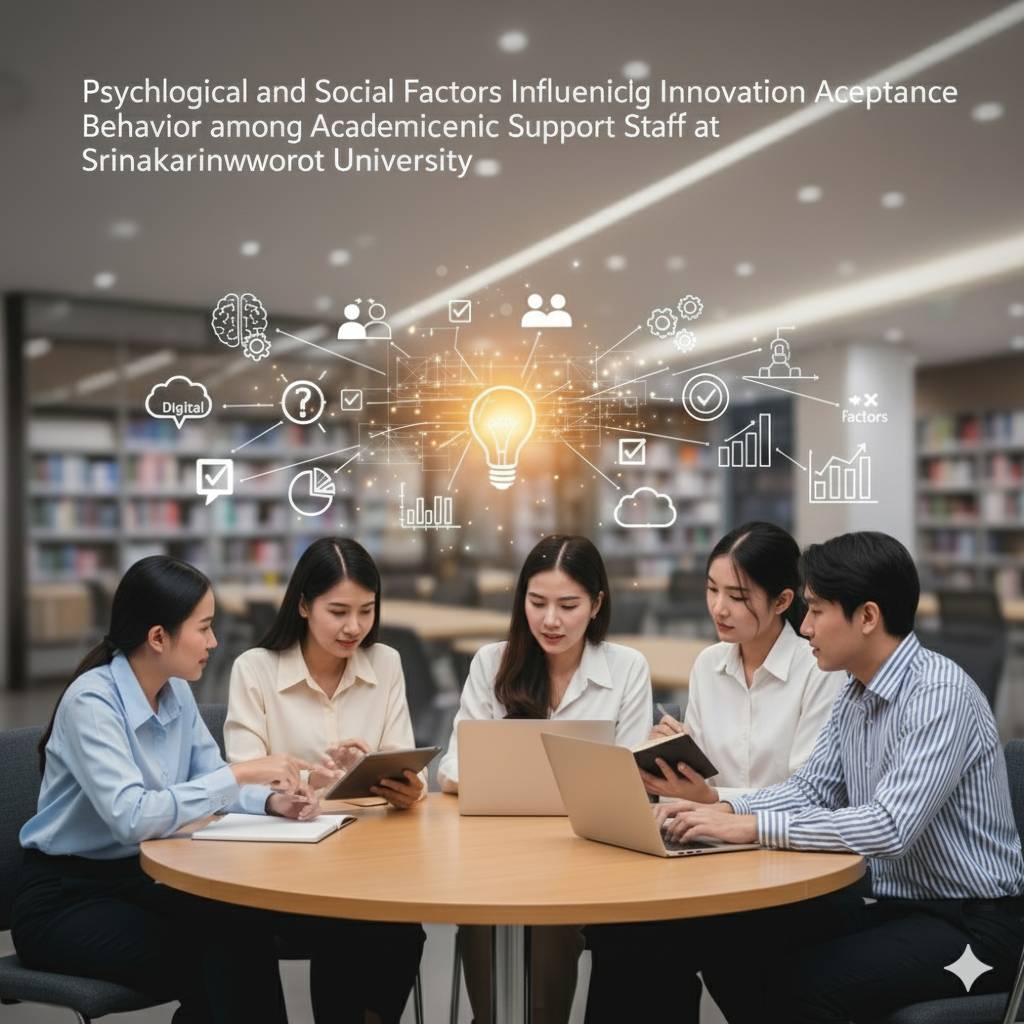
ปัจจัยเชิงเหตุทางจิตและสังคมที่เกี่ยวข้องกับพฤติกรรมการยอมรับนวัตกรรมในการ ปฏิบัติงานของบุคลากรสายสนับสนุนวิชาการ มหาวิทยาลัยศรีนครินทรวิโรฒ
คำสำคัญ:
พฤติกรรมการยอมรับนวัตกรรม , จิตลักษณะ, สถานการณ์ทางสังคม , บุคลากรสายสนับสนุนวิชาการบทคัดย่อ
การวิจัยนี้มีวัตถุประสงค์เพื่อ (1) วิเคราะห์ความสัมพันธ์ระหว่างสถานการณ์ทางสังคมและจิตลักษณะกับพฤติกรรมการยอมรับนวัตกรรม (2) ประเมินความสามารถในการทำนายพฤติกรรมการยอมรับนวัตกรรมโดยใช้ตัวทำนายด้านจิตลักษณะและสถานการณ์ทางสังคม และ (3) จำแนกประเภทของบุคลากรตามพฤติกรรมการยอมรับนวัตกรรม กลุ่มตัวอย่างคือบุคลากรสายสนับสนุนวิชาการ มหาวิทยาลัยศรีนครินทรวิโรฒ จำนวน 364 คน เก็บข้อมูลด้วยแบบสอบถาม วิเคราะห์ข้อมูลด้วยสถิติพรรณนา การวิเคราะห์สหสัมพันธ์ การวิเคราะห์การถดถอยพหุคูณแบบขั้นตอน และการวิเคราะห์กลุ่ม ผลการวิจัยพบว่า (1) พฤติกรรมการยอมรับนวัตกรรมมีความสัมพันธ์ทางบวกกับจิตลักษณะตามสถานการณ์ (r = .645) จิตลักษณะเดิม (r = .625) และลักษณะสถานการณ์ (r = .582) อย่างมีนัยสำคัญทางสถิติที่ระดับ .01 (2) ตัวแปรทั้งสามร่วมกันทำนายพฤติกรรมการยอมรับนวัตกรรมได้ร้อยละ 56.6 โดยจิตลักษณะตามสถานการณ์มีอำนาจการทำนายสูงสุด (β = .342) และ (3) สามารถจำแนกบุคลากรได้เป็น 3 กลุ่มตามระดับพฤติกรรม ได้แก่ กลุ่มระดับสูง (26.92%) กลุ่มระดับปานกลาง (42.86%) และกลุ่มระดับต่ำ (30.22%) ผลการวิจัยนี้สามารถนำไปใช้ในการพัฒนานโยบายและแนวทางการส่งเสริมการยอมรับนวัตกรรมที่เหมาะสมกับบุคลากรแต่ละกลุ่ม
เอกสารอ้างอิง
Alessandro, L. (2022). How is technology accepted? Fundamental works in user technology acceptance from diffusion of innovations to UTAUT-2. https://doi.org/10.1145/3568834.3568903
Ardianti, T., Tukiran, M., & Mariana, D. (2024). Innovative work behavior in higher education: A systematic literature review. Research and Development Journal of Education (RDJE). https://doi.org/10.30998/rdje.v10i2.23807
Benson, T. (2019). Digital innovation evaluation: User perceptions of innovation readiness, digital confidence, innovation adoption, user experience and behaviour change. BMJ Health & Care Informatics, 26(1). https://doi.org/10.1136/bmjhci-2019-000018
Best, J. W. (1981). Research in education (4th ed.). Prentice Hall.
Choudhary, R., Shaik, Y. A., Yadav, P., A. N. M., & Rashid, B. (2024). Generational differences in technology behavior: A systematic literature review. Journal of Infrastructure, Policy and Development, 8(9), 6755. https://doi.org/10.24294/jipd.v8i9.6755
Godoe, P., & Johansen, T. S. (2012). Understanding adoption of new technologies: Technology readiness and technology acceptance as an integrated concept. Journal of European Psychology Students, 3(1), 38–52. https://doi.org/10.5334/jeps.aq
Hair, J. F., Black, W. C., Babin, B. J., & Anderson, R. E. (2019). Multivariate data analysis (8th ed.). Cengage Learning.
Krejcie, R. V., & Morgan, D. W. (1970). Determining sample size for research activities. Educational and Psychological Measurement, 30(3), 607–610. https://doi.org/10.1177/001316447003000308
Likert, R. (1932). A technique for the measurement of attitudes. Archives of Psychology, 22(140), 1–55.
Ministry of Higher Education, Science, Research and Innovation. (2021). Higher education plan for the production and development of the national workforce, B.E. 2564–2570 (2021–2027). Office of the Permanent Secretary, Ministry of Higher Education, Science, Research and Innovation.
Mutonyi, B. R. (2021). Employees’ psychological capital and innovative behavior in higher education. International Journal of Quality and Service Sciences, 13(2), 198–215. https://doi.org/10.1108/IJQSS-02-2020-0024
Omar, M. A. H., Al-Adwan, A. S., Yaseen, H. Y., Hmoud, H., Al-Rahmi, W. M., & Alkhalifah, A. (2023). The critical determinants impacting artificial intelligence adoption at the organizational level. Information Development. https://doi.org/10.1177/02666669231166889
Owusu-Agyeman, Y. (2021). Transformational leadership and innovation in higher education: A participative process approach. International Journal of Leadership in Education, 24(5), 694–716. https://doi.org/10.1080/13603124.2019.1623919
Rovinelli, R. J., & Hambleton, R. K. (1977). On the use of content specialists in the assessment of criterion-referenced test item validity. Dutch Journal of Educational Research, 2, 49–60.
Sengchuen, C. (2023). Influential factors shaping innovation behavior among ABC Agency personnel. https://doi.org/10.62788/0cztaat
Shan, Y., Chin, T., & Mutsvene, N. (2023). The varying effects of four components of employee psychological capital on sustainable-business-model innovation in the new normal. Sustainability. https://doi.org/10.3390/su151511787
Srinakharinwirot University Computer Center. (2022). Master plan for information and communication technology, Srinakharinwirot University, B.E. 2565–2569 (2022–2026). Srinakharinwirot University.
Srinakharinwirot University Division of Human Resources. (2022). Srinakharinwirot University personnel development plan, B.E. 2565–2569 (2022–2026). Srinakharinwirot University.
Tabachnick, B. G., & Fidell, L. S. (2019). Using multivariate statistics (7th ed.). Pearson.
Talukder, M. (2019). Causal paths to acceptance of technological innovations by individual employees. Business Process Management Journal, 25(4), 582–605. https://doi.org/10.1108/BPMJ-06-2016-0123
Tran, P. T. T., Phan, D. D., Đỗ, P. T., & Phan, P. T. T. (2017). The moderating role of autonomy on the relationship of positive psychological capital and innovation performance. Ekonomika. https://doi.org/10.32508/stdjelm.v6i3.1045
V. S., K., T. S., N., S. K., & Y. N. D. (2022). A study on technology causes a gap between human generation. Journal of Data Mining and Management, 7(1), 17–27. https://doi.org/10.46610/jodmm.2022.v07i01.003
Venkatesh, V., Morris, M. G., Davis, G. B., & Davis, F. D. (2021). Unified theory of acceptance and use of technology. https://doi.org/10.1037/t57185-000
Webster, A., & Gardner, J. (2019). Aligning technology and institutional readiness: The adoption of innovation. Technology Analysis & Strategic Management, 31(10), 1229–1241.
Wu, X., & Wiebrecht, F. (2024). Environmental antecedents, innovation experience, and officials’ innovation willingness: Evidence from China. Public Management Review. https://doi.org/10.1080/14719037.2024.2349118
Zhou, E., Li, D., Madden, A., Chen, Y., Ding, Y., Kang, Q., & Su, H. (2019). Modeling adoption behavior for innovation diffusion. In Proceedings of the International Conference on Innovative Technologies (pp. 339–349). https://doi.org/10.1007/978-3-030-15742-5_33
ดาวน์โหลด
เผยแพร่แล้ว
รูปแบบการอ้างอิง
ฉบับ
ประเภทบทความ
สัญญาอนุญาต
ลิขสิทธิ์ (c) 2025 วารสารการวิจัยนวัตกรรมการจัดการธุรกิจ

อนุญาตภายใต้เงื่อนไข Creative Commons Attribution-NonCommercial-NoDerivatives 4.0 International License.
ข้อคิดเห็นและเนื้อหาที่ปรากฏในบทความเป็นความเห็นส่วนบุคคลของผู้แต่งแต่ละท่าน มิได้สะท้อนถึงทัศนะของวารสารหรือหน่วยงาน/สถาบันต้นสังกัด ความถูกต้องและข้อผิดพลาดใด ๆ เป็นความรับผิดชอบของผู้แต่งโดยเฉพาะ
การนำบทความ เนื้อหา ข้อมูล หรือภาพประกอบไปใช้ซ้ำหรือเผยแพร่ในลักษณะอื่น ต้องได้รับอนุญาตเป็นลายลักษณ์อักษรจากวารสารการวิจัยนวัตกรรมการจัดการธุรกิจก่อนเท่านั้น

