The Role and Popularity of the Chinese Guzheng in Thailand’s Musical Development
บทคัดย่อ
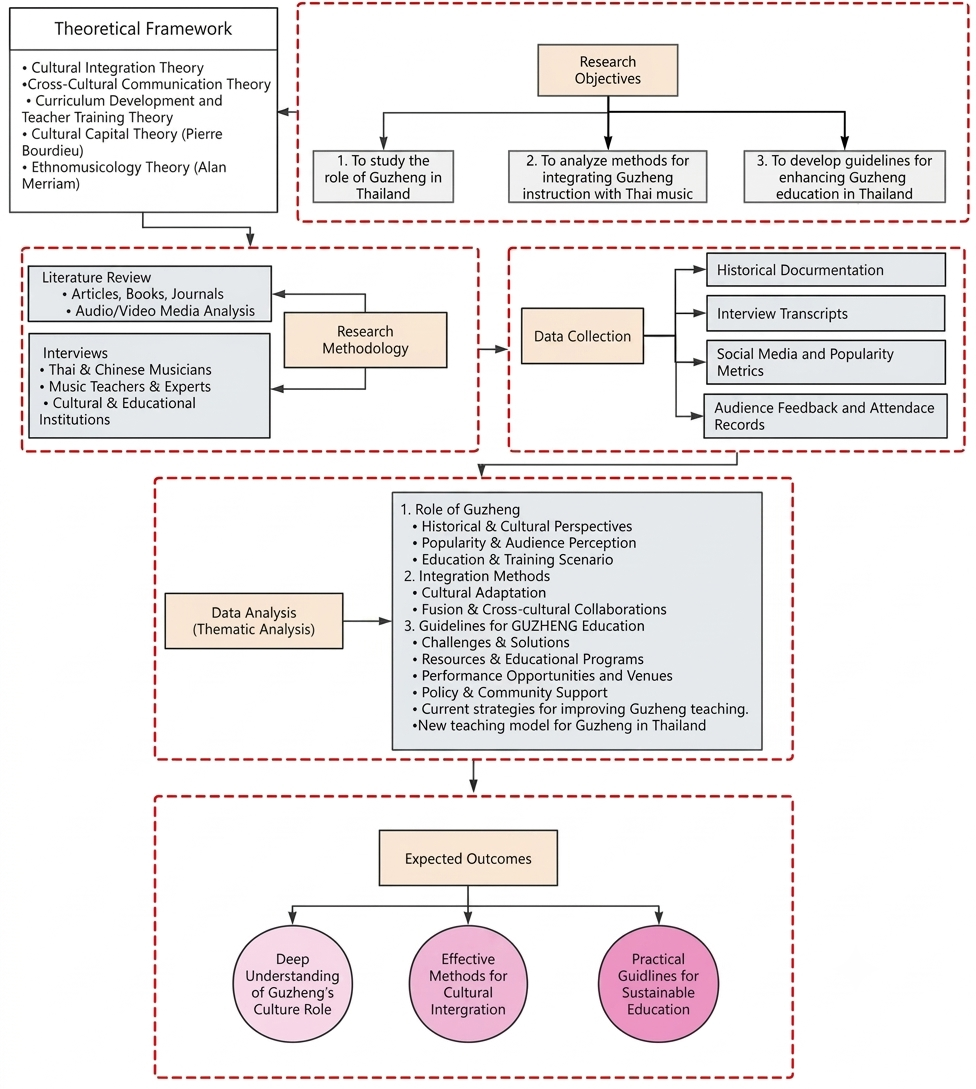
This study examines how the Chinese guzheng has developed within Thailand’s musical landscape and how it is learned, adapted, and sustained. Using a qualitative design, the research combines content analysis of documentary materials with fieldwork in Bangkok, including semi-structured interviews, focus groups, and questionnaires from students and parents. The analysis focuses on three objectives : 1) clarifying the guzheng’s cultural role, public recognition, and learning patterns in Thailand; 2) identifying integration approaches in Thai traditional and popular music, especially tuning, arrangement, and collaboration; and 3) developing guidelines for strengthening guzheng education. Findings indicate that guzheng popularity is shaped by the interaction between institutional support and sustained public performance. Integration is most effective when arrangement and ensemble role design take priority over minor technical adjustments. Sustainable development depends on coordinated support across teaching systems, localized curriculum design, and performance platforms. The study proposes a T-L-P model linking Teacher Development, Localized Curriculum, and Performance Integration as a framework for long-term development.
Downloads
Article Details
รูปแบบการอ้างอิง
ประเภทบทความ
บทความวิจัย
Copyright & License
ลิขสิทธิ์ (c) 2026 วารสารศิลปะและวัฒนธรรมลุ่มแม่น้ำมูล

อนุญาตภายใต้เงื่อนไข Creative Commons Attribution-NonCommercial-NoDerivatives 4.0 International License.
บทความทุกเรื่องที่ตีพิมพ์ในรูปแบบ เปิดให้เข้าถึง (Open Access) ภายใต้สัญญาอนุญาต CC BY-NC-ND 4.0 จะสามารถเข้าถึงได้ฟรีทันทีและอย่างถาวรสำหรับทุกคน โดยผู้อ่านสามารถอ่าน ดาวน์โหลด ทำสำเนา แจกจ่าย พิมพ์ ค้นหา หรือเชื่อมโยงไปยังบทความได้โดยไม่เสียค่าใช้จ่าย การใช้งานอนุญาตเฉพาะเพื่อวัตถุประสงค์ที่ไม่แสวงหากำไร (ไม่อนุญาตการใช้เพื่อการค้า) และต้องไม่ทำการดัดแปลงแก้ไขผลงาน (ไม่อนุญาตการดัดแปลง) การเข้าถึงไม่จำเป็นต้องขออนุญาตล่วงหน้าจากสำนักพิมพ์หรือผู้แต่ง ทั้งนี้ต้องมีการอ้างอิงถึงแหล่งตีพิมพ์ต้นฉบับอย่างถูกต้องและเหมาะสม




เอกสารอ้างอิง
Anderson, W. M., & Campbell, P. S. (Eds.). (2011). Multicultural Perspectives in Music Education : Volume III. Bloomsbury Publishing USA.
Chen, X. (2023). The Recognition of Chinese Culture among Thailand People from the Perspective of Music Dissemination Studies-A Case Study on Appreciating Guzheng and Analyzing by the TV Program. Oncology and Radiotherapy, 17(12), 891 - 898.
Chen, Y. (2018). Research on the Promotion and Dissemination of the Guzheng in the Confucius Institute at Mae Fah Luang University, Thailand [Unpublished master's thesis]. Xiamen University. (In Chinese)
Julia, J., Supriyadi, T., & Iswara, P. D. (2020). Training the Non-Specialist Music Teacher : Insights from an Indonesian action research study. Universal Journal of Educational Research, 8(2), 547 - 558. https://doi.org/10.13189/ujer.2020.080226.
Ning, H., & Maneewattana, C. (2024). The Inheritance and Development Situation of Contemporary Chinese Zheng Music. Journal of Roi Kaensarn Academi, 9(9), 110 - 122.
Ruiya, S., Phansue, V., & Punvaratorn, M. (2024). The Study of Cultural Appropriation of Guzheng Music in Performance of a Traditional Thai Song. Journal of Multidisciplinary in Humanities and Social Sciences, 7(6), 3259 - 3279.
Sawasdipakdi, P. (2021). Thailand’s Engagement with China’s Belt and Road Initiative : Strong Will, Slow Implementation. Asian Perspective, 45(2), 349 - 374. https://doi.org/10.1353/apr.2021.0004.
Sukhumvat, S. (2011). The Migration, Conservation of Chinese Music in Thailand and Thai Cultural Influence. Fine Arts International Journal, 15(2), 93 - 102.
Suwanwattana, A. (2022). The Gu Zheng Performance in Thai Style : Cultural Context and Social Relationship. Wipitpatanasilpa Journal of Arts, 2(1), 1 - 14. https://doi.org/10.14456/wipit.2022.1. (In Thai)
Van Aalst, J. A. (2012). Chinese music. Cambridge University Press.
Volk, T. M. (2006). An Application of Thai Music for General and Instrumental Music Programs. International Journal of Music Education, 24(3), 243 - 254. https://doi.org/10.1177/0255761406069660.
