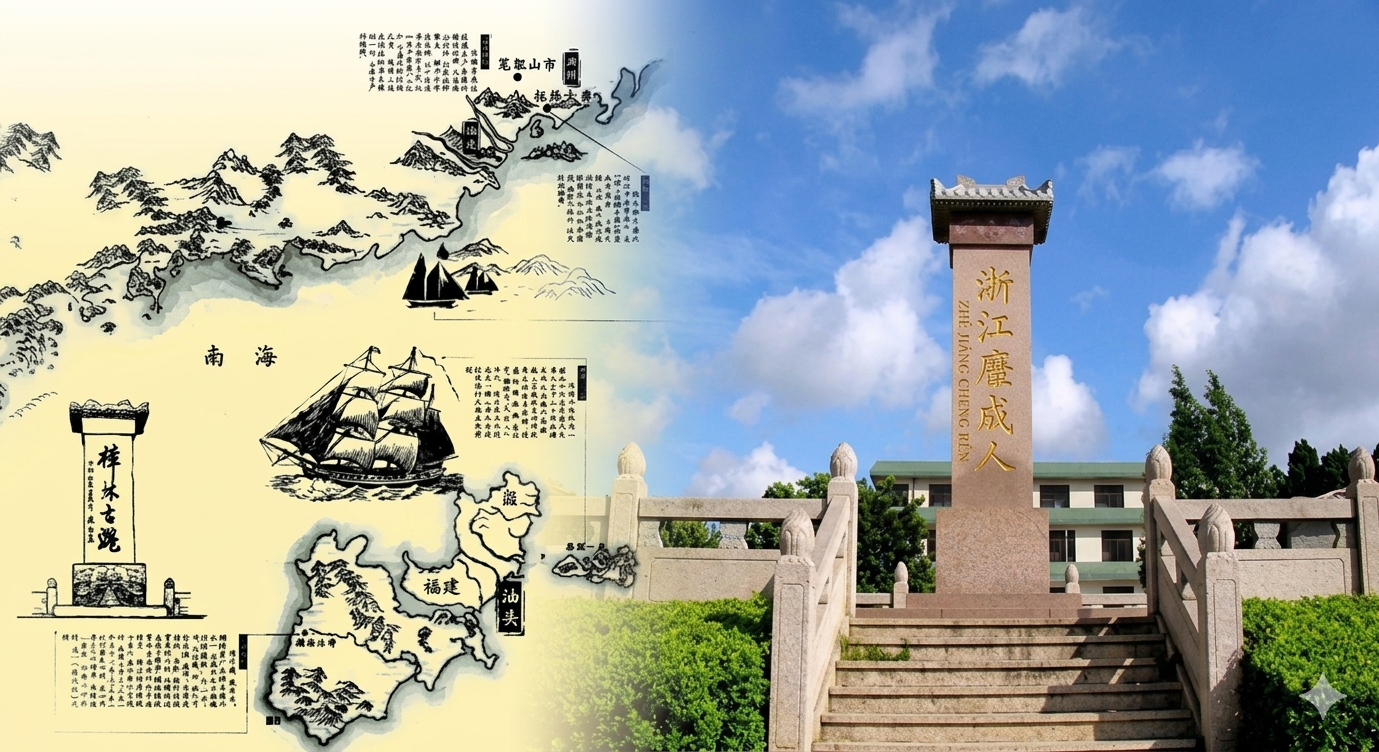
The Overseas Spread of Teochew Music Culture and Its Influence on Thai Traditional Music
บทคัดย่อ
This study examines the mechanisms of musical interaction and cultural integration between Teochew string music and the Thai Khrueang Sai ensemble in the context of Teochew migration to Thailand. Employing an ethnomusicological approach, the research combines documentary analysis, fieldwork, and in-depth interviews with comparative musical analysis of representative pieces, including the Teochew works Liu Qing Niang and Han Ya Xi Shui (Cold Crow Playing in the Water), the Khim solo Pae Huai Phang Song, and the Khrueang Sai ensemble piece Pae Huai Phang Thao Song. The analysis focuses on instrumentation, tuning systems, modal structures, melodic organization, and performance practice. The findings indicate that sustained Teochew migration since the late Southern Song Dynasty has established a stable social foundation for the overseas transmission of Teochew music, and that structural compatibilities between Teochew string music and the Thai Khrueang Sai ensemble particularly in ensemble configuration, tonal systems, modal structures, and melodic elaboration have enabled a gradual process of localization through melodic borrowing, structural adjustment, and ensemble reconstruction. The study contributes to ethnomusicological scholarship on cross-cultural musical interaction and Chinese diaspora music by demonstrating how migrant communities function as active agents of cultural reconstruction, and by revealing how traditional musical languages acquire new artistic forms and cultural meanings in cross-regional and cross-cultural contexts.
Downloads
Article Details
รูปแบบการอ้างอิง
ประเภทบทความ
บทความวิจัย
Copyright & License
ลิขสิทธิ์ (c) 2026 วารสารศิลปะและวัฒนธรรมลุ่มแม่น้ำมูล

อนุญาตภายใต้เงื่อนไข Creative Commons Attribution-NonCommercial-NoDerivatives 4.0 International License.
บทความทุกเรื่องที่ตีพิมพ์ในรูปแบบ เปิดให้เข้าถึง (Open Access) ภายใต้สัญญาอนุญาต CC BY-NC-ND 4.0 จะสามารถเข้าถึงได้ฟรีทันทีและอย่างถาวรสำหรับทุกคน โดยผู้อ่านสามารถอ่าน ดาวน์โหลด ทำสำเนา แจกจ่าย พิมพ์ ค้นหา หรือเชื่อมโยงไปยังบทความได้โดยไม่เสียค่าใช้จ่าย การใช้งานอนุญาตเฉพาะเพื่อวัตถุประสงค์ที่ไม่แสวงหากำไร (ไม่อนุญาตการใช้เพื่อการค้า) และต้องไม่ทำการดัดแปลงแก้ไขผลงาน (ไม่อนุญาตการดัดแปลง) การเข้าถึงไม่จำเป็นต้องขออนุญาตล่วงหน้าจากสำนักพิมพ์หรือผู้แต่ง ทั้งนี้ต้องมีการอ้างอิงถึงแหล่งตีพิมพ์ต้นฉบับอย่างถูกต้องและเหมาะสม




เอกสารอ้างอิง
Berry, J. W. (1997). Immigration, Acculturation, and Adaptation. Applied Psychology: An International Review, 46(1), 5–34. https://doi.org/10.1111/j.1464-0597.1997.tb01087.x. DOI: https://doi.org/10.1111/j.1464-0597.1997.tb01087.x
Blacking, J. (1973). How musical is man?. University of Washington Press.
Chen, X., & Chen, H. (2010). The Dissemination and Influence of Teochew Opera and Music Overseas. China Theatre Press. (In Chinese)
Geertz, C. (1973). The Interpretation of Cultures. Basic Books.
Liu, Y. (2022). Teochew Music. Jinan University Press. (In Chinese)
Miller, T. E., & Williams, S. (Eds.). (2008). The Garland Handbook of Southeast Asian music. Routledge.
Morton, D. (1976). The Traditional Music of Thailand. University of California Press. DOI: https://doi.org/10.1525/9780520321335
Nettl, B. (2005). The Study of Ethnomusicology: Thirty-one Issues and Concepts (2nd ed.). University of Illinois Press.
Skinner, G. W. (1957). Chinese Society in Thailand: An Analytical History. Cornell University Press.
Slobin, M. (1993). Subcultural Sounds: Micromusics of the West. Wesleyan University Press.
Stokes, M. (Ed.). (1994). Ethnicity, Identity and Music: The musical Construction of Place. Berg.
Ward, C., Bochner, S., & Furnham, A. (2001). The Psychology of Culture Shock (2nd ed.). Routledge.
Wong, D. A. (2001). Sounding the Center: History and Aesthetics in Thai Buddhist performance. University of Chicago Press.
