An Analysis of Narrative Techniques in Award-Winning Chinese Mythological Animated Films (2015 - 2024)
บทคัดย่อ
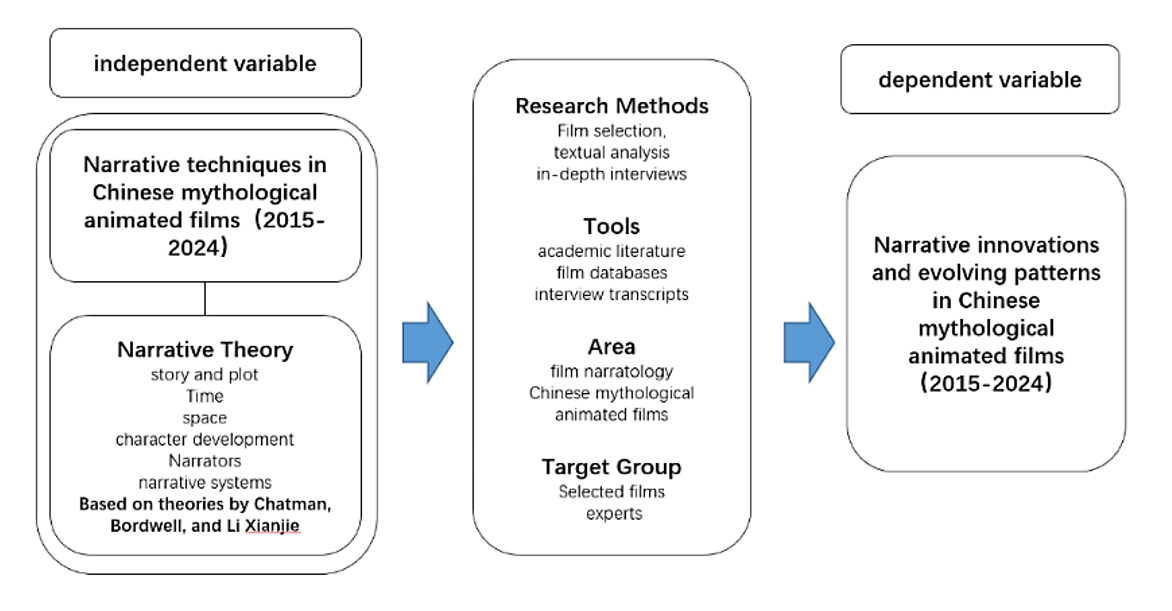
Although Chinese mythological animated films have gained increasing attention, few studies systematically examine their narrative techniques in a modern cultural context. This study fills the gap by analyzing ten award-winning Chinese mythological animated films released between 2015 and 2024, selected based on criteria of awards and recognition, market performance, diversity in themes, production technology and innovation, and cultural influence. Grounded in narrative theories by Seymour Chatman, David Bordwell, and Li Xianjie, the research adopts a six-element framework including story and plot, time, space, character development, narrator, and narrative systems. Using qualitative methods, including textual analysis and in-depth interviews with animation professionals and scholars, the study reveals a three-phase evolution including the exploratory phase (2015 - 2016), the narrative maturation phase (2019 - 2020), and the stylistic hybridization phase (2021 - 2024). These works reveal increasing complexity in temporal structures, symbolic space, and narrative perspective, shifting from omniscient to subjective storytelling. Notably, heroic themes dominate this genre, responding to both state-driven cultural discourse and the psychological needs of younger audiences confronting identity challenges. The study argues that the success of these films lies in their ability to reframe traditional mythology through emotionally resonant, aesthetically diverse, and culturally adaptive storytelling. By decoding how myth is rearticulated through contemporary animation, this research contributes to the localization of narrative theory and provides practical implications for scholars and creators focused on visual storytelling in modern Chinese culture.
Downloads
Article Details
รูปแบบการอ้างอิง
ประเภทบทความ
บทความวิจัย
Copyright & License
ลิขสิทธิ์ (c) 2025 วารสารศิลปะและวัฒนธรรมลุ่มแม่น้ำมูล

อนุญาตภายใต้เงื่อนไข Creative Commons Attribution-NonCommercial-NoDerivatives 4.0 International License.
บทความทุกเรื่องที่ตีพิมพ์ในรูปแบบ เปิดให้เข้าถึง (Open Access) ภายใต้สัญญาอนุญาต CC BY-NC-ND 4.0 จะสามารถเข้าถึงได้ฟรีทันทีและอย่างถาวรสำหรับทุกคน โดยผู้อ่านสามารถอ่าน ดาวน์โหลด ทำสำเนา แจกจ่าย พิมพ์ ค้นหา หรือเชื่อมโยงไปยังบทความได้โดยไม่เสียค่าใช้จ่าย การใช้งานอนุญาตเฉพาะเพื่อวัตถุประสงค์ที่ไม่แสวงหากำไร (ไม่อนุญาตการใช้เพื่อการค้า) และต้องไม่ทำการดัดแปลงแก้ไขผลงาน (ไม่อนุญาตการดัดแปลง) การเข้าถึงไม่จำเป็นต้องขออนุญาตล่วงหน้าจากสำนักพิมพ์หรือผู้แต่ง ทั้งนี้ต้องมีการอ้างอิงถึงแหล่งตีพิมพ์ต้นฉบับอย่างถูกต้องและเหมาะสม




เอกสารอ้างอิง
An’an, Z. (2023). Research on Folk Narrative Adaptation in Chinese Animation Films. Zhejiang Normal University.
Barthes, R. (1972). Mythology. Hill and Wang.
Bordwell, D. (2006). The Way Hollywood Tells It : Story and Style in Modern Movies. University of California Press.
Bordwell, D., Thompson, K., & Smith, J. (2008). Film Art : An Introduction (8th ed.). World Book Publishing Company.
Chatman, S. (1978). Story and Discourse : Narrative Structure in Fiction and Film. Cornell University Press.
Fanshu, X. (2018). On the Narrative Art of Chinese Animation Films. Shanghai Normal University.
Feiying, L. (2024). A Study on the Spatial Narrative of Chinese Animated Films in the Past Decade (2013 - 2023). Beijing Cultural and Creative Industries, (03), 43 - 50. (In Chinese)
Haonan, S. (2024). A Study on the Narrative Strategies of Domestic Myth - themed Animated Films (2015 - 2022). Zhejiang University of Media and Communications. (In Chinese)
Huiyuan, P., & Keying, L. (2019). The Evolution of Nezha's Screen Image in National Animation from 1961 to 2019. New Movie, (06), 90 - 95. (In Chinese)
Jinke, L. (2022). A Study on the Design of Narrative Modes of Domestic Commercial Animated Films. Shanghai University. (In Chinese)
Ming, L. (2015). A Study on the Adaptation of Chinese Mythological Stories and the Narrative Structure of Hollywood Animation. Journal of Qiqihar University (Philosophy and Social Sciences Edition), (09), 12 - 13 + 20. (In Chinese)
Qi, W. (2023). Research on the Narrative Characteristics of Domestic Animated Films from the Perspective of Narrative Communication Theory (2015 - 2021). Beijing Foreign Studies University.
Ran, Z. (2023). Research on the Technical Aesthetics of Chinese 3D Animated Films. Jilin University. (In Chinese)
Warner, M. (1995). From the Beast to the Blonde : On Fairy Tales and Their Tellers. Random House.
Wells, P. (2002). Animation : Genre and Authorship (13th ed.). Wallflower Press.
Xianjie, L. (2000). Film Narratology : Theory and Case Studies. China Film Press. (In Chinese)
Xinyue, S. (2023). The Construction of the Divinity of Scenery in Chinese Myth - themed Animated Films (2015 - 2022). Shanghai University. (In Chinese)
Yaoyao, W. (2024). Research on the Spatial Narration of Domestic Fantasy Animated Films. Harbin Normal Nniversity.
Yi, W., & Lin, G. (2024). The Heroic Narrative in Chinese Myth - themed Animated Films. Film Literature, (24), 114 - 118. (In Chinese)
Ying, D. (2020). The Genre Formulas and Aesthetic Values of Chinese Mythological Animated Films. Film Literature, (16), 109 - 115. (In Chinese)
Ying, D. (2021). The Aesthetic Transformation of Heroic Images in Mythological Animations Since 2015. Film Literature, (15), 49 - 55. (In Chinese)
Yuchen, K. (2022). The Aesthetic Construction of Chinese Fantasy Animated Films (2015 - 2021). Liaoning Normal University. (In Chinese)
Yue, Z. (2022). Narrative Studies of Chinese Mythological Animated Films from 2015 to 2021. Inner Mongolia University.
Zipes, J. (2013). Why Fairy Tales Stick : The Evolution and Relevance of a Genre. Routledge.
