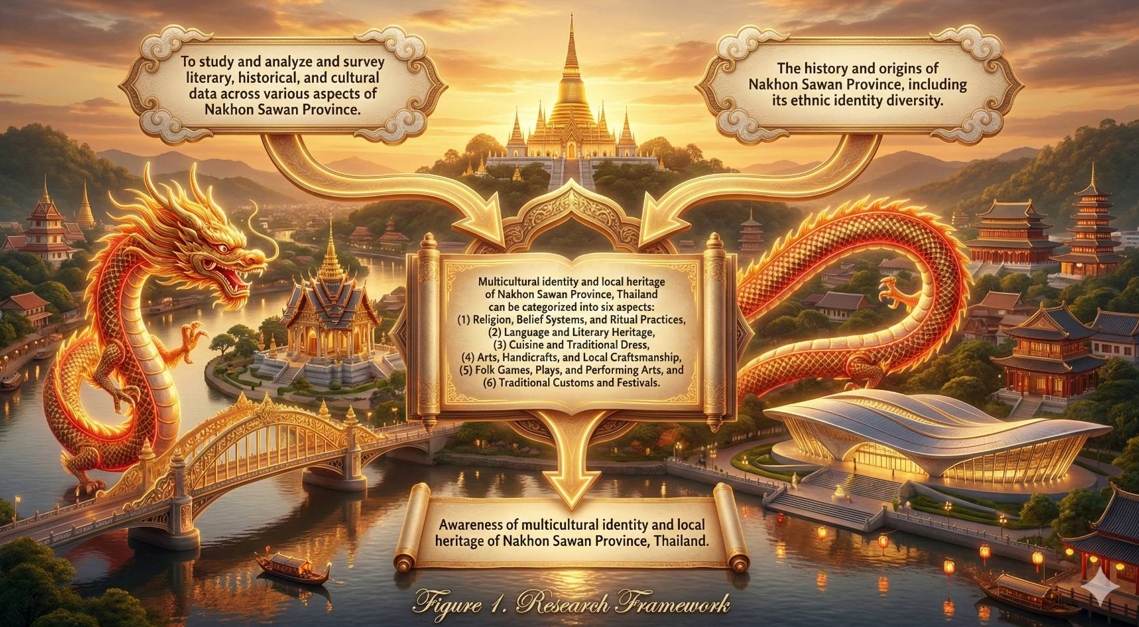
Multicultural Identity and Local Heritage of Nakhon Sawan Province, Thailand
บทคัดย่อ
This research aims to investigate and analyze data derived from literary, historical, and cultural evidence of Nakhon Sawan Province in various aspects, including its history, origins, ethnicity, and local foundational culture. The study seeks to foster understanding and awareness of the cultural identity about the local cultures based on Nakhon Sawan Province. It employs a qualitative descriptive - analytical approach based on documentary sources and relevant research studies.
The research findings reveal that Nakhon Sawan is a city with a long and continuous historical development, dating back to prehistoric settlements and gaining significance since the Sukhothai period. Geographically, Nakhon Sawan is located in the lower northern region of Thailand, characterized by fertile lowlands along the Chao Phraya River, which are highly suitable for settlement and agricultural activities. This advantageous geography has fostered the coexistence of diverse ethnic groups, including Thai, Chinese, Lao, Mon, Muslim, and Vietnamese communities, leading to cultural interaction and exchange within the province’s historical and cultural landscape. The combination of geographical features and ethnic diversity has contributed to Nakhon Sawan’s distinctive cultural plurality. The local cultures based on Nakhon Sawan Province can be categorized into six aspects that shows clearly multicultural identity and local heritage. Therefore, the local cultures based on Nakhon Sawan Province reflects the rich cultural diversity that has been harmoniously shaped along the Chao Phraya River, forming a distinctive multicultural identity that represents the province’s unique cultural charm within Thailand.
Downloads
Article Details
รูปแบบการอ้างอิง
ประเภทบทความ
บทความวิจัย
Copyright & License
ลิขสิทธิ์ (c) 2026 วารสารศิลปะและวัฒนธรรมลุ่มแม่น้ำมูล

อนุญาตภายใต้เงื่อนไข Creative Commons Attribution-NonCommercial-NoDerivatives 4.0 International License.
บทความทุกเรื่องที่ตีพิมพ์ในรูปแบบ เปิดให้เข้าถึง (Open Access) ภายใต้สัญญาอนุญาต CC BY-NC-ND 4.0 จะสามารถเข้าถึงได้ฟรีทันทีและอย่างถาวรสำหรับทุกคน โดยผู้อ่านสามารถอ่าน ดาวน์โหลด ทำสำเนา แจกจ่าย พิมพ์ ค้นหา หรือเชื่อมโยงไปยังบทความได้โดยไม่เสียค่าใช้จ่าย การใช้งานอนุญาตเฉพาะเพื่อวัตถุประสงค์ที่ไม่แสวงหากำไร (ไม่อนุญาตการใช้เพื่อการค้า) และต้องไม่ทำการดัดแปลงแก้ไขผลงาน (ไม่อนุญาตการดัดแปลง) การเข้าถึงไม่จำเป็นต้องขออนุญาตล่วงหน้าจากสำนักพิมพ์หรือผู้แต่ง ทั้งนี้ต้องมีการอ้างอิงถึงแหล่งตีพิมพ์ต้นฉบับอย่างถูกต้องและเหมาะสม




เอกสารอ้างอิง
Banda, L., L., Banda, V., C., Banda, T., J., & Singini, T. (2024). Preserving Cultural Heritage: A Community-Centric Approach to Safeguarding the Khulubvi Traditional Temple Malawi. Heliyon, 10(18), 1 - 22. https://doi.org/10.1016/j.heliyon.2024.e37610. DOI: https://doi.org/10.1016/j.heliyon.2024.e37610
Chailuksakul, S., & Boonyananta, S. (2025). An Integrative Approach to Arts and Experiential Learning in Tourist Attractions of Nakhon Sawan Province. DEC Journal: Art and Design, 4(3), 80 - 103. http://doi.org/10.69598/decjournalartanddesign.4.80 - 103. DOI: https://doi.org/10.69598/decjournalartanddesign.4.80-103
Committee on Documentation and Archives, Executive Committee for the Celebration of His Majesty the King’s Jubilee. (1999). Culture, Historical Development, Identity, and Wisdom of Nakhon Sawan Province. Ministry of Interior, Ministry of Education, and Fine Arts Department.
Dararuang, K. (2025). Guidelines for Promoting Cultural Identity to Promote Cultural Tourism in Pak Nam Pho District, Nakhon Sawan Province. The Journal of Research and Academics, 8(6), 276 - 289. https://doi.org/10.14456/jra.2025.150.
Duangwiset, N. (2015). Culture: Anthropological Terminology. Princess Maha Chakri Sirindhorn Anthropology Centre (Public Organization). https://anthropology-concepts.sac.or.th/glossary/30.
Duangwiset, N. (2015). Multiculturalism. Princess Maha Chakri Sirindhorn Anthropology Centre (Public Organization). https://anthropology-concepts.sac.or.th/glossary/90
Eagan, J., L. (2025). Multiculturalism. Britannica.
Fuengfusakul, A. (2003). Identity: A Review of Theories and Conceptual Frameworks. National Research Council of Thailand.
Harrison, R. (2017). Heritage: Critical Approaches. Routledge.
Haycroft, P., & Siribunsobh, S. (2024). The Restoring Food Culture Identity of the Upper Chao Phraya River Community that Lead to Sustainable Tourism. Social Sciences Research and Academic Journal, 19(1), 81 - 94.
Hinchiranan, N. (1985). Chansen: The Forgotten Dvaravati City. In Ocharoen, S. (Eds.), Nakhon Sawan: A Central State (35 - 48). Nakhon Sawan Teachers College.
Jomyim, T., Luangpipat, T., & Naiyananon, P. (2024). Identity Creating and Community Products Development to Combine Cultural Tourism Routes of Tai-Khrang (Lao Khrang) Ethnic Group in Nakhon Sawan Province. Arts of Management Journal, 8(1), 57 - 78.
Kasetsiri, C. (2005). Ayutthaya: History and Politics (4th ed.). Social Science and Humanities Textbook Project Foundation.
Ketprathum, W. (1985). Folk Games in Nakhon Sawan Province. In Ocharoen, S. (Eds.), Nakhon Sawan : A Central State (287 - 313). Nakhon Sawan Teachers College.
Kuwinpant, P. (2008). Identity and Cultural Diversity in Southeast Asia. Southeast Current, 5(55), 8 - 37.
Laguerre, M., S. (1984). American Odyssey: Haitians in New York City. Cornell University Press.
Leepreecha, P. (2004). The Creation and Perpetuation of the Hmong Ethnic Identity. In Luangaram Sri (Eds.), Identity, Ethnicity, and Marginality. Princess Maha Chakri Sirindhorn Anthropology Centre.
Nakhon Sawan Provincial Administrative Organization. (n.d.-a). Nakhon Sawan: Community Ways of Life in Pak Nam Pho. Nakhon Sawan Provincial Administrative Organization.
Nakhon Sawan Provincial Administrative Organization. (n.d.-b). Nakhon Sawan : The Charm of Nakhon Sawan City. Nakhon Sawan Provincial Administrative Organization.
Nakhon Sawan Provincial Office of Buddhism. (2022). Wat Tak Fa, Royal Monastery. Nakhon Sawan Provincial Office of Buddhism. https://nsn.onab.go.th/th/content/category/detail/id/110/iid/647.
Na Nakhon, Prasert. (1985). History of Nakhon Sawan from Inscriptions. In Ocharoen, S. (Eds.), Nakhon Sawan: A Central State (139 - 150). Nakhon Sawan Teachers College.
Office of Provincial Commercial Affairs Nakhonsawan. (2021). General Information of Nakhon Sawan Province. Office of Provincial Commercial Affairs Nakhonsawan. https://nakhonsawan.moc.go.th/th/content/page/index/id/1055.
Office of the Permanent Secretary for Culture, Ministry of Culture. (2021). Festivals, Traditions, and Performing Arts. Office of the Permanent Secretary for Culture, Ministry of Culture.
Pongpradit, P. (1986). Poems Praising Nakhon Sawan City. Nakhon Sawan Cultural Center, Nakhon Sawan Teachers College.
Raksrithong, C. (2024). Types of Culture. Princess Maha Chakri Sirindhorn Anthropology Centre (Public Organization). https://culturio.sac.or.th/content/1888.
Sankom, T. (2021). The Role of Muang Nakhon Sawan in History of Ayutthaya. Journal of Ayutthaya Studies, 13(1), 23 - 37.
Saisang, P. (1985). Folk Medical Literature. In Ocharoen, S. (Eds.), Nakhon Sawan: A Central State (277 - 286). Nakhon Sawan Teachers College.
Saengthong, S. (2016a). 100 Years: History and Background of Nakhon Sawan Province. Office of Arts and Culture, Nakhon Sawan Rajabhat University.
Saengthong, S. (2016b). 100 Years: Cultural and Ethnic Diversity in Nakhon Sawan. Office of Arts and Culture, Nakhon Sawan Rajabhat University.
Saengthong, S., Vongkamjan, S., & Jedaman, P. (2025). Cultural Identity Revival of Nakhon Sawan Province Toward Chinese Culture City. Interdisciplinary Academic and Research Journal, 5(1), 983 - 1002. https://doi.org/10.60027/iarj.2025.284283. DOI: https://doi.org/10.60027/iarj.2025.284283
