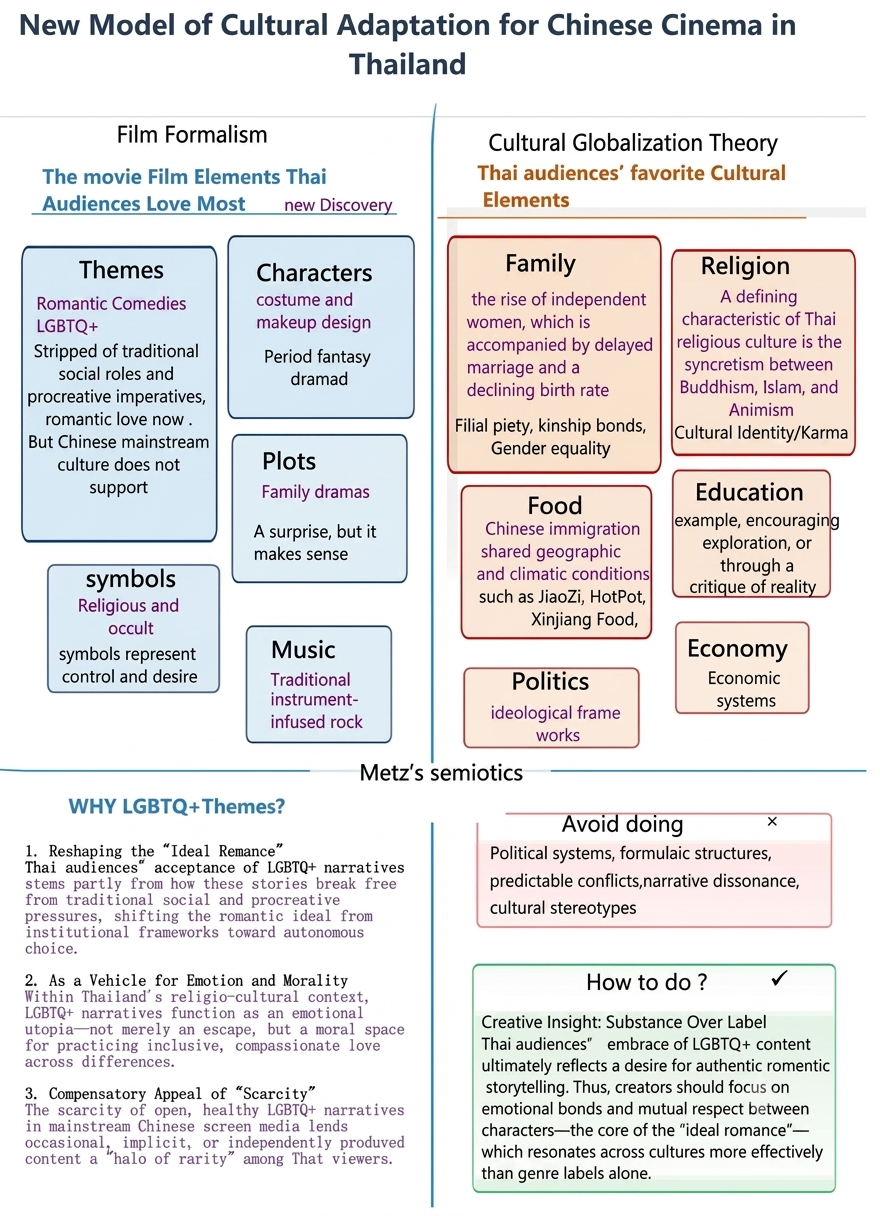
The Study of Highest-Rated Chinese Films (2015–2025) in Thailand
บทคัดย่อ
This study is guided by three core objectives. 1) To analyze the ten most popular Chinese films in Thailand using a formalist-based, five-dimensional framework of theme, plot, character, symbol, and music, while integrating cultural elements; 2) To investigate Thai audiences' perceptions and viewing preferences regarding Chinese films through a survey and empirical analysis; 3) To propose a new cinematic adaptation model designed to address the unique characteristics of the Thai film market. A mixed-methods approach was employed, grounded in Metz semiotics, cinematic formalism, and cultural globalization theory. The analysis encompassed ten high-grossing, culturally significant Chinese films. Data were collected via a survey of 100 Thai viewers (analyzed using SPSS) and in-depth interviews with five film industry practitioners. The findings resulted in the "Thai Audience Preference Model," which posits that appeal is driven by a synergy of the following elements: culturally familiar visual elements, emotionally universal characters, themes of romance or LGBT, plots with strong dramatic tension, and soundtracks that effectively incorporate traditional instruments. The study identifies religion and food as the most resonant cultural symbols. It concludes that China's international film communication should shift from pure "output" to strategic "adaptation".
Downloads
Article Details
รูปแบบการอ้างอิง
ประเภทบทความ
บทความวิจัย
Copyright & License
ลิขสิทธิ์ (c) 2026 วารสารศิลปะและวัฒนธรรมลุ่มแม่น้ำมูล

อนุญาตภายใต้เงื่อนไข Creative Commons Attribution-NonCommercial-NoDerivatives 4.0 International License.
บทความทุกเรื่องที่ตีพิมพ์ในรูปแบบ เปิดให้เข้าถึง (Open Access) ภายใต้สัญญาอนุญาต CC BY-NC-ND 4.0 จะสามารถเข้าถึงได้ฟรีทันทีและอย่างถาวรสำหรับทุกคน โดยผู้อ่านสามารถอ่าน ดาวน์โหลด ทำสำเนา แจกจ่าย พิมพ์ ค้นหา หรือเชื่อมโยงไปยังบทความได้โดยไม่เสียค่าใช้จ่าย การใช้งานอนุญาตเฉพาะเพื่อวัตถุประสงค์ที่ไม่แสวงหากำไร (ไม่อนุญาตการใช้เพื่อการค้า) และต้องไม่ทำการดัดแปลงแก้ไขผลงาน (ไม่อนุญาตการดัดแปลง) การเข้าถึงไม่จำเป็นต้องขออนุญาตล่วงหน้าจากสำนักพิมพ์หรือผู้แต่ง ทั้งนี้ต้องมีการอ้างอิงถึงแหล่งตีพิมพ์ต้นฉบับอย่างถูกต้องและเหมาะสม




เอกสารอ้างอิง
Ang, I. (2001). On not Speaking Chinese: Living Between Asia and the West. Routledge.
Appadurai, A. (1996). Modernity at Large: Cultural Dimensions of Globalization. University of Minnesota Press.
Athique, A., & Parthasarathi, V. (2020). Platform Capitalism in India. Palgrave Macmillan.
Bordwell, D., & Thompson, K. (2010). Film Art: An Introduction (9th ed.). McGraw-Hill.
Brace, I. (2018). Questionnaire Design: How to Plan, Structure and Write Survey Material for Effective Market Research (4th ed.). Kogan Page.
Braun, V., & Clarke, V. (2006). Using Thematic Analysis in Psychology. Qualitative Research in Psychology, 3(2), 77–101. https://doi.org/10.1191/1478088706qp063oa.
Chaiworaporn, A. (2006). Thailand: Revival in an Age of Globalization. In Ciecko, A, T. (Eds.), Contemporary Asian cinema (58 - 70). Berg.
Content Shifu, YouGov Thailand, & Adapter. (2024). Digital Insights Thailand Report 2024. Content Shifu. https://contentshifu.com
Creswell, J. W., & Plano Clark, V. L. (2018). Designing and Conducting Mixed Methods Research (3rd ed.). Sage Publications.
dela Cruz, E. J. A. (2025, November 8). Interplay of Institutional Pathways and Queer Identities in BL Media in the Philippines and Thailand [Conference presentation]. The Asian Conference on Media, Communication & Film (MediAsia). The International Academic Forum.
Field, A. (2013). Discovering Statistics Using IBM SPSS Statistics (4th ed.). Sage Publications.
Hoskins, C., & Mirus, R. (1988). Reasons for the US Dominance of the International Trade in Television Programmes. Media, Culture & Society, 10(4), 499 - 515. https://doi.org/10.1177/016344388010004006.
Lee, H.-K. (2011). Participatory Media Fandom: A Case Study of Anime Fansubbing. Media, Culture & Society, 33(8), 1131 - 1147. https://doi.org/10.1177/0163443711418271.
Lobato, R. (2019). Netflix Nations: The Geography of Digital Distribution. New York University Press.
Marketbuzzz. (2024). Thai Media and Entertainment Landscape Study. Marketbuzzz. https://marketbuzzz.com.
Media Partners Asia. (2023). Southeast Asia Online Video Consumer Insights & Analytics. Media Partners Asia. https://www.media-partners-asia.com.
Metz, C. (1974). Film Language: A Semiotics of the Cinema (M. Taylor, Trans.). Oxford University Press.
Ministry of Foreign Affairs of the People’s Republic of China. (2022). Joint statement between the People’s Republic of China and the Kingdom of Thailand on Strengthening Comprehensive Strategic Cooperative Partnership. Ministry of Foreign Affairs of the People’s Republic of China https://www.fmprc.gov.cn/mfa_eng/wjdt_665385/2649_665393/202211/t20221119_10970402.html. (In Chinese)
Nielsen Thailand. (2024). Fewer Thais Tuning into Traditional TV. Bangkok Post. https://www.bangkokpost.com/business/general/2855472/.
Nowell, L. S., Norris, J. M., White, D. E., & Moules, N. J. (2017). Thematic Analysis: Striving to Meet the Trustworthiness Criteria. International Journal of Qualitative Methods, 16(1), 1 - 13. https://doi.org/10.1177/1609406917733847.
Skinner, G. W. (1957). Chinese Society in Thailand: An Analytical History. Cornell University Press.
Straubhaar, J. D. (1991). Beyond Media Imperialism: Asymmetrical Interdependence and Cultural Proximity. Critical Studies in Mass Communication, 8(1), 39 - 59. https://doi.org/10.1080/15295039109366779.
Straubhaar, J. D. (2007). World Television: From Global to Local. Sage Publications.
Synergy Journal. (2026). Beyond the Bechdel Test: The development of Girls Love in Thailand. Synergy Journal. https://utsynergyjournal.org.
Tavakol, M., & Dennick, R. (2011). Making Sense of Cronbach’s Alpha. International Journal of Medical Education, 2, 53 - 55. https://doi.org/10.5116/ijme.4dfb.8dfd.
Turner, R. C., & Carlson, L. (2003). Indexes of Item-Objective Congruence for Multidimensional items. International Journal of Testing, 3(2), 163–171. https://doi.org/10.1207/S15327574IJT0302_5.
