From Raw Materials to Valuable Products: Dynamics of Agricultural Product Value Addition in Nanmalt Community Enterprise Context
Abstract
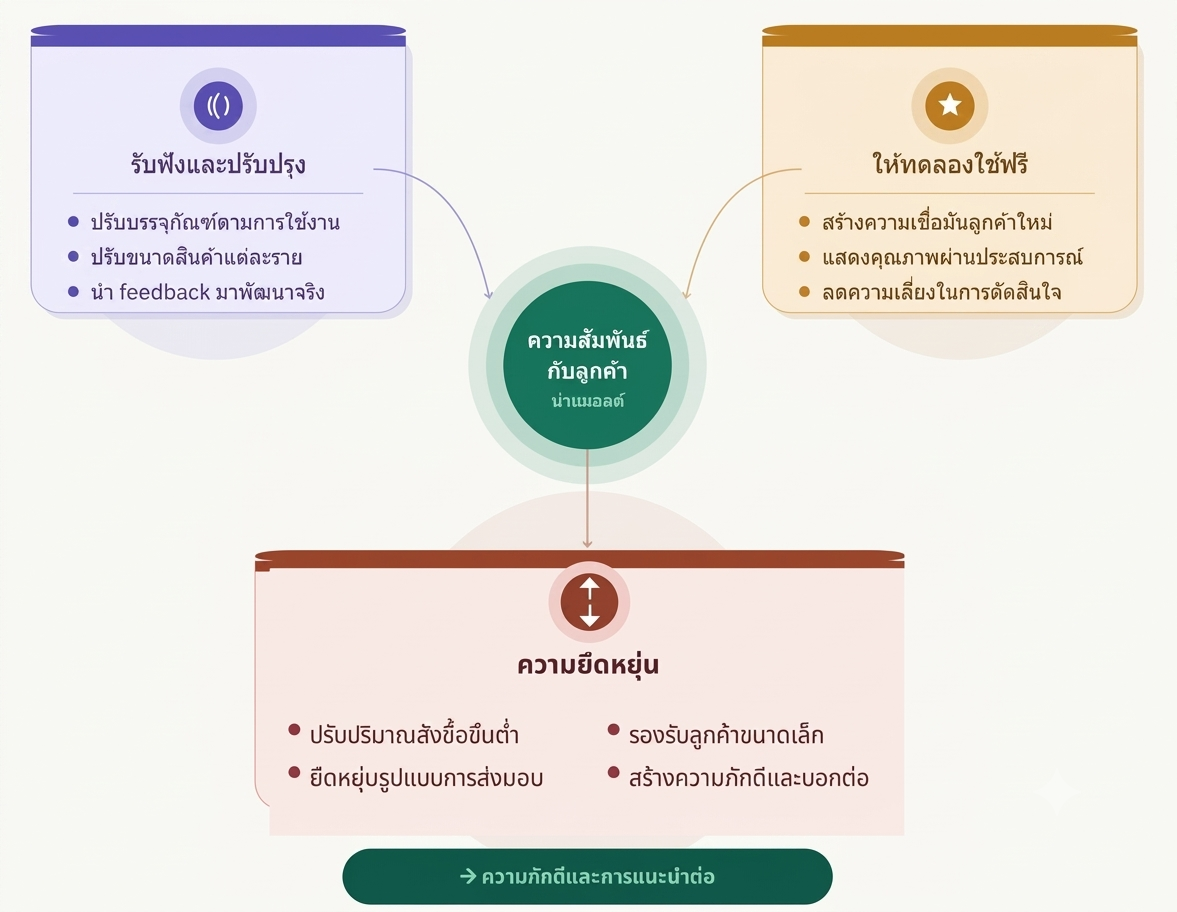
This study aims to analyze the success factors in agricultural product value addition of the Nanmalt Community Enterprise, Klang Wiang Subdistrict, Wiang Sa District, Nan Province. Employing a qualitative case study methodology, data were collected through focus group discussions and interviews from 15 key informants comprising community enterprise members, government officials, and experts. The conceptual frameworks of value addition, cultural capital, and competitive advantage were integrated in the analysis. Findings reveal that Nanmalt's success in transforming locally grown wheat into malt products stems from the integration of five key factors: (1) product development and innovation emphasizing chemical-free quality production, along with new products addressing specific market needs such as Diastatic Malt Powder and liquid Malt Extract; (2) management with visionary leadership, an annual cost-averaging system, and an open knowledge management culture; (3) cultural capital reflected through the preservation of local wisdom combined with modern technology and the creation of place-based identity; (4) marketing strategies and customer relationship building, including the transition from business-to-consumer (B2C) to business-to-business (B2B) markets; and (5) network building and collaboration with other community enterprises, government agencies, and customers as long-term partners. The study demonstrates that organizational adaptability, the conversion of cultural capital into economic value, and the adoption of a differentiation strategy over price competition are critical enablers of sustainable competitiveness for small community enterprises. These findings may contribute to the development of policies supporting community enterprises and grassroots economic development in the country.
Downloads
Article Details
How to Cite
Section
Research Articles
Categories
Copyright & License
Copyright (c) 2026 Arts and Culture Journal of the Lower Moon River

This work is licensed under a Creative Commons Attribution-NonCommercial-NoDerivatives 4.0 International License.
All articles published open access under the CC BY-NC-ND 4.0 license will be immediately and permanently free for everyone to read, download, copy, distribute, print, search, or link to articles free of charge. Use of the articles is permitted for non-commercial purposes only and without modifications. Access does not require prior permission from the publisher or the author, provided that the original publication is appropriately and adequately cited.




References
กรมการพัฒนาชุมชน. (2554). คู่มือการพัฒนาผลิตภัณฑ์ชุมชน. กรมการพัฒนาชุมชน กระทรวงมหาดไทย.
กรมส่งเสริมการเกษตร. (2568). กรมส่งเสริมการเกษตรประกาศผลวิสาหกิจชุมชนดีเด่น ปี 2568 ยกย่อง 6 ชุมชนต้นแบบ สร้างรายได้-ขับเคลื่อนเศรษฐกิจฐานราก. กรมส่งเสริมการเกษตร.
ณภัทร ทิพย์ศรี, ภัทรา พรสมเสมอ, และ กนกอร จิตจำนงค์. (2560). ความสามารถการเป็นผู้ประกอบการกับความสำเร็จในการประกอบธุรกิจวิสาหกิจขนาดกลางและขนาดย่อมในจังหวัดเชียงราย. วารสารบัญชีปริทัศน์ มหาวิทยาลัยราชภัฏเชียงราย, 2(1), 1 - 14.
นิออน ศรีสมยง. (2552). แนวทางการพัฒนาแหล่งท่องเที่ยวเชิงเกษตรอย่างยั่งยืน กรณีศึกษา อำเภอวังน้ำเขียว จังหวัดนครราชสีมา [รายงานการศึกษาอิสระปริญญามหาบัณฑิตไม่ได้ตีพิมพ์]. มหาวิทยาลัยเกษตรศาสตร์.
ศิริพร เลิศยิ่งยศ. (2557). โครงการจัดทำแผนชุมชนที่สอดคล้องกับวิถีชีวิตแบบมีส่วนร่วมของคนในหมู่บ้านโคกแฝก ตำบลขามทะเลสอ อำเภอขามทะเลสอ จังหวัดนครราชสีมา. Naresuan University Journal: Science and Technology (NUJST), 21(1), 93 - 106.
สำนักงานนโยบายและยุทธศาสตร์การค้า. (2566). การพัฒนาศักยภาพวิสาหกิจชุมชน เพื่อยกระดับเศรษฐกิจฐานราก. สำนักงานนโยบายและยุทธศาสตร์การค้า กระทรวงพาณิชย์.
อัญชลี หิรัญแพทย์, วราภรณ์ สารอินมูล และ ทมนี สุขใส. (2560, 10 มีนาคม). การจัดการห่วงโซ่อุปทานของกลุ่มวิสาหกิจชุมชนบ้านโฉนดชุมชนคลองโยงลานตากฟ้า จ.นครปฐม. ใน เอกสารสืบเนื่องจากการประชุมวิชาการระดับชาติ มหาวิทยาลัยราชภัฏเพชรบูรณ์ ครั้งที่ 4, 36 - 43. มหาวิทยาลัยราชภัฏเพชรบูรณ์.
Aaker, D. A. (1996). Building Strong Brands. Free Press.
Agrawal, A. (1995). Dismantling the Divide Between Indigenous and Scientific Knowledge. Development and Change, 26(3), 413 - 439. https://doi.org/10.1111/j.1467-7660.1995.tb00560.x.
Barney, J. (1991). Firm Resources and Sustained Competitive Advantage. Journal of Management, 17(1), 99 - 120. https://doi.org/10.1177/014920639101700108.
Berkes, F., Colding, J., & Folke, C. (2000). Rediscovery of Traditional Ecological Knowledge as Adaptive Management. Ecological Applications, 10(5), 1251 - 1262. https://doi.org/10.2307/2641280.
Bessière, J. (1998). Local Development and Heritage: Traditional Food and Cuisine as Tourist Attractions in Rural Areas. Sociologia Ruralis, 38(1), 21 - 34. https://doi.org/10.1111/1467-9523.00061.
Bourdieu, P. (1986). The Forms of Capital. In J. Richardson (Ed.), Handbook of theory and research for the sociology of education (241 - 258). Greenwood.
Fellows, P., & Hilmi, M. (2011). Selling Street and Snack Foods (FAO Diversification Booklet No. 18). Food and Agriculture Organization of the United Nations.
Fournier, S. (1998). Consumers and Their Brands: Developing Relationship Theory in Consumer Research. Journal of Consumer Research, 24(4), 343 - 373. https://doi.org/10.1086/209515.
Howells, J. (2002). Tacit Knowledge, Innovation and Economic Geography. Urban Studies, 39(5–6), 871–884. https://doi.org/10.1080/00420980220128354.
Ilbery, B., & Kneafsey, M. (2000). Producer Constructions of Quality in Regional Speciality Food Production: A Case Study from South West England. Journal of Rural Studies, 16(2), 217–230. https://doi.org/10.1016/S0743-0167(99)00041-8.
Ingram, V., Riisgaard, L., Waarts, Y., & Ton, G. (2023). Smallholder Participation in Modernising Agri-Food Value Chains in Thailand: The Role of Traditional Markets. The European Journal of Development Research, 35(3), 537–558. https://doi.org/10.1057/s41287-023-00587-9
Kaplinsky, R., & Morris, M. (2001). A Handbook for Value Chain Research. Institute of Development Studies, University of Sussex.
Maneenin, P., Pinichchan, G., Kamphangdee, S., Kootiphakdee, T., Laotanataworn, B., & Maneenin, T. (2024). Development of Community Enterprise for Sustainable Success: Lessons from The Tha Sap Coconut Shell Group in Yala, Thailand. Asian Interdisciplinary and Sustainability Review, 13(2), 25 - 32. https://doi.org/10.14456/aisr.2024.10.
Muangmee, C., Pongvatnanusorn, V., Sawangcharoen, K., Chaitorn, T., Kassakorn, N., & Saqib, S. E. (2024). Factors Influencing the Success of Processed Agricultural Products: An Empirical Study from Thailand. Sarhad Journal of Agriculture, 40(3), 1033 - 1045. https://dx.doi.org/10.17582/journal.sja/2024/40.3.1033.1045.
Nakhonsong, P., & Chamruspanth, V. (2024). Promoting Community Enterprises in Thailand: Challenges and Opportunities. Revista de Gestão Social e Ambiental, 18(4), e06505. https://doi.org/10.24857/rgsa.v18n4-123.
Oliver, R. L. (1999). Whence Consumer Loyalty? Journal of Marketing, 63(Special Issue), 33–44. https://doi.org/10.1177/00222429990634s105.
Porter, M. E. (1985). Competitive Advantage: Creating and sustaining superior performance. Free Press.
Putnam, R. D. (1993). Making Democracy Work: Civic Traditions in Modern Italy. Princeton University Press.
Ray, C. (1998). Culture, Intellectual Property and Territorial Rural Development. Sociologia Ruralis, 38(1), 3 - 20. https://doi.org/10.1111/1467-9523.00060.
Rundh, B. (2009). Packaging Design: Creating Competitive Advantage with Product Packaging. British Food Journal, 111(9), 988 - 1002. https://doi.org/10.1108/00070700910992880.
Senge, P. M. (1990). The Fifth Discipline : The Art and Practice of the Learning Organization. Doubleday.
Suwanmaneepong, S., Llones, C., Kerdsriserm, C., Khermkhan, J., Sabaijai, P. E., Samanakupt, T., ... & Dana, L. P. (2024). Participatory Value Chain Development. Insights from Community-based Enterprise in Rural Thailand. International Journal of Agricultural Sustainability, 22(1), 2371703.
Throsby, D. (2001). Economics and Culture. Cambridge University Press.
Tregear, A. (2003). From Stilton to Vimto: Using Food History to Re-think Typical Products in Rural Development. Sociologia Ruralis, 43(2), 91 - 107. https://doi.org/10.1111/1467-9523.00233.
Vivalt, E., & Coville, A. (2023). How do Policymakers Update Their Beliefs?. Journal of Development Economics, 165, 103121.
