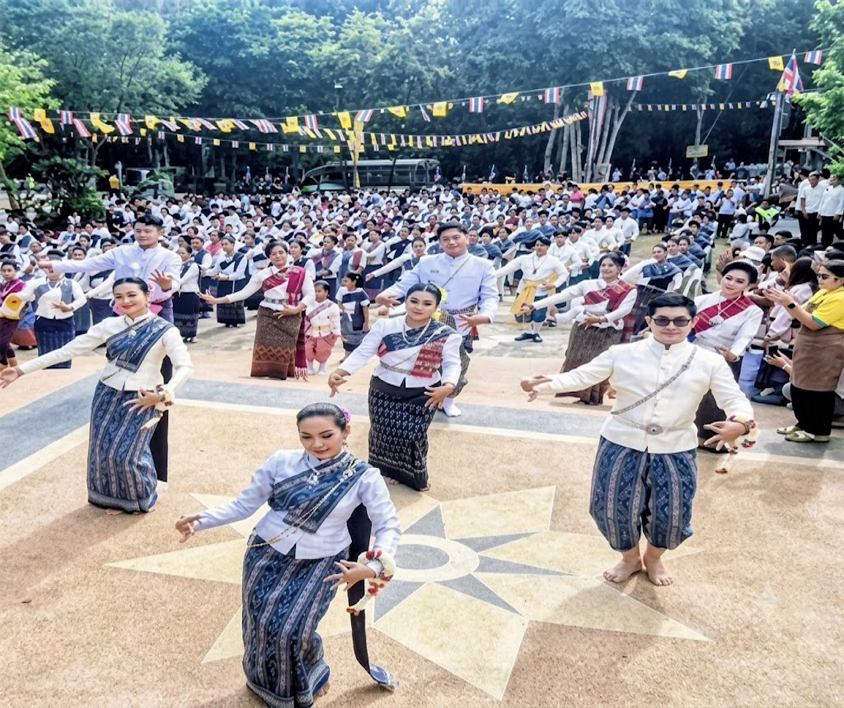
Fon Sam Phaen Din: The Create of Dance to Honor the Great Buddha at Wat khaoChong Chad, Nong Wua So District, Udon Thani Province
Abstract
This research titled “Fon Sam Phaen Din: The Create of Dance to Honor the Great Buddha at Wat khaoChong Chad, Nong Wua So District, Udon Thani Province” aims to: 1) study the prototype dance movements from local communities Nong Wua So District, Udon Thani and Fon maebod Isan 2) design adapted dance movements based on traditional forms and the cultural identity and Fon Mae Bot Isan 3) create and transfer the Fon Sam Phaen Din dance to the community 4) disseminate the Fon Sam Phaen Din to cultural identity.This research employs a mixed-method approach, integrating qualitative research and creative research methodologies. Data were collected through document analysis, interviews, observation, and descriptive analysis.The findings revealed 9 core prototype dance movements, such as Wai (paying respect), Sod Soi, Son Pla, Soeng Bang Fai, Kwaeng Kung, Hae Bang Fai, Lom Phat,Lai Maeng Wee, Sa Pat Bat Mue ana Fon Mae Bot Isan revealed 6 core prototype dance movements, such as Wai Wai (paying respect),Phrom Si Na, Lam Ploen, Phiphek- Thuai Khru, Un Manora, Khon Kha Yaengh ana Hanuman Thawai Waen.The dance movements were creatively developed based on the choreographer experience revealed 22 core. Fon Sam Phaen Din choreography, comprising 37 movements. The symbolic gesture “Dok Bua Tuum” (lotus bud gesture) represents the act of paying homage to the Great Buddha Image. The performance is structured into three parts: Part 1 - the significance of the Great Buddha; Part 2 - the location and enshrinement of the Buddha image; and Part 3 - a prayer for blessings. Costumes were designed to reflect local identity, using mudmee silk, traditional Thai silk, and cotton fabrics. The accompanying music is divided into three segments with traditional Isan melodies: Lam Puen, Lam Dern Khon Kaen, and Lam Dern Dong. Evaluation by five experts affirmed that the Fon Sam Phaen Din dance is appropriate for ritual performances dedicated to the Great Buddha and effectively preserves and transmits Isan folk dance traditions to the community, particularly during the annual Tak Bat Theworohana ceremony at Wat Khao Chong Chad.
Downloads
Article Details
How to Cite
Section
Research Articles
Copyright & License
Copyright (c) 2026 Arts and Culture Journal of the Lower Moon River

This work is licensed under a Creative Commons Attribution-NonCommercial-NoDerivatives 4.0 International License.
All articles published open access under the CC BY-NC-ND 4.0 license will be immediately and permanently free for everyone to read, download, copy, distribute, print, search, or link to articles free of charge. Use of the articles is permitted for non-commercial purposes only and without modifications. Access does not require prior permission from the publisher or the author, provided that the original publication is appropriately and adequately cited.




References
วชิรารัตน์ นิรันดร์เตชาภัทร. (2567). การวิเคราะห์สัญญาในการรำบวงสรวงท้าวสุรนารีเนื่องในโอกาสเฉลิมฉลองเมืองนครราชสีมา ครบรอบ 555 ปี. วารสารสหวิทยาการวิจัยและวิชาการ, 4(2), 845. DOI: https://doi.org/10.60027/iarj.2024.275463
ศราวดี ภูชมศรี. (2562). ถวยแถน แอ่นฟ้อน: สักการะธรรมเนียมการฟ้อน บวงสรวงสิ่งศักดิ์สิทธิ์ในความเชื่อชาวอีสาน. วารสารศิลปกรรมศาสตร์ มหาวิทยาลัยขอนแก่น, 11(1), 201-202.
ศักดิ์ชัย หิรัญรักษ์ และ อัครวัตร เชื่อมกลาง. (2564). ลักษณะเพลงพื้นบ้านอีสานเพื่อการสร้างสรรค์บทเพลงวงซิมโฟนิก .วารสารมนุษยศาสตร์และสังคมศาสตร์ มหาวิทยาลัยมหาสารคาม, 40(4), 129-132.
ศุภกร ฉลองภาค. (2565). ฟ้อนบวงสรวง: นาฏยประดิษฐ์จากความศรัทธาในบริบทวัฒนธรรมสมัยนิยม. รายงานการวิจัย. มหวิทยาลัยมหาสารคาม
อาหมัดอัลซารีย์ มูเก็ม. (2559). ประเพณี พิธีกรรม ความเชื่อ ที่มีความสัมพันธ์ต่อวิถีชีวิตของชนกลุ่มชาติพันธุ์เขมรบนพื้นที่บ้านจารย์ อำเภอสังขะ จังหวัดสุรินทร์. รายงานการวิจัย.มหาวิทยาลัยธรรมศาสตร์.
เอกพงษ์ ตรีตรง. (2564). Design + 4 DNA : ศาสตร์การถอดรหัสเพื่อการออกแบบ (เล่มพิเศษ). อ.การพิมพ์
