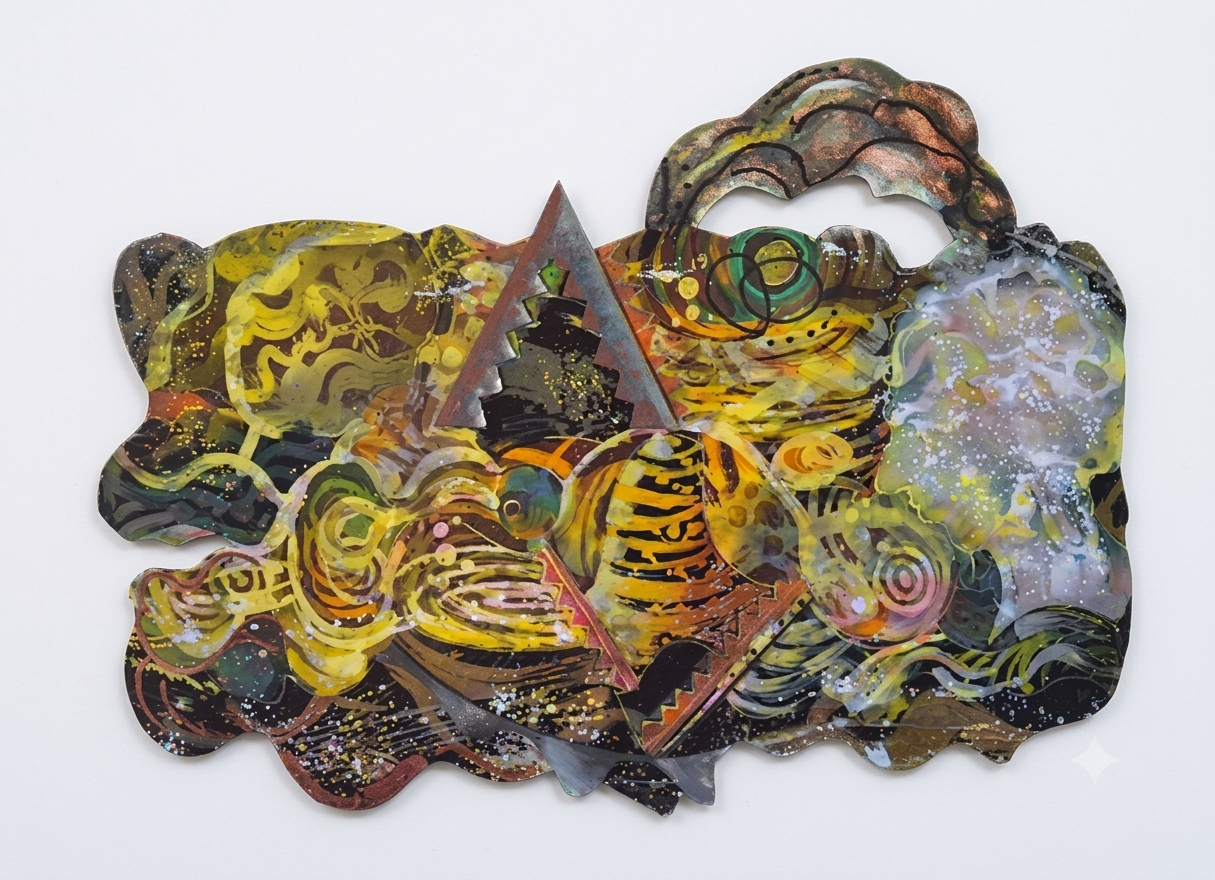
Andaman Identity in a New Perspective through the Contemporary Batik Art
Abstract
This study sought to: (1) examine the contextual constitution of the shared identity of Thailand’s Andaman provincial cluster, and (2) produce contemporary batik artworks that articulate this shared identity through visual practice. The research adopted an axiological, practice-based approach in visual arts, focusing on three sites in the Andaman region: Phuket, Phang Nga, and Krabi. Data were generated through perception-based surveys on regional image and identity expression, alongside investigations of the physical and landscape characteristics of each site. The data were analyzed to identify shared themes and place-specific values, which were subsequently interpreted through a Saussurean semiotic framework linking artistic form to nature, lifeways, belief systems, memory, and cultural diversity.
The findings indicate that the shared identity of the Andaman provincial cluster functions as a repository of spatial meanings, comprising both abstract and concrete dimensions. The abstract dimension was predominant, accounting for 62%, while the concrete dimension accounted for 38%. The most prominent shared identity was nature, particularly the sea, mountains, and forests.
These findings were synthesized into an imagined visual construct and semiotic framework consisting of three categories: iconic signs, abstract signs, and polysemic signs. This framework informed the creation of six contemporary batik artworks. The works employed batik techniques, including controlled dye diffusion, the preservation of white fabric areas, and layered wax application to create tonal depth, combined with mixed media in a contemporary installation-oriented approach.
The creative process operated as a mechanism for meaning-making through materials, signs, and visual structures. The works were characterized by simplified forms, grouped color schemes, and dynamic linear movement as key visual elements.
The evaluation of the six artworks showed an overall highest-level rating, with a mean score of 4.48 out of 5.00. The highest-rated aspect was the use of contemporary materials, techniques, or concepts to enhance the value of traditional identity ( x̄ = 4.80), followed by the potential for national or international development without losing local identity ( x̄ = 4.60).
Downloads
Article Details
How to Cite
Section
Research Articles
Copyright & License
Copyright (c) 2026 Arts and Culture Journal of the Lower Moon River

This work is licensed under a Creative Commons Attribution-NonCommercial-NoDerivatives 4.0 International License.
All articles published open access under the CC BY-NC-ND 4.0 license will be immediately and permanently free for everyone to read, download, copy, distribute, print, search, or link to articles free of charge. Use of the articles is permitted for non-commercial purposes only and without modifications. Access does not require prior permission from the publisher or the author, provided that the original publication is appropriately and adequately cited.




References
ธวัชชัย ทุมทอง. (2545). ศิลปะการทำบาติก: ลายเขียนระบายสี. โอเดียนสโตร์.
ปริตตา เฉลิมเผ่า กออนันตกูล. (2545). อัตลักษณ์ซ่อนของนักมนุษยวิทยาในบ้านเกิด. ใน ปริตตา เฉลิมเผ่า กออนันตกูล (บ.ก.), คนใน: ประสบการณ์ภาคสนามของนักมานุษยวิทยาไทย (201 - 202). ศูนย์มานุษยวิทยาสิรินธร.
พีรยา บุญประสงค์. (2562). อัตลักษณ์ของถิ่นที่ในกระบวนการเปลี่ยนแปลงการใช้สอยของอาคารเก่าในเขตเมืองเก่า. วารสารวิจัยและสาระสถาปัตยกรรม/การผังเมือง (JARS), 16(2), 31–47. https://doi.org/10.56261/jars.v16i2.175256.
สำนักงานราชบัณฑิตยสภา. (2550). พจนานุกรมศัพท์ศิลปะ. สำนักงานราชบัณฑิตยสภา.
เอกสรรค์ อังคารวัลย์. (2534). ศิลปะบาติก. โอเดียนสโตร์.
Hall, S. (1997). Representation: Cultural representations and signifying practices. Sage.
Lefebvre, H. (1991). The production of space (D. Nicholson-Smith, Trans.). Blackwell.
Saussure, F. de. (2011). Course in general linguistics (W. Baskin, Trans.; P. Meisel & H. Saussy, Eds.). Columbia University Press. (Original work published 1916).
Sullivan, G. (2010). Art practice as research: Inquiry in the visual arts (2nd ed.). Sage.
