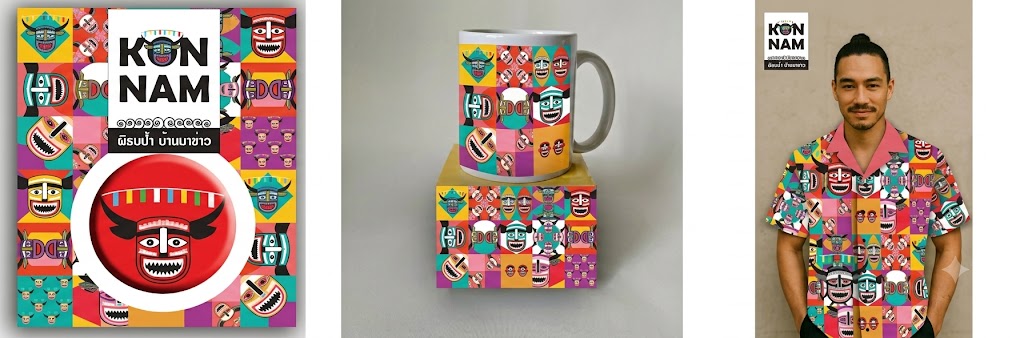
The Community Participation Process in Upgrading Souvenir Products from the Phi Khon Nam Festival toward a Creative Economy: A Case Study of Na Sao Subdistrict, Chiang Khan District, Loei Province, Thailand
Abstract
This study, entitled Community Participation in Upgrading Souvenirs from the Phi Khon Nam Festival toward the Creative Economy: A Case Study of Na Sao Subdistrict, Chiang Khan District, Loei Province, aimed to 1. examine the local context, community capital, and existing challenges associated with souvenirs derived from the Phi Khon Nam Festival, and 2. investigate the community participation process in upgrading these souvenirs within the framework of the creative economy.
A qualitative research approach was employed. Thirty key informants were purposively selected, comprising community leaders, representatives from government agencies and academic institutions, local wisdom holders and entrepreneurs, and community residents. Data were collected through semi-structured interviews, participant observation, focus group discussions, and documentary research. The data were analyzed using content analysis and interpretive descriptive analysis.
The findings revealed that Na Sao Subdistrict possesses substantial cultural and social capital, particularly reflected in the distinctive identity of the Phi Khon Nam Festival, indigenous knowledge of mask-making and traditional costume craftsmanship, and the strong collaborative spirit among community members. Nevertheless, the existing souvenirs were constrained by limited product design, insufficient diversity, inadequate communication of cultural narratives, and weak integration with contemporary markets. The community participation process encompassed collaborative problem identification, collective brainstorming, co-design and product development, prototype testing, and participatory evaluation. These processes resulted in the development of new souvenir products that effectively embody the unique identity of the Phi Khon Nam Festival while enhancing both their economic value and cultural significance. Furthermore, the participatory process strengthened community learning, fostered local pride in cultural identity, and reinforced community cohesion. The study concludes that community participation constitutes a fundamental mechanism for upgrading cultural souvenirs by integrating cultural capital with creativity. Such an approach not only adds value to local products but also contributes to the preservation of cultural heritage and the sustainable development of the community-based creative economy.
Downloads
Article Details
How to Cite
Section
Research Articles
Categories
Copyright & License
Copyright (c) 2026 Arts and Culture Journal of the Lower Moon River

This work is licensed under a Creative Commons Attribution-NonCommercial-NoDerivatives 4.0 International License.
All articles published open access under the CC BY-NC-ND 4.0 license will be immediately and permanently free for everyone to read, download, copy, distribute, print, search, or link to articles free of charge. Use of the articles is permitted for non-commercial purposes only and without modifications. Access does not require prior permission from the publisher or the author, provided that the original publication is appropriately and adequately cited.




References
กาญจนา แก้วเทพ. (2559). ศาสตร์แห่งสื่อและวัฒนธรรมศึกษา พิมพ์ครั้งที่ 3. ภาพพิมพ์.
จุฑารัตน์ ธรรมรัตน์. (2562). ประเพณีผีขนน้ำ: ความเชื่อและอัตลักษณ์ท้องถิ่น. มหาวิทยาลัยราชภัฏเลย.
ณัฎฐพัชร มณีโรจน์. (2564). การพัฒนาศักยภาพของแหล่งน้ำพุร้อนบ้านหนองเจริญ จังหวัดกาญจนบุรี สำหรับรองรับการท่องเที่ยวมูลค่าสูง. วารสารปรัชญาปริทรรศน์, 26(1), 146 - 167.
นุชจรี ทียะบุญ. (2564). รูปแบบการประกอบการสินค้าแปรรูปเกษตรกลุ่มสมุนไพร ด้วยกระบวนการมีส่วนร่วมของชุมชน: กรณีศึกษากลุ่มวิสาหกิจยาหม่องสมุนไพรเสลดพังพอน ตำบลยางเนิ้ง ตำบลหนองผึ้ง ตำบลสารภี อำเภอสารภี จังหวัดเชียงใหม่. วารสารมนุษยศาสตร์และสังคมศาสตร์ มหาวิทยาลัยราชพฤกษ์, 7(Special), 84 - 97.
ปาริชาติ วลัยเสถียร. (2543). กระบวนการและเทคนิคการทำงานของนักพัฒนา. สำนักงานกองทุนสนับสนุนการวิจัย
พาขวัญ ทองรักษ์, วรรภา วงศ์แสงธรรม, วรรภา วงศ์แสงธรรม, สุภาพร พาเจริญ, จันทร์เพ็ญ บุตรใส และ รุ่งทิพย์ ไทยสม (2560). การพัฒนากระบวนการผลิตข้าวเกรียบมันเทศ สู่การผลิตเชิงพาณิชย์โดยชุมชนมีส่วนร่วม. Area Based Development Research Journal, 9(4), 242 - 256.
เมธา หริมเทพาธิป. (2561). การมีส่วนร่วมในมุมมองหลังนวยุค. มนุษยสังคมสาร (มสส.) คณะมนุษยศาสตร์และสังคมศาสตร์ มหาวิทยาลัยราชภัฏบุรีรัมย์, 16(3), 63 - 78.
ยุวดี สิทธิพาที (2527). ปัจจัยที่มีผลต่อการมีส่วนร่วมของประชาชน ศึกษาเฉพาะกรณี กลุ่มผู้ใช้น้ำเพื่อการเกษตรกรรม โครงการปฏิรูปที่ดินสาธารณประโยชน์ ดงเทพรัตน์ ต. ดงคอน อ. สรรคบุรี จ. ชัยนาท.. มหาวิทยาลัยธรรมศาสตร์.
สำนักงานส่งเสริมวิสาหกิจขนาดกลางและขนาดย่อม. (2565). รายงานสถานการณ์วิสาหกิจขนาดกลางและขนาดย่อมปี 2565. สำนักงานส่งเสริมวิสาหกิจขนาดกลางและขนาดย่อม.
Cohen, J. M., & Uphoff, N. T. (1980). Participation’s Place in Rural Development: Seeking Clarity Through Specificity. World Development, 8(3), 213 - 235. DOI: https://doi.org/10.1016/0305-750X(80)90011-X
Florida, R. (2002). The Rise of the Creative Class: And How It’s Transforming Work, Leisure, Community and Everyday Life. Basic Books.
Howkins, J. (2001). The Creative Economy: How People Make Money from Ideas. Penguin.
Kaplinsky, R., & Morris, M. (2001). A Handbook for Value Chain Research. Institute of Development Studies.
Kotler, P., Kartajaya, H., & Setiawan, I. (2017). Marketing 4.0: Moving from Traditional to Digital. John Wiley & Sons.
Kotler, P., & Keller, K. L. (2016). Marketing Management (15th ed.). Pearson.
Porter, M. E. (1990). The Competitive Advantage of Nations. Free Press. DOI: https://doi.org/10.1007/978-1-349-11336-1
Prahalad C, Ramaswamy V (2004), "Co-creating Unique Value with Customers". Strategy & Leadership, 32(3), 4 - 9. https://doi.org/10.1108/10878570410699249. DOI: https://doi.org/10.1108/10878570410699249
Pretty, J. N. (1995). Participatory Learning for Sustainable Agriculture. World Development, 23(8), 1247 - 1263. https://doi.org/10.1016/0305-750X(95)00046-F. DOI: https://doi.org/10.1016/0305-750X(95)00046-F
Schumpeter, J. A. (1934). The Theory of Economic Development: An Inquiry into Profits, Capital, Credit, Interest, and the Business Cycle. Harvard University Press.
UNCTAD. (2010). Creative Economy Report 2010: Creative Economy: A Feasible Development Option. United Nations.
UNESCO. (2013). Creative Economy Report 2013 Special Edition: Widening Local Development Pathways. United Nations Development Programme.
World Health Organization, & UNICEF. (1978). Primary Health Care: Report of the International Conference on Primary Health Care, Alma-Ata, USSR. World Health Organization.
