Social Innovation for Driving Supportive Welfare Mechanism in Surin Province
Abstract
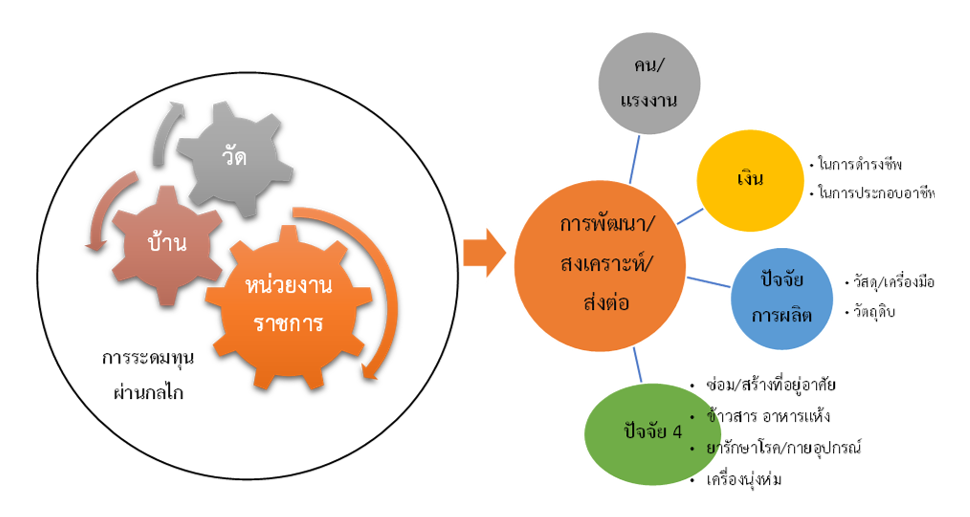
Project Design to Assist the Extremely Poor and Vulnerable Groups Based on the Analysis and Utilization of the PPPConnext Database and the Provincial Sustainable Poverty Eradication and Development Center (PPEDC) According to the Philosophy of Sufficiency Economy. This research and development aims to drive a welfare support mechanism in Surin Province through social innovation involving 1,400 targeted poor individuals from 17 districts in Surin. The concept of social innovation is used as a process to promote an appropriate welfare support mechanism suitable to the context of Surin Province, based on Buddhist principles and the “Baworn” power concept through six steps including 1) inspiration and internal motivation; 2) brainstorming; 3) prototyping and testing; 4) sustainability; 5) scaling up; and 6) systemic change. The research findings show as follows 1) Psychologically, participants received empowerment that strengthened life stability, building resilience and guidance to adapt happily in contemporary society with an emphasis on self-reliance, 2) Regarding the four basic necessities of life, through aid and forwarding of needs information to network partners, 23 houses were repaired or built, dry rice and food were provided to 1,550 households, medicine and medical devices to 938 households, clothing to 228 households, and scholarships to 51 households, and 3) For livelihood factors, support was given in materials, tools, and raw materials to promote occupations and generate income for 100 households. Social impacts include improved quality of life among the poor in terms of social support, health, and housing, by encouraging community participation in solving local poverty issues.
Downloads
Article Details
How to Cite
Section
Research Articles
Copyright & License
Copyright (c) 2025 Arts and Culture Journal of the Lower Moon River

This work is licensed under a Creative Commons Attribution-NonCommercial-NoDerivatives 4.0 International License.
All articles published open access under the CC BY-NC-ND 4.0 license will be immediately and permanently free for everyone to read, download, copy, distribute, print, search, or link to articles free of charge. Use of the articles is permitted for non-commercial purposes only and without modifications. Access does not require prior permission from the publisher or the author, provided that the original publication is appropriately and adequately cited.




References
กระทรวงการอุดมศึกษา วิทยาศาสตร์ วิจัยและนวัตกรรม. (2563). สมุดปกขาว อววน. กับการขจัดความยากจนอย่างตรงจุด. https://www.nxpo.or.th/th/wp-content/uploads/2021/01/2020.10.16-Poverty-to-prosperity_V2.0.pdf.
กระทรวงวัฒนธรรม. (2562). แนวทางการเสริมสร้างความเข้มแข็งของ “บวร” เพื่อความมั่นคง มั่งคั่ง และยั่งยืนของชุมชน ตามหลักปรัชญาของเศรษฐกิจพอเพียง. กระทรวงวัฒนธรรม.
ชนินทร์ วะสีนนท์, นันทกาญจน์ เกิดมาลัย, ปทุมทิพย์ ม่านโคกสูง,มาลี ศรีพรหม, กาญจนา วงษ์สวัสดิ์, ภาวิณี แสนชนม์, นิรมล เนื่องสิทธะ, ปริฉัตร ภูจิตร, และ รจิตรา กาญบุตร. (2567). การสร้างต้นแบบนโยบายการแก้ไขปัญหาความยากจนในพื้นที่นําร่อง ตําบลกุดบาก อําเภอกุดบาก จังหวัดสกลนคร. วารสารวิทยาการจัดการ มหาวิทยาลัยราชภัฏสกลนคร, 4(1), 13 - 28.
ชลวิทย์ เจียรจิตต์, ชัยวัชร พรหมจิตติพงศ์, ธันนิกานต์ สูญสิ้นภัย, สายชล ปัญญชิต, และ ภูเบศ วณิชชานนท์. (2565). นวัตกรรมทางสังคมกับแนวทางการพัฒนาเครือข่ายสัมมาชีพชุมชนอย่างยั่งยืน. วารสาร มจร สังคมศาสตร์ปริทรรศน์, 11(2), 1 - 14.
นภาพรรณ พัฒนฉัตรชัย, อุบลวรรณ สุวรรณภูสิทธิ์, นิศานาถ แก้ววินัด, ลดาวัลย์ ปัญตะยัง, และ พิสชานันท์ สนธิธรรม. (2565). การยกระดับระบบบริหารจัดการเพื่อแก้ไขปัญหาความยากจนจังหวัดสุรินทร์สู่การดำรงชีพอย่างยั่งยืน. รายงานการวิจัย. มหาวิทยาลัยราชภัฏสุรินทร์.
พระมหาถาวร ขนฺติวิชฺโช. (2566). การบูรณาการศีล 5 กับการแก้ไขปัญหาความยากจนในสังคมไทย. วารสารพุทธนวัตกรรมและการจัดการ, 6(5), 144 – 157.
พิมพ์ประภา อมรกิจภิญโญ, ธัญธรณ์ อมรกิจภิญโญ, นเรศ สถิตยพงศ์, สมสมร วงศ์รจิต, และ ชวกิจ ทองนุ้ยพราหมณ์. (2565). นวัตกรรมทางสังคมเพื่อคุณภาพชีวิต. วารสารนวัตกรรมการจัดการศึกษาและการวิจัย, 4(2), 279 - 286.
ระบบบริหารจัดการข้อมูลการพัฒนาคนแบบชี้เป้า. (2568). ภาพรวมคนจนเป้าหมายในปี 2567 สุรินทร์. https://www.tpmap.in.th/2567/32.
ศูนย์สื่อสารวาระทางสังคมและนโยบายสาธารณะ. (2564). ความจริงของคนจน : นโยบายแก้จน 5 ทศวรรษ. https://theactive.thaipbs.or.th/data/truth-about-poverty-poor
สำนักข่าวอิศรา. (2565). สภาพัฒน์เผยความเหลื่อมล้ำยังสูง – 10% ของคนรวยครอบครองทรัพย์สินถึง 1 ใน 3. https://www.isranews.org/article/isranews-news/108803-gov-NESDC-National-Economic-and-Social-Development-Plan-12-news.html.
สำนักงานจังหวัดสุรินทร์. (2568). แผนพัฒนาจังหวัดสุรินทร์ (พ.ศ.2566 - 2570) ฉบับทบทวนปี 2569. กลุ่มงานยุทธศาสตร์และข้อมูลเพื่อการพัฒนาจังหวัด.
สำนักงานสภาพัฒนาการเศรษฐกิจและสังคมแห่งชาติ. (2565). แผนพัฒนาเศรษฐกิจและสังคมแห่งชาติ ฉบับที่ 13 (พ.ศ. 2566–2570). https://www.nesdc.go.th/download/Plan13/Doc/Plan13_Final.pdf.
สำนักงานสภานโยบายการอุดมศึกษา วิทยาศาสตร์ วิจัยและนวัตกรรมแห่งชาติ. (2565). “เอนก” แนะติดอาวุธวิชาชีพให้กลุ่มฐานราก สร้างแรงบันดาลใจพัฒนาตนเอง เสนอตั้ง “สมาคมคนเคยลำบาก” เป็นพี่เลี้ยงแนะแนวทางดึงคนฐานรากขยับสถานะพ้นความยากจน. https://www.nxpo.or.th/th/10169. (in Thai).
Murray, R., Caulier-Grice, J., & Mulgan, G. (2010). The Open Book of Social Innovation. http://temp.uefiscdi.ro/edigiregion_v2/the_open_book_of_social_innovationNESTA.pdf.
Ungkleng, S. (2020). On the Human Learning and Social Movement with Social Innovation. Journal of Development Studies, 3(2), 113 - 142.
