Health Policies Addressing Southern Thailand's Needs : Lessons from Human Security-Based Support Systems
Abstract
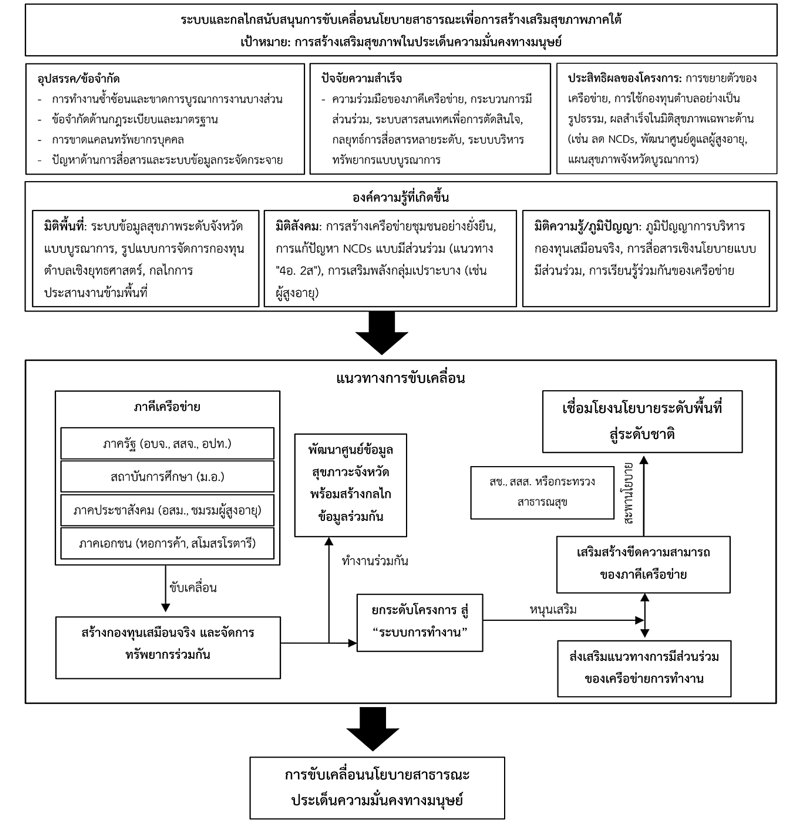
This research extracts lessons from the development of a system and mechanism to support the implementation of public policy for health promotion in Southern Thailand, framed by the concepts of human security and community health plans. It involved expanding networks, fostering participation, and utilizing sub-district funds to drive sustainable and equitable health outcomes. The primary objectives were to analyze the efficiency, effectiveness, success factors, and obstacles, extract knowledge, and establish guidelines for developing a public policy support system for Southern Thailand's health promotion within a human security framework. A qualitative research methodology was applied with 12 key informants, purposively selected and divided into five groups : 3 supporters, 3 implementers, 2 monitors, 2 internal evaluators, and 2 public communication officers. Data were collected using semi-structured interviews and focus group discussions, with an overall content validity of 0.72, and analyzed through content analysis. The research findings revealed that; (1) Efficiency & Effectiveness : Personnel demonstrated clear roles working in an interdisciplinary manner. Budgeting effectively mobilized funds from sub-district funds. The network expanded from 5 to over 10 organizations within one year. In terms of effectiveness, there was a 15% reduction in NCD rates among the at-risk group, three elderly care centers were developed, and an integrated provincial health plan was formulated. (2) Success Factors & Barriers : Key success factors included cross-sectoral network collaboration, a holistic participatory process, an information system for decision-making, multi-level communication strategies, and shared resource management. Major barriers comprised overlapping work functions, regulatory constraints, personnel shortages, and fragmented data systems. (3) Knowledge Extraction : Extracted knowledge can be categorized into three dimensions; Area : Integrated provincial health information system + strategic sub-district funds., Society : Participatory NCD problem-solving using the 4Es2Ss approach (Food/ Exercise/ Emotion/ Environment/ Alcohol/ Smoking). And Knowledge : Design of virtual fund innovations and policy communication. (4) System Development Guidelines : Guidelines involve scaling projects into a system through the Sub-district Health Committee mechanism, establishing a virtual fund, developing a provincial health data center, and promoting participation at the decision-making level. Therefore, this system fosters sustainable well-being by leveraging social capital as its foundation, driven through local networks, and integrating human security across all dimensions.
Downloads
Article Details
How to Cite
Section
Research Articles
Copyright & License
Copyright (c) 2025 Arts and Culture Journal of the Lower Moon River

This work is licensed under a Creative Commons Attribution-NonCommercial-NoDerivatives 4.0 International License.
All articles published open access under the CC BY-NC-ND 4.0 license will be immediately and permanently free for everyone to read, download, copy, distribute, print, search, or link to articles free of charge. Use of the articles is permitted for non-commercial purposes only and without modifications. Access does not require prior permission from the publisher or the author, provided that the original publication is appropriately and adequately cited.




References
กองยุทธศาสตร์และแผนงาน. (2565). แผนปฏิบัติราชการกระทรวงสาธารณสุข ระยะ 5 ปี (พ.ศ. 2566 - 2570). สำนักปลัดกระทรวงสาธารณสุข กระทรวงสาธารณสุข.
กองยุทธศาสตร์และแผนงาน. (2561). แผนยุทธศาสตร์ชาติ ระยะ 20 ปี ด้านสาธารณสุข (พ.ศ. 2560 - 2579) ฉบับปรับปรุง ครั้งที่ 2. สํานักงานปลัดกระทรวงสาธารณสุข กระทรวงสาธารณสุข.
กองยุทธศาสตร์และแผนงาน. (2562). แนวทางการปฏิบัติงานด้านสาธารณสุขในระดับพื้นที่ระหว่างองค์ปกครองส่วนท้องถิ่น (อบต. เทศบาล) และกระทรวงสาธารณสุข (รพ.สต.). สำนักงานปลัดกระทรวงสาธารณสุข กระทรวงสาธารณสุข.
ขวัญใจ สุขสวัสดิ์ และ ศุภการ สิริไพศาล. (2568). องค์ความรู้จากภูมิปัญญาชาวบ้านในการดูแลสุขภาพผู้สูงอายุ กรณีศึกษา เทศบาลเมือง คอหงส์ อำเภอหาดใหญ่ จังหวัดสงขลา. วารสารพิพัฒนสังคม, 2(2), 1 - 15.
จิรัชยา เจียวก๊ก. (2568). เทคนิคการพัฒนาชุมชน. สำนักวิทยบริการ มหาวิทยาลัยสงขลานคริทร์ วิทยาเขตปัตตานี.
เจษฎา เนตะวงศ์. (2568). เมื่อ “พื้นที่คุ้มครองวิถีชีวิตกลุ่มชาติพันธุ์”…ได้ปรากฏ. ศูนย์มานุษยวิทยาสิรินธร. https://www.sac.or.th/portal/th/article/detail/704.
ชาย โพธิสิตา. (2549). ศาสตร์และศิลป์แห่งการวิจัยเชิงคุณภาพ. อมรินทร์พริ้นติ้งแอนด์ พับลิชชิ่ง.
ประกิต วาทีสาธกกิจ. (2560). การควบคุมยาสูบของไทย : บทเรียนจากความสำเร็จ. มูลนิธิรณรงค์เพื่อการไม่สูบบุหรี่.
สำนักข่าวออนไลน์ Hfocus. (2567). ชูนวัตกรรม “สุขเป็น” นำร่อง 6 จ. ดันชุมชนเกาะติดปัญหาสุขภาพจิต-ภาวะซึมเศร้า. https://www.hfocus.org/content/2024/06/30889.
เพ็ญนภา เกื้อเกตุ และ ภูริชาติ พรหมเต็ม. (2565). ผลกระทบของสมรรถนะที่จำเป็นต่อความสำเร็จในการปฏิบัติงานของพนักงานบัญชีในยุคความปกติใหม่. วารสารวิทยาการจัดการและการบัญชี, 1(1), 47 - 63.
ลลิตา พิมทา และ บุญช่วง ศรีธรราษฎร์. (2562). ผลกระทบของจริยธรรมทางการบัญชีที่มีต่อความสำเร็จในการทำงาน ของนักบัญชีบริษัทในจังหวัดร้อยเอ็ด. วารสารการจัดการธุรกิจ มหาวิทยาลัยบูรพา, 8(2), 119 - 141.
วิมล บ้านพวน, ปิยวดี พิศาลรัตนคุณ, และ จันจิรา ทรัพย์อาภรณ์. (2567). ปัจจัยกำหนดสุขภาพและพฤติกรรมสุขภาพที่ส่งผลกระทบต่อครอบครัวชุมชน. Journal of Roi Kaensarn Academi, 9(4), 632 - 648.
วีระศักดิ์ พุทธาศรี, นาตยา พรหมทอง, เพ็ญ สุขมาก, วรางคณา นาคเสน, เสน่ห์ แสงเงิน, สิริมา มงคลสัมฤทธิ์, พัชนา เฮ้งบริบูรณ์พงศ์ ใจดี, ฤทธิรงค์ จังโกฏิ, วลัญช์ชยา เขตบำรุง และ สุวิชา ทวีสุข. (2567). การพัฒนารูปแบบการดำเนินงานในการประเมินผลกระทบด้านสุขภาพ เพื่อพัฒนานโยบาย สาธารณะขององค์กรปกครองส่วนท้องถิ่น โดยใช้หลักฐานเชิงประจักษ์. รายงานการวิจัย. สำนักงานคณะกรรมการสุขภาพแห่งชาติ.
วุฒิสาร ตันไชย. (2559). สมัชชาสุขภาพแห่งชาติ : พลวัตนโยบายสาธารณะแบบมีส่วนร่วม. สถาบันวิจัยระบบสาธารณสุข.
สถาบันวิจัยระบบสาธารณสุข. (2565). การทบทวนช่องว่างงานวิจัยสุขภาพภาคใต้. สถาบันวิจัยระบบสาธารณสุข.
สำนักงานคณะกรรมการพัฒนาการเศรษฐกิจและสังคมแห่งชาติ. (2560). แผนพัฒนาเศรษฐกิจและสังคมแห่งชาติ ฉบับที่ 12 (พ.ศ. 2560 - 2564). สำนักนายกรัฐมนตรี.
สุทธิพันธ์ จิตพิมลมาศ. (2563). ชู ‘งานวิจัยท่องเที่ยวชุมชน’ ช่วยฟื้นเศรษฐกิจหลังโควิด. สำนักงานคณะกรรมการส่งเสริมวิทยาศาสตร์ วิจัยและ นวัตกรรม.
สุรสิทธิ์ วชิรขจร. (2559). การประเมินการดำเนินงานของสภาองค์กรชุมชน. วารสารมนุษยศาสตร์สังคมศาสตร์มหาวิทยาลัยทักษิณ. 11(2), 31 - 58.
โสวัตรี ณ ถลาง. (2564). แนวความคิดและทฤษฎีมานุษยวิทยา. มหาวิทยาลัยเกษตรศาสตร์.
อมรา พงศาพิชญ์. (2551). ความมั่นคงของมนุษย์: แนวคิดและประสบการณ์จากนานาชาติ. จุฬาลงกรณ์มหาวิทยาลัย.
อัญชลิตา สุวรรณะชฎ. (2565). ทฤษฎีพหุวัฒนธรรมนิยม ของ ชาร์ลส เทย์เลอร์. วารสาร มจร ปรัชญาปริทรรศน์, 5(2), 65 - 77.
อามีน สัสดีวงศ์. (2565). ปัจจัยที่ส่งผลต่อความสำเร็จในการดำเนินโครงการการส่งเสริมและพัฒนาผู้ประกอบการธุรกิจขนาดกลางและขนาดย่อม (SMEs) [วิทยานิพนธ์ปริญญามหาบัณฑิต, มหาวิทยาลัยธรรมศาสตร์]. TU Digital Collections. https://digital.library.tu.ac.th/tu_dc/frontend/Info/item/dc:311514.
Commission on Human Security. (2003). Human Security Now : Protecting and Empowering People. United Nations Digital Library. https://digitallibrary.un.org/record/503749?v=pdf.
Dahlgren, G., & Whitehead, M. (1991). Policies and Strategies to Promote Social Equity in Health. Institute for Futures Studies. https://ideas.repec.org/p/hhs/ifswps/2007_014.html.
Kickbusch, I. (2007). Health Governance : The Health Society. In McQueen, D. V., Kickbusch, I., Potvin, L., Pelikan, J. M., Balbo, L., & Abel, T. (Eds.), Health and Modernity : The Role of Theory in Health Promotion (144 – 161). Springer. https://doi.org/10.1007/978-0-387-37759-9_9.
Nutbeam, D. (1998). Health Promotion Glossary. Health Promotion International, 13(4), 349 - 364. https://doi.org/10.1093/heapro/13.4.349.
Putnam, R. D., Leonardi, R., & Nonetti, R. Y. (1994). Making Democracy Work : Civic Traditions in Modern Italy. Princeton University Press.
Rhodes, R. A. W. (1997). Understanding Governance : Policy Networks, Governance, Reflexivity and Accountability. Open University.
Sotarauta, M., & Beer, A. (2017). Governance, Agency and Place Leadership : Lessons from a Cross-National Analysis. Regional Studies, 51(2), 210 - 223. https://doi.org/10.1080/00343404.2015.1119265.
Tadjbakhsh, S., & Chenoy, A. (2007). Human Security : Concepts and Implications. Routledge. https://doi.org/10.4324/9780203965955.
United Nations Development Programme. (1994). Human Development Report 1994. Oxford University Press.
Wenger, E. (1998). Communities of Practice : Learning, Meaning, and Identity. Cambridge University Press. https://doi.org/10.1017/CBO9780511803932.
World Health Organization. (n.d.). The 1st International Conference on Health Promotion, Ottawa, 1986. https://www.who.int/teams/health-promotion/enhanced-wellbeing/first-global-conference.
World Health Organization. (2025). Social Determinants of Health. https://www.who.int/health-topics/social-determinants-of-health#tab=tab_1.
