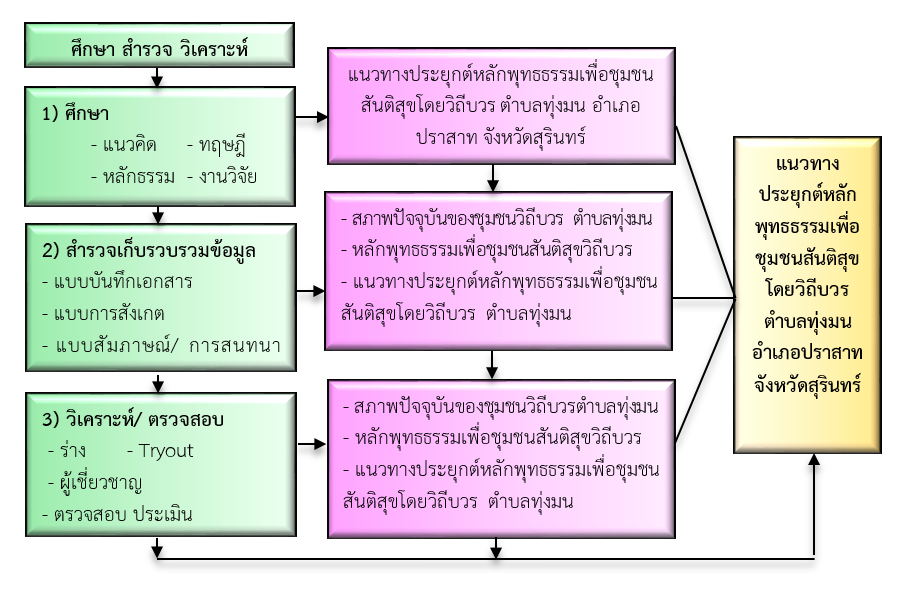
Guidelines for Buddhadhamma to Create a Peaceful Community Through the 'Bor-Wor' Way in Thung Mon Subdistrict, Prasat District, Surin Province
Abstract
This research aims to: 1. study the current state of the 'Bor-Wor' Way community in Thung Mon Subdistrict, Prasat District, Surin Province; 2. investigate Buddhist principles for peaceful the 'Bor-Wor' Way communities; and 3. explore ways to apply Buddhist principles to create peaceful communities through the 'Bor-Wor' Way in Thung Mon Subdistrict, Prasat District, Surin Province. This study uses a qualitative research design, collecting data through in-depth interviews and focus group discussions with 30 participants, including monks, local politicians, village headmen, government officials, and local religious and cultural scholars. and the presentation of descriptive-analytical data. The research found that 1. The community of Thung Mon Subdistrict faces two major challenges: natural disasters and behavioral issues. These two pervasive problems have created socioeconomic vulnerabilities. However, the emerging strength of the 'Bor-Wor' Way model is now driving a powerful and cohesive effort to address these issues. 2. The Threefold Training, consisting of Morality (Sīla), Concentration (Samādhi), and Wisdom (Paññā), is a pivotal principle. This framework directly corresponds to the Four Noble Truths and the Noble Eightfold Path, serving as the essential core for creating an environment conducive to a community's journey toward peace. 3. The application of Buddhist principles for a peaceful community following the 'Bor-Wor' Way in Thung Mon has focused on strengthening the collaborative mechanisms among the village, temple, and state. The temple serves as the central hub for driving various activities to tangibly reduce community problems. Examples include reducing funeral-related debt through the “No Debt, No Suffering at Funerals” concept, promoting road safety via the “Merit-filled Route, Safe Community” project, and integrating multi-sectoral cooperation to prevent and solve drug problems sustainably.
Downloads
Article Details
How to Cite
Section
Research Articles
Copyright & License
Copyright (c) 2025 Arts and Culture Journal of the Lower Moon River

This work is licensed under a Creative Commons Attribution-NonCommercial-NoDerivatives 4.0 International License.
All articles published open access under the CC BY-NC-ND 4.0 license will be immediately and permanently free for everyone to read, download, copy, distribute, print, search, or link to articles free of charge. Use of the articles is permitted for non-commercial purposes only and without modifications. Access does not require prior permission from the publisher or the author, provided that the original publication is appropriately and adequately cited.




References
กรัณฑรัตน์ สุทธิพรมณีวัฒน์. (2559). การขัดเกลาทางสังคมในพระพุทธศาสนา [วิทยานิพนธ์ปริญญาดุษฎีบัณฑิตไม่ได้ตีพิมพ์]. มหาวิทยาลัยมหาจุฬาลงกรณราชวิทยาลัย.
ชูชาติ สุทธะ, พิสิฎฐ์ โคตรสุโพธิ์, และ พระครูสิริปริยัตยานุศาสก์. (2562). กระบวนการพัฒนาชีวิตเชิงพุทธบูรณาการ. วารสารสังคมศาสตร์วิชาการ, 12(1), 158 - 168.
ณัฎฐ์สิณี รุ่งเพ็ชรมณี. (2564). การศึกษาองค์ประกอบทางภูมิทัศน์วัฒนธรรม กรณีศึกษา : ชุมชนวัดเกตการาม อำเภอเมืองเชียงใหม่ จังหวัดเชียงใหม่. สาระศาสตร์, 4(4), 895 - 907.
ไตรรัตน์ ธนะประกอบกรณ์ และ พระศรีวินยาภรณ์. (2562). การสร้างสันติประชาคมตามแนวพุทธ. วารสารบัณฑิตศึกษาปริทรรศน์, 15(3), 16 - 26.
ทวีศักดิ์ ทองทิพย์. (2561). แนวคิดการบริหารการศึกษาตามหลักไตรสิกขากับแนวคิดตามทฤษฎีเชิงระบบเป็นความสอดคล้องกันที่ลงตัว. วารสารมหาจุฬาคชสาร, 9(2), 95 - 104.
ธนพล สราญจิตร์. (2558). ปัญหาความยากจนในสังคมไทย. วารสารวิชาการมหาวิทยาลัยอีสเทิร์นเอเชีย ฉบับสังคมศาสตร์และมนุษยศาสตร์, 5(2), 12 - 21.
พระครูบูรพาธรรมประทีป (ไทยสวัสดิ์ อตฺตทีโป). (2565). การประยุกต์ใช้ฆราวาสธรรมเพื่อเสริมสร้างความเข้มแข็งแก่สถาบันครอบครัว. วารสารศึกษิตาลัย, 3(1), 1 - 14.
พระครูปริยัติกิตติวรรณ. (2567). วิถีทุ่งมน ตำบลคุณธรรม [ภาพถ่าย]. การจัดเก็บส่วนตัว.
พระครูสังฆรักษ์ประจวบ วุฑฺฒิจารี, วีรธรรม ปัญจขันธ์, พระวุฒิชัย มหาสทฺโท, เดชา ตาละนึก, และ สกุณา คงจันทร์. (2562). บทบาทของพระสงฆ์ในการพัฒนาสังคมจังหวัดเชียงใหม่. วารสารพุทธศาสตร์ศึกษา, 10(1), 101 - 119.
พระมหาเกรียงศักดิ์ โสภากุล. (2562). พุทธวิธีแก้ไขปัญหาความขัดแย้งในครอบครัวสังคมไทยปัจจุบัน. วารสารสังคมศาสตรัญญาพัฒน์, 1(2), 25 - 32.
พระมหาชาญ อชิโต. (2568). ผลสอบบาลีวัดอุทุมพร พ.ศ. 2554 - 2567. สำนักศาสนศึกษาวัดอุทุมพร.
พระมหาหรรษา ธมฺมหาโส (นิธิบุณยากร). (2547). รูปแบบการจัดการความขัดแย้งโดยพุทธสันติวิธี : ศึกษาวิเคราะห์กรณีลุ่มน้ำแม่ตาช้าง จ.เชียงใหม่ [วิทยานิพนธ์ปริญญาดุษฎีบัณฑิต, มหาวิทยาลัยมหาจุฬาลงกรณราชวิทยาลัย]. e-Thesis Central Library Mahachulalongkornrajavidyalaya University. https://e-thesis.mcu.ac.th/thesis/2871.
พระอธิการโสภณ ปิยธมฺโม (กิ่งแก้ว), ละเอียด จงกลนี, และ พระฮอนด้า วาทสทฺโท (เข็มมา). (2564). พลังบวร : พลังหลักของชุมชนคุณธรรม. วารสารปัญญาปณิธาน, 6(1), 69 - 80.
รัฐวิชญ์ อริยพัชญ์พล และ พภัสสรณ์ วรภัทร์ถิระกุล. (2563). การแก้ปัญหาความรุนแรงในครอบครัวของไทย. วารสารสังคมศาสตร์และมานุษยวิทยาเชิงพุทธ, 5(4), 321 - 335.
วสมน ทิพณีย์. (2559). การแก้ไขปัญหาความรุนแรงในครอบครัวตามแนวพุทธธรรม. วารสารสถาบันวิจัยญาณสังวร มหาวิทยาลัยมหามกุฏราชวิทยาลัย, 7(1), 51 - 60.
สมเด็จพระพุทธโฆษาจารย์ (ป.อ.ปยุตโต). (2541). พุทธธรรม ฉบับปรุงปรุงและขยายความ (พิมพ์ครั้งที่ 7). โรงพิมพ์มหาจุฬาลงกรณราชวิทยาลัย.
