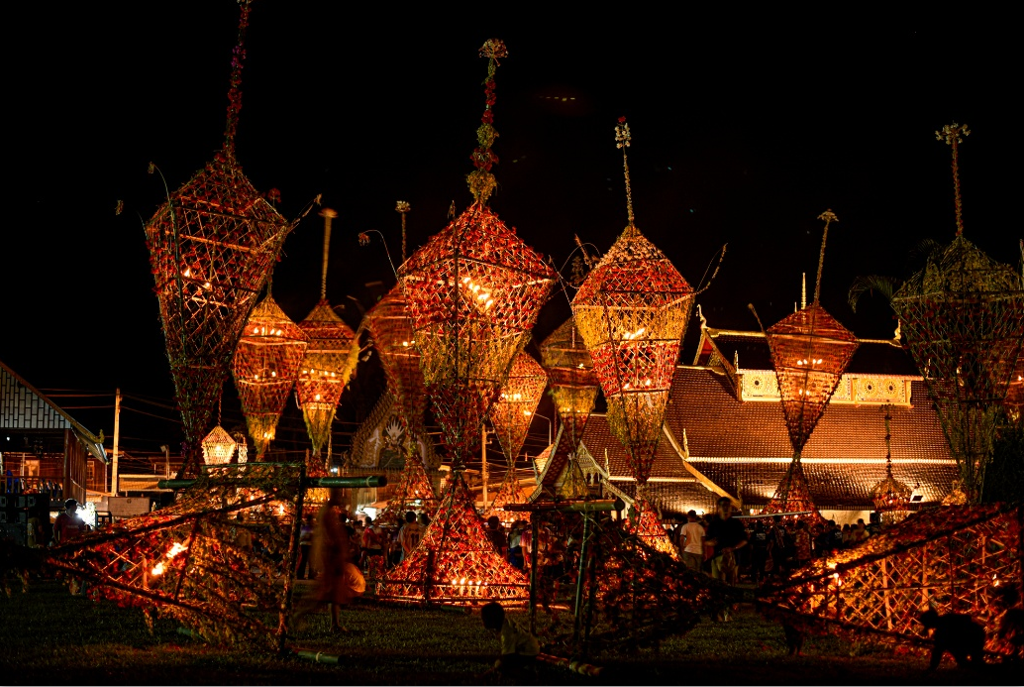
Flower Trees of Faith : Local Wisdom and Cultural Identity of Ban Saeng Pha Community, Na Haeo District, Loei Province
Abstract
This research aimed to analyze the intellectual identity of the Ban Saeng Pha Flower Tree Procession tradition in Na Haeo District, Loei Province, by applying the framework of cultural capital, identity, and cultural wisdom. Data collection involved primary surveys, both participatory and non-participant observations, and in-depth interviews with knowledgeable people and villagers involved in the tradition. The research results found that the flower tree is a cultural symbol reflecting technical and aesthetic knowledge that has been passed down for over 400 years.It is used in the Buddhist ceremonies honoring the Triple Gem during the Boon Duan Song Nam Festival. The unique identity of the Ban Saeng Pha flower tree lies in its distinctive shape, height, and size, attributed to the abundant bamboo resources, which allow for the construction of large, strong, and stable structures. Technical wisdom is evident in the standardized proportions of the flower tree. The design of key components, structural assembly techniques, tying of pegs, and the use of all natural materials, as well as aesthetically pleasing decorations, such as seasonal flower spacing and the use of candlelight during the procession around the ubosot (ordination hall) at night. Furthermore, knowledge is passed down between generations, from working-age adults to youth, reflecting the integration of Buddhist beliefs, folk art, and community lifestyles. The traditional flower tree procession, therefore, not only possesses artistic and aesthetic value, but also plays a role in fostering unity, promoting the community economy, and preserving local cultural identity. It also serves as a medium for connecting religious beliefs with the way of life and clearly proclaiming the identity of the Ban Saeng Pha community.
Downloads
Article Details
How to Cite
Section
Research Articles
Copyright & License
Copyright (c) 2025 Arts and Culture Journal of the Lower Moon River

This work is licensed under a Creative Commons Attribution-NonCommercial-NoDerivatives 4.0 International License.
All articles published open access under the CC BY-NC-ND 4.0 license will be immediately and permanently free for everyone to read, download, copy, distribute, print, search, or link to articles free of charge. Use of the articles is permitted for non-commercial purposes only and without modifications. Access does not require prior permission from the publisher or the author, provided that the original publication is appropriately and adequately cited.




References
ชาย โพธิสิตา. (2562). ศาสตร์และศิลป์การวิจัยเชิงคุณภาพ : คู่มือนักศึกษาและนักวิจัยสังคมศาสตร์ (พิมพ์ครั้งที่ 8). อมรินทร์พริ้นติ้ง.
ปฐม หงส์สุวรรณ. (2560). ประเพณีแห่ต้นดอกไม้ ชุมชนบ้านอาฮี อ.ท่าลี่ จ.เลย. องค์การบริหารการพัฒนาพื้นที่พิเศษเพื่อการท่องเที่ยวอย่างยั่งยืน.
ปรีชา พิณทอง. (2540). ประเพณีโบราณไทยอีสาน. ศิริธรรมออฟเซ็ท.
ไพโรจน์ พวงมณี. (2567). พื้นที่ทางประวัติศาสตร์และวัฒนธรรมบ้านอาฮี ตำบลอาฮี อำเภอท่าลี่ จังหวัดเลย กับแนวทางการจัดการท่องเที่ยวชุมชนสู่ความยั่งยืน. วารสารวิชาการมนุษยศาสตร์และสังคมศาสตร์ มหาวิทยาลัยราชภัฏพระนครศรีอยุธยา, 12(1), 95 - 120. https://doi.org/10.14456/husoaru.2024.7.
เรณู เหมือนจันทร์เชย. (2562). การเรียนรู้กับการบรรลุผลการทำงานของชาวเมียนมาและชาวไทยในบริษัทไทยที่ไปลงทุนในเมียนมา. Veridian E-Journal Silpakorn University, 12(5), 811 - 830.
สนิกถา พงษ์เสน่ห์, ผสม นาฏิญา, หลิน มั่นมา, พระครูโพธิจริยาวัฒน์, สมบัติ ชิดทิด, จุตินัฏฐ์ เครือแดงชัยพร, ชนกภรณ์ สิทธิ์ทองหลาง, ปัญญาพร อ้วนศิริ, วิเศษ พุทธรักษ์, คำหล้า รัตนโค้น, โสดา สุวรรณ, ผาด ชิดทิด, เชิดพงษ์ ชิดทิด, อาทิตย์ ขลุยแก้ว, นรินทร์ สีบุ, คำม่วน แก้วสุวรรณ, และศุภโชค ผสม. (2555). วัฒนธรรมความเชื่อของชุมชนเพื่อสร้างกระบวนการเรียนรู้ในการจัดการทางสังคมของชุมชนบ้านแสงภา ตำบลแสงภา อำเภอนาแห้ว จังหวัดเลย. รายงานการวิจัย. สำนักงานกองทุนสนับสนุนการวิจัย.
สมศักดิ์ ศรีสันติสุข. (2552). การศึกษาสังคมและวัฒนธรรม : แนวความคิด วิธีวิทยา และทฤษฎี. มหาวิทยาลัยขอนแก่น.
องค์การบริหารส่วนตำบลแสงภา. (2562). แสงภา ประวัติบ้านแสงภา ตำบลแสงภา อำเภอนาแห้ว จังหวัดเลย. องค์การบริหารส่วนตำบลแสงภา.
อัญธิชา มั่นคง. (2560). บทบาทของทุนทางวัฒนธรรมกับการพัฒนาเศรษฐกิจชุมชน: กรณีศึกษาชุมชนในตำบลบ้านตุ่น อำเภอเมือง จังหวัดพะเยา. วารสารวิจัยและพัฒนา มหาวิทยาลัยราชภัฏเลย, 12(39), 90 - 100.
อิสเรส สุขเสนี. (2568ก). โครงสร้าง ส่วนประกอบต้นดอกไม้ชุมชนบ้านแสงภา [ภาพถ่าย]. การจัดเก็บส่วนบุคคล.
อิสเรส สุขเสนี. (2568ข). การขนย้ายต้นดอกไม้ขนาดพ้ง 2.8 เมตร และต้นดอกไม้ขนาดมาตรฐานของบ้านแสงภา [ภาพถ่าย]. การจัดเก็บส่วนบุคคล.
อิสเรส สุขเสนี. (2568ค). การเรียนรู้ในภูมิปัญญาเชิงช่างของกลุ่มคนต่างวัย [ภาพถ่าย]. การจัดเก็บส่วนบุคคล.
อิสเรส สุขเสนี. (2568ง). ขบวนแห่ต้นดอกไม้ยามค่ำคืนรอบอุโบสถ [ภาพถ่าย]. การจัดเก็บส่วนบุคคล.
Art & Culture. (2567). ประเพณีแห่ต้นดอกไม้ บ้านแสงภา อำเภอนาแห้ว จังหวัดเลย. https://humans-journey.com/art-and-culture/f/ประเพณีแห่ต้นดอกไม้-บ้านแสงภา-อำเภอนาแห้ว-จังหวัดเลย.
Barth, F. (1969). Ethnic Groups and Boundaries : The Social Organization of Culture Difference. Universitetsforlaget.
Barthes, R. (1972). Mythologies. (Trans., Lavers, A. Mythologies.) Hill and Wang.
Berkes, F. (2012). Sacred Ecology (3rd ed.). Routledge.
Bourdieu, P. (1986). The Forms of Capital. In Richardson, J. G. (Eds.), Handbook of Theory and Research for the Sociology of Education (241 - 258). Greenwood Press.
Cohen, A. P. (1985). Symbolic Construction of Community. Routledge.
Durkheim, É. (1995). The Elementary Forms of Religious Life (Trans., Fields, K. E., Les Formes élémentaires de la vie religieuse). The Free Press.
Geertz, C. (1973). The Interpretation of Cultures : Selected Essays. Basic Books.
Hall, S. (1990). Cultural Identity and Diaspora. In Rutherford, J. (Eds.), Identity : Community, Culture, Difference (222 - 237). Lawrence & Wishart.
Hall, S. (1997). Representation : Cultural Representations and Signifying Practices. Sage Publications.
https://doi.org/10.4324/9780203131688.
Ingold, T. (2013). Making : Anthropology, Archaeology, Art and Architecture. Routledge. https://doi.org/10.4324/9780203559055.
Jenkins, R. (2014). Social Identity (4th ed.). Routledge. https://doi.org/10.4324/9781315887104
Lave, J., & Wenger, E. (1991). Situated Learning : Legitimate Peripheral Participation. Cambridge University Press.
Proshansky, H. M., Fabian, A. K., & Kaminoff, R. (1983). Place - Identity : Physical World Socialization of the Self. Journal of Environmental Psychology, 3(1), 57 - 83. https://doi.org/10.1016/S0272-4944(83)80021-8.
Sennett, R. (2008). The Craftsman. Yale University Press.
Smith, L. (2018). Uses of Heritage. In Smith, C. (Eds.), Encyclopedia of Global Archaeology (1 - 6). Springer.
Throsby, D. (1999). Cultural Capital. Journal of Cultural Economics, 23(1/2), 3 - 12.
Tuan, Y.-F. (1974). Topophilia : A Study of Environmental Perception, Attitudes, and Values. Prentice - Hall.
Turner, V. (1969). The Ritual Process : Structure and Anti-Structure. Aldine.
UNESCO. (2003). Text of the Convention for the Safeguarding of the Intangible Cultural Heritage. UNESCO. https://ich.unesco.org/en/convention.
Yosso, T. J. (2005). Whose Culture Has Capital? A Critical Race Theory Discussion of Community Cultural Wealth. Race Ethnicity and Education, 8(1), 69 - 91. https://doi.org/10.1080/1361332052000341006.
